
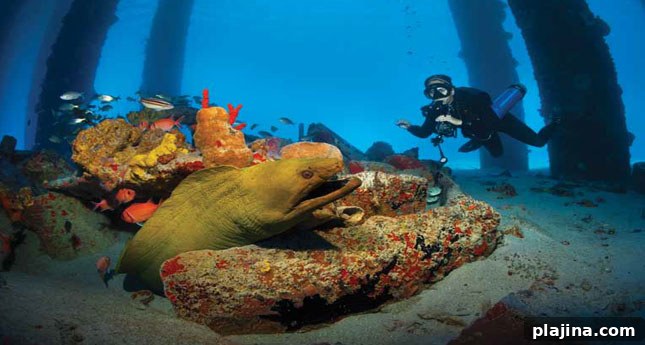
When conversation turns to travel, many of the most memorable stories come from remote tropical destinations—and more often than not, scuba diving plays a starring role. Diving uniquely immerses you in a place: the underwater world reveals a location as much as its beaches and resorts do. Dive travelers tend to be meticulous researchers, seeking facts, recommendations and first-hand reports to plan the ideal dive holiday. Dive tourism continues to grow—an estimated 1.2 million divers are certified in the United States alone—and dive-friendly resorts now dot the globe, from Myanmar to Mozambique. Whether well-established or newly emerging, these destinations are among the most stunning tropical locations imaginable.
THE OUT ISLANDS OF THE BAHAMAS demonstrate that world-class diving doesn’t require a long flight. Beyond the crowds and cruise ports of Nassau and Grand Bahama, this understated island chain of dazzling white sand and sapphire water offers a wealth of dive sites that see relatively few visitors. Less developed and often uninhabited, the more than 700 islands, cays, rocky islets and sand spits that make up the Commonwealth of the Bahamas are, quite literally, out there.
For example, the Abacos—a 120-mile chain—claim the world’s third-longest barrier reef. Much of the diving here takes place among shallow reefs warmed by the clear Gulf Stream, producing conditions comparable to many Caribbean dive spots. Towers of star coral rise across these reefs, full of crevices and swim-throughs prized by divers. One of the most scenic spots is a cavern known as Cathedral, alive with colorful reef fish and schools of silversides that glitter in shafts of sunlight. Outside the barrier reef, Wayne’s World is a standout site where bulbous coral heads shelter an impressive roll call of reef fish.
Further south, the Exuma chain feels like a world made of sand and sea. This 176-square-mile maze of extraordinarily clear water, cays and paper-white beaches was designated the first land-and-sea preserve in the world and is a favorite among liveaboard operators. Dives here include Pillar Wall, an exhilarating descent that begins at about 30 feet, slopes to 55 feet and then drops over a ledge into deep water. Many Exuma itineraries include Stingray Reef off Stocking Island, famous for large stingrays that rise from sandy bottoms, and Whale Tail Wall, noted for its sharks and eagle rays.
Rays in St. Croix © U.S. Virgin Islands Department of Tourism
THE U.S. VIRGIN ISLANDS are another major draw for dive travelers. Funky, lively and relaxed, these American territories are convenient for U.S. travelers: familiar currency, language and easy travel logistics, while each island offers its own character.
St. Croix, the largest of the three, is nearly ringed by the largest living barrier reef around any Caribbean island. Cane Bay on the north shore is famous for a dramatic wall dive that drops 2,000 feet just 200 yards offshore, with the deeper Puerto Rican Trench beyond creating upwellings that attract large pelagics such as whales, tuna and hammerhead sharks.
St. Thomas—known for its cruise port at Charlotte Amalie and the famed Magen’s Bay—also offers excellent wreck diving. The M/V WIT Shoal II, a 360-foot freighter resting at about 90 feet, provides roomy passages to explore and abundant marine life, including a resident Goliath grouper. The USS John F. Kennedy, a U.S. Navy transport barge, sits mid-depth near stingray-populated sand flats outside Charlotte Amalie’s harbor.
St. John, nicknamed “the park island,” is quieter and less visited by cruise ship crowds. Two-thirds of the island is protected land, and nearby Coral Reef National Monument adds nearly 13,000 submerged acres to the conservation mix. Divers will find rugged coastal topography, canyons, pinnacles and coral-encrusted formations that attract Spanish mackerel, tarpon and other lively species—making St. John well worth a closer look.
BELIZE often ranks as a crown jewel among Caribbean dive destinations. Early British colonists described the reefs as treacherous to navigate and teeming with lobster; today, the same barrier reef—185 miles long—is a primary reason divers flock to Belize. The reef and its island cayes span about 3,000 square miles of protected waters and offer a spectacular variety of dives.
Ambergris Caye is the busiest hub, with shallow dive sites full of coral mounds, colorful sponges and abundant reef life well suited to divers of varying experience. Hol Chan Marine Reserve and Shark Ray Alley, just a few miles from San Pedro, are popular shallow encounters where divers and snorkelers often meet friendly stingrays and nurse sharks.
Belize is also notable for hosting three of the Caribbean’s only four atolls—Turneffe Atoll, Glover’s Reef and Lighthouse Reef. Turneffe ranges from gentle shallows to dramatic walls like Black Coral Wall. Glover’s Reef features more than 700 shallow reefs, excellent visibility and currents that can bring pelagic visitors such as sharks and tuna. Lighthouse Reef is home to the famed Blue Hole, a circular sinkhole where divers descend to about 110 feet to explore ancient stalactites and dramatic vertical walls.
THE PHILIPPINES represent the Western Pacific’s diving frontier, an archipelago of immense scale and biodiversity. With 7,107 islands and an expansive coastline, the Philippines sits at the northern edge of the Coral Triangle and hosts an extraordinary variety of marine life—more than 2,000 fish species and roughly 500 coral species among them. Divers can explore unnamed reefs and WWII wrecks, and the growing dive infrastructure includes dedicated resorts and liveaboards.
Tubbataha Reef in the Sulu Sea is a bucket-list destination: a remote UNESCO World Heritage site of twin atolls offering 70- to 130-foot wall dives. The 128-square-mile marine park supports pristine coral communities and large pelagics such as mantas and several shark species; access is seasonal, typically from March through June, and regulated by permits for liveaboards.
More accessible year-round is tiny Apo Island in the Bohol Sea, renowned for its protected marine preserve. Divers enjoy expansive table corals, barrel sponges and gorgonians, with chances to see blacktip sharks, tuna and fast pelagic species like wahoo. Many visitors base themselves on nearby Negros, where more accommodations and dive operators are available.
Diving at Four Seasons Maldives © Four Seasons Resorts & Hotels
OTHER STANDOUT DESTINATIONS that have grown in reputation over the last decade include Palau, Malaysia’s Sipadan, Raja Ampat in West Papua and the Indonesian archipelago serviced by numerous liveaboards. The Maldives, in the Indian Ocean, remains one of the world’s premier dive destinations: an archipelago of about 1,200 islands across 26 atolls, with warm clear water, expansive coral formations and abundant megafauna.
Maldives diving is often compared to remote sections of the Great Barrier Reef, with numerous “thila” sites—shallow coral mounts—and “kandu” passes where current-driven diving can be exhilarating. Most resorts offer scuba facilities, and liveaboards visit a wide variety of atolls. Between June and October, the chance to encounter large manta rays and whale sharks is particularly high.
Whether you prefer short island-based dives with easy access to shore reefs or extended liveaboard itineraries that cover multiple atolls and remote atolls, the world’s tropical dive destinations offer spectacular variety. From the shallow gardens of the Caribbean to the deep walls of the Pacific and the wide-ranging atolls of the Indian Ocean, each region presents unique ecosystems, remarkable visibility and the potential for unforgettable encounters with marine life.