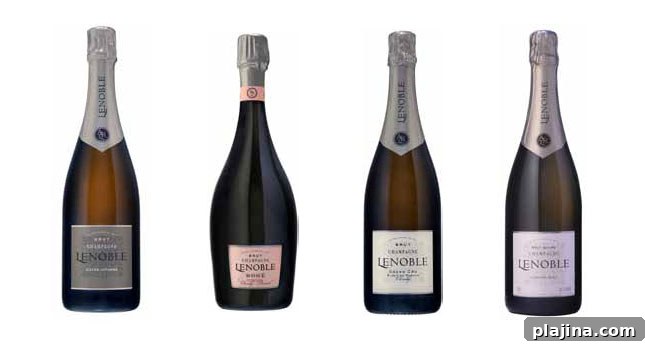
A fine Champagne does not shout; it draws the taster in with nuance and subtlety. Those words may seem unexpected when describing a house that could have produced on a large scale, but they perfectly suit A.R. Lenoble Champagne, a producer that deliberately limits output to roughly 400,000 bottles a year to preserve its character and quality.
Maison Lenoble was founded in 1920 by Armand-Raphaël Graser, a wine merchant from Alsace who planted vines in the Champagne village of Damery and branded his wines with his initials, A.R. The house remains family owned: today the fourth generation, siblings Anne and Antoine Malassagne, manage the domaine. That continuity is increasingly rare among Champagne houses.
Champagne’s classification system recognizes only 17 Grand Cru and 44 Premier Cru villages out of 320. Maison Lenoble’s 44.5 acres include holdings in the Grand Cru village of Chouilly in the Côte des Blancs and in the Premier Cru village of Bisseuil, ensuring high-quality fruit that underpins the house style.
After limited availability in the United States over the past decade and a half, Lenoble has been reintroduced to the American market by its new importer, Cognac One. The initial release includes four non-vintage cuvées, with a vintage bottling to follow soon.
Brut Intense (about $47) blends 40 percent Chardonnay with 30 percent Pinot Noir and 30 percent Pinot Meunier. It is clean and round, with gentle autolytic notes and ripe fruit; overall it presents a harmonious, accessible profile.
Brut Nature (about $52) shares the same grape composition as Brut Intense but sees an extra six months of ageing and receives no dosage. Despite that zero-dosage approach, it remains rounded and almost creamy, with concentrated fruit expression and precise balance.
The Grand Cru Blanc de Blancs (about $56) is made entirely from Grand Cru Chardonnay. Focused and refined, it delivers an elegant, persistent finish that showcases the finesse of the Côte des Blancs.
Rosé Terroirs (about $62) is an authentic rosé in color and character, offering a clear hint of Pinot Noir and light strawberry notes. It is well-structured, with pleasing length and a satisfying finish.
Overall, Lenoble brings a restrained, terroir-driven style to the market—a welcome addition for readers seeking Champagne that favors subtlety, balance, and quality over overt richness or showiness.