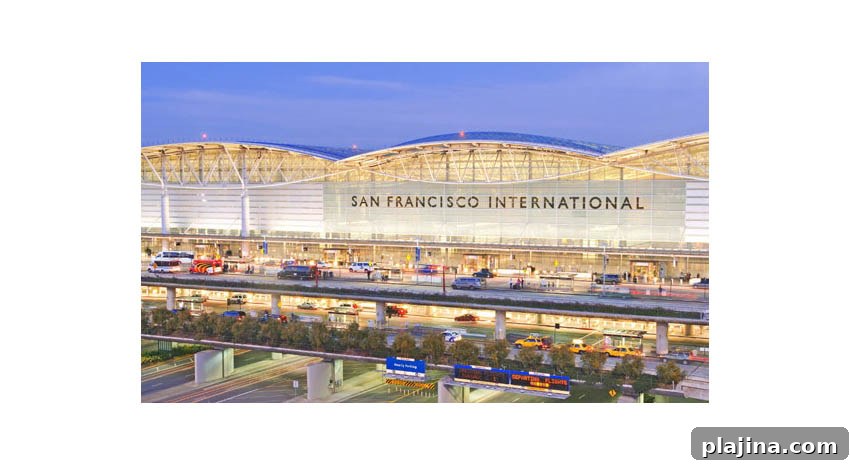
LOCATED 13 miles south of San Francisco’s downtown, San Francisco International Airport (SFO) is the largest airport in Northern California and the state’s second-busiest after Los Angeles International. Serving destinations across North America, Europe, and Asia, SFO offers nonstop flights to more than 46 international cities on 39 international carriers and connects nonstop to 79 U.S. cities. It is a major United Airlines hub and was the principal base for Virgin America.
The airport has seen steady growth in passenger traffic since 2004. In 2016 SFO handled a record 53.1 million passengers, a 6.1 percent increase over the previous year. International travel grew particularly fast that year, up about 10 percent, driven by new carriers including Iceland’s low-cost WOW air, Fiji Airways, and Volaris.
Airline route expansion has been a key factor in SFO’s growth. In 2016 United Airlines launched three new international routes from San Francisco, including the airport’s first nonstop service to Tel Aviv (TLV) and nonstop flights to two Chinese cities, Xi’an (XIY) and Hangzhou (HGH). China Eastern Airlines also began the airport’s first nonstop service to Qingdao (TAO). These additions helped SFO become the airport in the Americas serving the most destinations in China.
Growing passenger numbers have also driven significant construction and modernization. From 2020 to 2022 the airport embarked on a major rebuild of the southern portion of Terminal 1, including Boarding Areas A and B. The $2.4 billion program, led by Gensler, modernizes the concourse and adds 24 new gates. The project was planned in four phases to keep at least nine gates open during construction and minimize service disruptions.
As part of the Terminal 1 redevelopment, the airport selected View Dynamic Glass to install more than 66,000 square feet of dynamic glazing, enhancing the passenger experience while improving energy efficiency. SFO also opened a Request for Proposals for 10 duty-free and luxury retail leases in the International Terminal and Terminal 1, signaling upgrades to dining and shopping offerings.
Infrastructure improvements extend beyond terminals. In early 2018 SFO announced plans to repave Runway 28L—one of four runways and one of two primarily used for arrivals—and to install durable LED centerline lights and refreshed ground markings. The project also included construction of a new taxiway and upgrades to an existing taxiway to improve operational efficiency and safety.
Environmental sustainability has been a major focus at SFO. The airport was recognized with a top sustainability award from Acterra, a Silicon Valley nonprofit, which highlighted SFO as an industry leader for its climate actions and transparent sustainability reporting.
Since 1990 SFO has reduced greenhouse gas emissions from airport-controlled operations by 38 percent, cut energy consumption by nearly 11,000 megawatt-hours per year, and restored 558 acres of wetlands across the Bay Area. Key initiatives driving these results include the electric-powered AirTrain system, which replaced more than 600 daily shuttle bus trips between terminals; programs and incentives to encourage airport employees to use public transit; and a Clean Vehicle Policy that promotes the adoption and deployment of energy-efficient vehicles across airport operations.