
On the rooftop of a 20-story building overlooking the bright lights of Alexanderplatz, a DJ spins techno as stylish Berliners drink, dance and socialize under the stars in the weeks before the 20th anniversary of the fall of the Berlin Wall.
From the Week-End rooftop club the panoramic view is exhilarating: shimmering blue-glass skyscrapers, flashing neon signs and avenues lit by rivers of car lights. Yet just two decades earlier the scene would have been starkly different. The western half of the city pulsed with light while East Berlin appeared as a vast dark field, punctuated only by scattered streetlights and the occasional slow-moving vehicle.
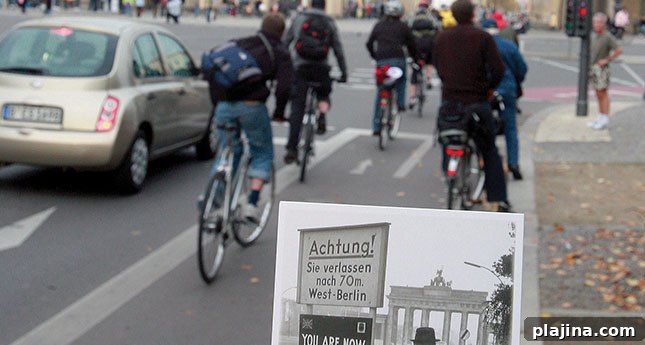
Although most Germans have grown accustomed to reunification, many remain struck by how rapidly the former communist sectors of the city transformed. Travelers still get goose bumps crossing by car, train or bicycle across neighborhoods once divided by the nearly impenetrable, 93-mile concrete barrier.
Between 1961 and 1989 some 140 Berliners were killed trying to cross the Wall and thousands more were captured and imprisoned. The Wall did more than split a city; for nearly 30 years it served as the international symbol of the Cold War. It began to come down in November 1989 — at first in small fragments as East Berliners nervously chipped away concrete, then in larger sections as bulldozers demolished it and crowds poured through the gaps. After reunification, however, Berlin’s future was uncertain. Heavily damaged in World War II and isolated for decades, the city faced the daunting task of rebuilding socially, politically and physically while Germany’s temporary capital in Bonn retained many institutions.
Within a few years, though, the city’s revival accelerated. The restored Reichstag, redesigned by British architect Lord Norman Foster, became a symbol of a united Germany. Construction cranes dotted the skyline as commercial, governmental and residential projects rose across Berlin, often in diverse architectural styles. Alongside politicians and government staff relocating from Bonn, nearly a million artists, musicians, writers and entrepreneurs from West Germany and other European countries were attracted by affordable housing and creative opportunities in the drab eastern neighborhoods. Although about a million former East Berliners moved westward, the influx of new residents and reunification funding spawned trendy restaurants, hotels, museums and theaters that quickly rivaled long-established venues in western districts.
That initial euphoria has since been tempered by economic realities. Despite years of government support, Berlin faces structural economic challenges: unemployment hovers near 15 percent versus roughly 8 percent nationwide, there are relatively few corporate headquarters and manufacturing output remains limited. The collapse of East German industry after 1989 led to steep deindustrialization across the eastern states, and global economic downturns have not helped. Small and medium enterprises are the backbone of Berlin’s economy — more than 94 percent of companies here employ fewer than 200 people. Major firms such as Siemens, Bayer Schering Pharma, Daimler and others maintain significant workforces, but Berlin’s corporate influence is smaller than that of Hamburg, Düsseldorf, Stuttgart or Frankfurt.
Still, new financial, technology and scientific research companies are establishing themselves, and the city continues to attract young professionals, architects and graphic designers who drive innovative museum and urban projects. More than half of Berlin’s workforce is under 40. Developers have converted historic communist-era bank buildings, warehouses and breweries into hotels, restaurants and boutiques in former East Berlin districts like Prenzlauer Berg, Mitte and Friedrichshain, helping Berlin become Germany’s most popular tourist destination and boosting service-sector employment by nearly 48 percent since 1989. Though cranes are no longer ubiquitous, national stimulus programs have renewed large projects, including the Berlin Brandenburg International Airport (BBI) and expansive development around the modern glass-and-steel Berlin Hauptbahnhof.
Important media organizations have expanded their presence in the city, including MTV Germany, Deutsche Welle, Der Spiegel and the Babelsberg studios, which produce international films and help host the Berlin Film Festival.
Visitors are often surprised by Berlin’s scale — nearly 348 square miles, roughly nine times the size of Paris. More than a third of the city is green or water, with lakes, rivers and canals woven into the urban fabric. Large parks such as the Tiergarten, the Botanical Gardens and the Zoological Gardens provide ample space for walking and cycling.
As Berlin marks the 20th anniversary of the Wall’s fall, portions of the concrete barrier remain, and Berliners continue to debate what to do with these reminders of division. The longest preserved stretch — about a mile long — is now the Eastside Gallery, an open-air museum where more than 100 international artists painted murals. Whether this section and other fragments should become protected heritage sites or be removed is a civic decision the city will decide together.
Info to Go
Tegel Airport (TXL), five miles from central Berlin, offers frequent bus service to downtown (about $2.80, 20 minutes), taxis (approximately $25) and rental cars. Tegel will close when the larger Brandenburg Airport opens. The central train station provides high-speed rail connections to many European cities.
Just the Facts
Time Zone: GMT +1 (GMT +2 April–October) Phone Code: +49 (Germany), 30 (Berlin)
Currency: Euro
Entry/Exit Requirements: U.S. citizens may enter Germany for up to 90 days for tourist or business purposes without a visa. Passports must be valid for at least three months beyond the intended stay.
Official Language: German; English is widely spoken.
Key Industries: Tourism, software and IT, scientific and medical research, pharmaceuticals, media and film production, financial services, conferences and conventions.
Diversions
With more than 175 museums, 430 art galleries, three opera houses and eight orchestras, Berlin offers more cultural institutions than most European cities. Notable attractions include the Jewish Museum (Lindenstrasse 9–14), designed by Daniel Libeskind; the New National Gallery (Potsdamer Strasse 50), designed by Ludwig Mies van der Rohe and housing important European and German works; and the Hamburger Bahnhof Museum of Contemporary Art (Invalidenstr. 50–51).
Museumsinsel (Museum Island) hosts five major museums: the Old Museum (1830), the New Museum (1859) — redesigned by David Chipperfield — the Old National Gallery (1876), the Bode Museum (1904) and the Pergamon Museum (1930).
The Reichstag’s Foster-designed glass dome offers sweeping city views and is free to visit, though it can be busy. The Holocaust Memorial, designed by Peter Eisenman, comprises 2,711 concrete slabs of varying heights and includes an underground information center that provides important historical context.
Cold War attractions include the Berlin Wall Documentation Center (Bernauer Strasse 111) with listening stations and exhibits adjacent to an original Wall segment. The DDR Museum (Karl-Liebknecht Strasse 1) recreates everyday life in East Germany, while the Stasi Museum (Ruschestrasse 103) documents the activities of the former state security agency.
Checking in with Dr. Axel Klausmeier
Director of the Berlin Wall Foundation
Your office sits across from a remaining Wall segment on Bernauer Strasse. Why was this site chosen for the center?
The Bernauer Strasse stretch dramatically illustrated the city’s division: houses on one side of the street were in the East while the sidewalk belonged to the West. East-facing windows were bricked up and many residents were prevented from fleeing. Numerous escape attempts along this street led to fatalities, and it was here that the first pieces of the Wall were removed after the border opened in 1989.
Will the Berlin Wall Memorial Exhibition on Bernauer Strasse continue after 2009?
Yes. We plan to expand the exhibition to cover nearly the entire length of Bernauer Strasse and preserve remaining Wall structures while adding audio and video installations. The expanded memorial will culminate in 2011 with the 50th anniversary of the Wall’s construction.
Has it been difficult for Berliners to keep portions of the Wall intact?
Immediately after the border opened, most of the 93-mile barrier was demolished because it symbolized suffering and division. Over time many people began to see value in preserving parts as tangible reminders. Some find the remnants painful to face; others believe they are important for future generations and visitors to understand the city’s history.
For visitors, navigating Berlin is easy by U-Bahn (subway) or S-Bahn (surface train). Bike rentals and guided tours, including trips along the Berlin Wall Trail, are widely available. For a nostalgic experience, some services offer drives in the iconic East German Trabant cars.
Lodging
Hotel Adlon Kempinski
Overlooking the Brandenburg Gate, this rebuilt landmark hotel attracts film stars and heads of state. Amenities include an indoor pool and the Michelin-starred Lorenz Adlon restaurant. Unter den Linden at Pariser Platz, tel 49 30 22610, $$$$
Hotel de Rome, Berlin
Housed in a 19th-century bank building that survived World War II, this five-star hotel features a spa and historic architectural details. Behrenstr. 37, tel 49 30 460 60 90, $$$$
The Ritz-Carlton Berlin
A modern luxury hotel opposite Potsdamer Platz, with refined dining and a club lounge on the 10th floor. Potsdamer Platz 3, tel 49 30 33 777 7, $$$$
Dining
Ma Tim Raute
This Michelin-starred restaurant delivers modern Asian-inspired cuisine in an elegant setting. Behrenstr. 72, tel 49 30 3011 1733, $$$$
Restaurant Maxwell
Located in a handsome 1893 Neo-Gothic former brewery, this Mitte restaurant offers courtyard dining and excellent fish and meat dishes. Bergstr. 22, tel 49 30 280 7121, $$$
Schneeweiss
A friendly, casual spot in a lively former East Berlin neighborhood with “snow white” décor and outdoor seating overlooking a small park. Simplonstr. 16, tel 49 30 290 497 04, $$