
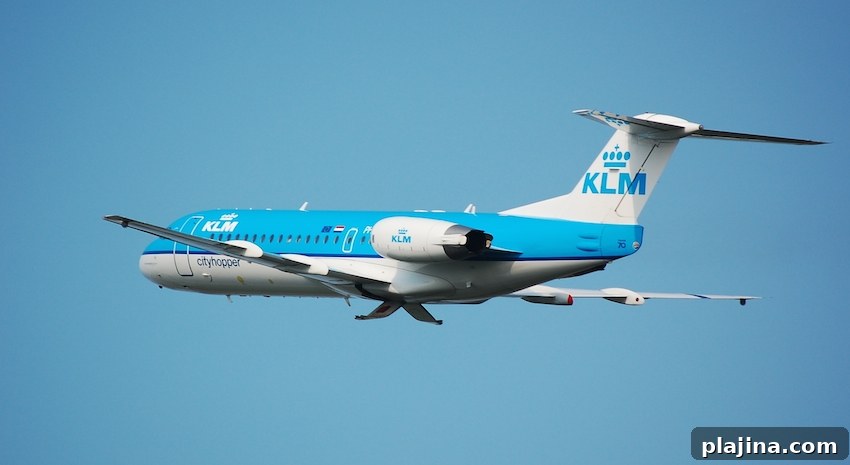
The future of document-free travel is approaching. At Amsterdam’s Schiphol International Airport, KLM is testing biometric facial-scanning technology that could eliminate the need for passengers to present passports. The trial is being conducted over a three-month period at one of KLM’s gates.
Travelers who opt into the program register at kiosks located at the departure gate. The process involves scanning a passport, scanning the boarding pass and having a photograph taken by the kiosk. That biometric image is securely stored for use on future trips. At boarding, passengers pass through a dedicated biometric eGate where a camera matches their face to the stored image and grants access without requiring a physical passport or ID card.
Designed to speed up boarding and streamline airport flows, the pilot is a collaboration between KLM and Vision-Box, the company providing the electronic identity solutions. If the trial proves successful, the partners plan to expand the technology to additional flights and gates, aiming to make travel faster and more convenient while maintaining security standards.
Biometric boarding systems like this work by converting facial features into a digital template that can be compared quickly and reliably. The intended benefits include reduced queue times, fewer bottlenecks at boarding, and a more seamless passenger experience. For airports and airlines, the potential advantages also include increased operational efficiency and the ability to automate routine identity checks.
Privacy and data protection are central concerns for any biometric program. Participants typically register voluntarily, and systems are subject to local and international data-protection regulations. Operators must ensure that biometric data is stored securely, used only for the stated travel purposes, and retained or deleted according to applicable retention policies.
As biometric technology evolves, integration with existing airport infrastructure and with airline IT systems will be important to achieve broad adoption. Successful pilots must demonstrate not only accuracy and speed but also user acceptance, robust privacy safeguards and smooth interoperability with border-control requirements.
For passengers, the shift toward document-less travel could mean a quicker, more predictable journey through the airport. For airlines and airports, it promises streamlined operations and reduced reliance on manual identity checks. Trials such as the one at Schiphol will help determine how quickly and widely facial-recognition boarding systems are rolled out across commercial routes.