“I will help you. Follow me,” said a smiling stranger who had pegged me as a temple newcomer. I followed obediently, mirroring her movements as we threaded through the smoke-filled halls of Taipei’s vibrant Longshan Temple (211 Guangzhou St., tel 886 2 2302 5162).
My first trip to Taiwan came just after Chinese New Year, and the island was still in festival mode. Longshan thrummed with worshippers paying respects to the Buddhist goddess of mercy, Kuan Yin, and to Taoist figures such as the sea goddess Matsu and the god of war, Kuan Kung.
Like a creature with many lives, this 271-year-old temple has been rebuilt and restored after an earthquake, a typhoon and bombing damage during World War II. That the statue of Kuan Yin survived so many disasters felt like a quiet testament to mercy and resilience.
I was struck by the serenity surrounding those who bowed, knelt, prayed and chanted amid the otherwise bustling temple atmosphere. Longshan dazzles with ornate decoration that makes it as much a cultural attraction as a place of worship. Add a dense haze of incense and the scene becomes immersive and almost intoxicating.
As we gathered around a huge yellow lantern with our joss sticks, I silently hoped my helper’s kindness wasn’t merely a one-off. It wasn’t. Her gesture was only the first of many warm encounters during my eight-day stay.
Like many travelers, I’d once seen Taipei as a practical stopover between more glamorous destinations such as Bangkok, Shanghai, Hong Kong or Bali. I soon discovered how wrong that impression was.
Like those cities, Taipei offers upscale shopping arcades featuring designer boutiques alongside rows of market-style stalls where you can assemble an entire outfit for the price of a dim sum meal.
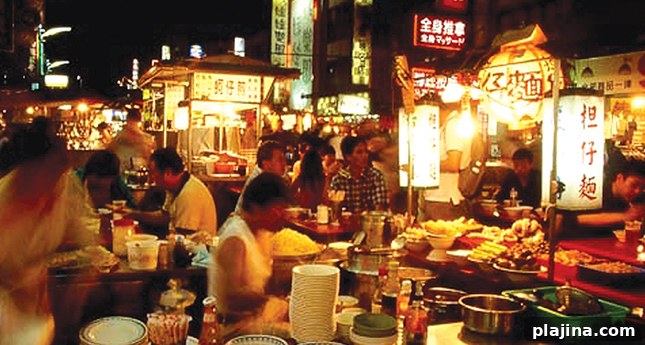
And then there are the night markets — astonishing, chaotic and irresistible. Shilin Night Market (between Wunlin, Jihe and Jhongshan N. roads, tel 886 2 2882 0340) is a sidewalk feast of Taiwanese street food: stinky tofu, scallion pancakes, oyster vermicelli, Shinlin sausages and even frog eggs, along with other oddities I chose to avoid. According to locals, the stronger the smell, the better the flavor.
Appearance can be misleading, but in the case of stinky tofu the pungency confirmed its reputation: it was absolutely delicious.
Shilin’s location near several schools keeps prices affordable and draws students and bargain hunters alike. Shopping there felt refreshingly pressure-free; I picked up gloves, socks, bags, scarves and trinkets to bring home. The bargains were expected, but the inventive prizes at the carnival-style games were surprising.
I’ve long enjoyed crane games where you win watches or plush toys, but I never imagined one where prizes could include a white bread sandwich or a smiley-face bun. No matter how often vendors rotate those edible prizes, winning them wasn’t particularly appealing.
Beyond the night market frenzy, the city moves with a particular, civilized energy. Waiting at a stoplight near the National Palace Museum (221 Jhihshan Road, Sec. 2, tel 886 2 2881 2021), I watched a swarm of scooters jockeying for position. I feared chaos, but when the light turned green, they surged forward in a fluid, coordinated rush—no collisions, just practiced instinct.
Everyday scenes like that kept fascinating me in a city of nearly 2.7 million people.
The National Palace Museum holds the world’s largest collection of Chinese artifacts, though only a fraction of its 620,000 pieces are on display at any time. I set aside three hours for a self-guided visit, which revealed only a slice of a 15,000-item exhibition selection.
Like many visitors, I came to see Taiwan’s version of the Mona Lisa: the Jadeite Cabbage with Insects from the Qing Dynasty (1644–1911). This exquisite carving resembles a bok choy cabbage in size and hue, crafted from natural green and white jade. Symbolizing fertility, its leaves hide tiny locusts and katydids. The crowd around it made clear many admirers appreciate its symbolism—lapel-pin replicas in the gift shop were popular with visitors.
Leaving the museum with a sudden craving for salad and steak, I encountered another form of public art: the CowParade had made its way to Taipei. This global movement, which began in Chicago, features life-sized fiberglass cows painted by local artists and displayed throughout the city as a fundraising effort.
Taipei 101 (89F, No. 7, Hsin Yi Road, Sec. 5, tel 886 2 8101 8899) showcased several of these whimsical cows in its lavish five-level mall. The tower itself is an engineering marvel, with double-deck elevators that fling visitors from the fifth to the 89th floor in just 39 seconds. Traveling at more than 55 feet per second, the ascent felt thrilling; the operator’s commentary barely kept pace.
For those uneasy about heights, the building’s 660-ton tuned mass damper is reassuring. Designed to counter seismic and wind-induced motion—resisting gale forces up to 134 mph and major earthquakes—the damper is a critical safety feature in a region prone to typhoons and tremors.
From high above the city, I couldn’t know then that my most vivid Taiwan memories would form later in remote villages and at night beneath lantern-lit skies. I would witness enchanting lantern festivals and spectacular fireworks displays. Still, Taipei proved to be far more than a jumping-off point.
Centuries ago Portuguese sailors called the island “Ilha Formosa,” the beautiful island, and the name still fits. Whether wandering energetic cities like Taipei, exploring pastoral villages or hiking in national parks, the island’s beauty and warmth left a lasting impression.