
Mesmerized. That single word best describes how I felt during my first visit to Israel. I was captivated by everything—the people, the landscape, the history and the everyday reality that surrounds them.
Sometimes you don’t realize how much a trip changed you until days or weeks later, back in the rhythm of ordinary life. For me, the transformation became clear during a day in New York City with friends. By mid-afternoon one of them joked, “Did you love Israel? I just can’t tell.” I had been talking about the trip nonstop. The experience had settled into me, reshaping how I answered a question I often get: “What’s the most amazing place you’ve ever been?”
And I had visited only northern Israel.
I began in Tel Aviv for a few days of business before setting out to explore the north and ending my journey in Jerusalem. From Tel Aviv it’s easy to reach several must-see destinations, such as Tishbi Winery, Akko, Beit She’an, the Dead Sea and the Mount of Beatitudes. Before heading out, stop at the Dan Hotel Tel Aviv and watch the sun sink beneath the Mediterranean from the pool deck—an unforgettable sight.
I left Tel Aviv late one morning and, somewhat unconventionally, started my day at Tishbi Winery. The winery’s roots go back to the late 1800s when Michael and Malka Chamiletzki emigrated from Lithuania and settled in Shefeya. In 1925 the poet Chaim Nachman Bialik called the family Tishbi, meaning “a resident of Shefeya in Israel.” The family has tended the land and vineyards ever since.
On arrival, the smell of baking bread drew me toward the on-site restaurant and bakery—almost as tempting as the wine and chocolate tasting I had planned. I sampled several Tishbi wines while nibbling Valrhona chocolates, letting the interplay of chocolate and wine awaken different flavors. The winery produces more than 20 grape varietals and even a brandy that was named best in the world in 1996.
While maintaining its reputation for quality wines, the family-run vineyard has been expanding into culinary ventures, building one of Israel’s largest wood-fired bakeries, and adding a food truck and barbecue pit to its offerings.
I couldn’t leave without taking home some specialties—Tishbi’s wine jellies, particularly Fig Cabernet and Strawberry Champagne, plus a warm loaf of fruit-and-nut bread to enjoy with them.
Next I traveled to Haifa to see the Bahá’í Hanging Gardens, a UNESCO World Heritage site since 2008. Haifa, once a German colony and now a city larger than Tel Aviv with roughly 300,000 residents, has made tourism a priority. The terraced gardens of the Bahá’í faith are a major attraction. The gardens form 19 terraces rising up Mount Carmel, crowned by the golden dome of the Shrine of the Báb on the central terrace—the resting place of the faith’s prophet-herald. Walking through the gardens and looking out over the bay toward Akko helped me learn more about the Bahá’í origins and admire the stunning landscaping.
Akko (Acre) is also a UNESCO World Heritage site, with an extraordinary underground city that archeologists began discovering about 50 years ago. Settled and reshaped by Crusaders, Canaanites, Romans, Turks and the British, Akko offers ancient walls, fortresses, knights’ halls, places of worship and layers of history to explore.
Knights Templar castle, Akko © Paul Prescott | Dreamstime.com
On the next day I continued exploring the north. Having attended Catholic school for twelve years, many biblical places took on renewed meaning as I first saw the Sea of Galilee, where the Bible recounts Jesus walking on water, and then visited the Mount of Beatitudes. Traditional accounts identify this hill as the site of the Sermon on the Mount, where the Beatitudes were delivered. It overlooks the Sea of Galilee and has been recognized as a sacred spot for over 1,600 years. A Roman Catholic Franciscan chapel built in 1938 marks the site along the Jesus Trail pilgrimage route.
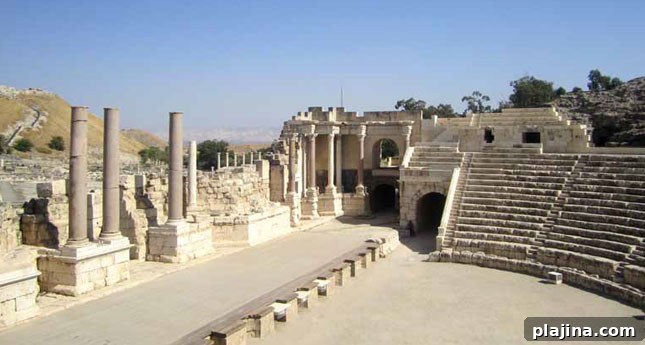
My journey then took me to Beit She’an National Park, an archaeological site covering more than 400 acres of an ancient Roman city. Excavations began in the 1920s and resumed in earnest in the 1980s through a collaboration between the Antiquities Authority and Hebrew University. The city—known as Scythopolis around 2,300 years ago—reached its height under Roman rule when nearly 40,000 people lived there. Today a fraction of the city has been unearthed, but visitors can still walk through the theater, bathhouse, Byzantine agora, Roman temple, city gate and amphitheater.
Floating in the Dead Sea was a bucket-list moment I couldn’t miss. I chose Neve Midbar beach, a bit less crowded than other spots but still popular. Once in the salty water, the sensation of buoyancy is remarkable—your body rests on the surface and, after a few moments, it’s easy to relax into the peaceful stillness. The seabed feels spongy underfoot, and the thick mineral mud onshore is perfect for smearing on your skin. After floating for twenty minutes, I coated myself in mud, dried in the sun and savored the moment.
That evening I arrived in Jerusalem, where history is present around every corner. Wandering the Old City and newer neighborhoods like Mamilla, I felt a constant mixture of wonder and reflection. The city’s religious and historical sites—the Church of the Holy Sepulchre, the Western Wall, King David’s Tomb and the Dead Sea Scrolls—are powerful experiences that often leave visitors searching for words.
Visiting Yad Vashem was a solemn, essential part of the trip. The Holocaust History Museum guides visitors through dark, thoughtfully designed galleries that convey the personal and collective tragedy of the Holocaust. It’s a difficult visit, but an important one that offers deep perspective.
Back in Tel Aviv I found unique artwork at the Art Nova gallery in Jaffa. The gallery features soft-painting techniques using synthetic acrylic fibers rather than traditional paint—a movement pioneered in Israel and practiced by only a few artists. I regretted not buying a piece on that visit, but later in Jerusalem I discovered another Art Nova studio and purchased two canvases. Every time I look at them on my wall, I am reminded of Israel’s beauty and feel that same sense of being mesmerized.
Israel Info to Go
Flights from North America arrive at Ben-Gurion International Airport (TLV), conveniently located between Tel Aviv and Jerusalem. EL AL operates many non-stop routes. Trains from the airport to Arlosoroff Station in Tel Aviv run about twice an hour (fares are inexpensive), and taxis to central Tel Aviv typically cost in the range of $35–$40. Jerusalem is about a 45-minute drive; a private taxi from the airport costs roughly $70. Bus service is also available and public transportation across Israel is generally accessible and affordable. Note that most bus lines do not run on Shabbat and Jewish holidays.
Read more about Israel’s Illana Goor Museum.