
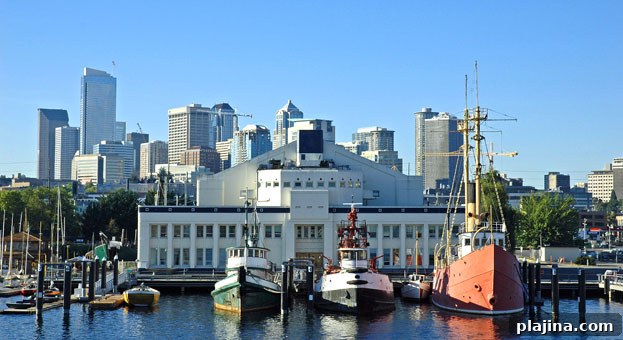
Given Seattle’s reputation for rain, its recent economic boom may come as a surprise. The city’s business climate has become particularly favorable for technology firms, with the region’s tech sector growing faster than Silicon Valley by recording roughly 12 percent growth in the past two years. As tech companies expand, a variety of development projects are rising to accommodate the city’s growing workforce.
Home to corporate giants such as Amazon.com and Microsoft, Seattle now supports more than 200,000 high-tech workers. Bay Area firms including Facebook and Google have expanded local offices—Facebook operates its largest location outside California in Seattle—and Twitter opened a new office near Pike Place Market. This influx of firms and talent has driven demand for office space, housing and urban amenities.
Last fall, Amazon purchased the headquarters campus it had been leasing in the South Lake Union neighborhood, paying more than $1 billion for the 1.7 million-square-foot site. That price marked a record for office buildings larger than 100,000 square feet in the city and far exceeded typical local office valuations. The transaction underscored both Amazon’s commitment to Seattle and the strength of the local commercial real estate market.
Only a decade earlier, South Lake Union was largely an overlooked industrial quarter just north of the Central Business District. After voters rejected a proposed Central Park-style green space—land that had been offered as a donation—developer Vulcan began assembling parcels and ultimately acquired close to a third of the neighborhood’s privately held land. The area has since transformed into a mixed-use hub anchored by Amazon and a cluster of life-science organizations, including the Fred Hutchinson Cancer Research Center, Seattle Cancer Care Alliance, ZymoGenetics and the Seattle Biomedical Research Institute.
City investments have supported that change: a new streetcar line, enhancements to local parks and zoning adjustments that allow taller buildings have all facilitated denser development. According to Maud Daudon, president and CEO of the Seattle Metropolitan Chamber of Commerce, “Over 35,000 new apartments are being created in the downtown core area, allowing employees to live close to their work. With this comes investment in new parks and possibly even new downtown schools.” Mayor Mike McGinn called South Lake Union an “engine for job growth and new housing, helping Seattle recover from the recession.”
Growth is not limited to South Lake Union. Amazon has also announced plans for a large campus in the Denny Triangle, the triangular zone between South Lake Union and the Central Business District. The planned 3.3 million-square-foot complex is expected to bring roughly 13,000 employees to the neighborhood, potentially driving even greater residential and commercial development than seen in South Lake Union.
Because downtown’s southern edge has stricter limits on office expansion, growth is shifting northward into Denny Triangle. Hundreds of apartments and condominiums are already under construction, with several high-rise residential projects—such as Via6, The Martin and Insignia—either underway or soon to break ground. Plans also call for a new 1,200-room convention hotel, reflecting broader demand for visitor accommodations tied to the city’s expanding business and conference activity.
View of downtown Seattle through the Washington State Convention Center arch © Vismax | Dreamstime.com
The Washington State Convention Center is within easy reach of the Triangle, offering a combined 414,722 square feet of meeting and exhibit space. In 2010 the center expanded with The Conference Center, a 71,000-square-foot space that can operate independently or in tandem with the main facility. The expansion highlighted the city’s emphasis on sustainability: the Conference Center is among many LEED-certified venues, and the convention center has earned recognition for recycling, composting and energy-efficiency efforts.
Overall, more than 20 million square feet of office space are in the development pipeline across Seattle to meet rising demand. That expansion corresponds with strong job growth: the region added about 16,000 office positions in 2012, and major employers continue to recruit. Amazon has been hiring heavily—adding more than 1,000 new roles in its Seattle offices—while Microsoft has sought to fill more than 1,500 positions, intensifying competition for top technical talent.
“Seattle is a place filled with innovation and vibrancy,” says Daudon. “We have an inclusive and well-educated workforce, are focused on international trade and connections, and are surrounded by natural beauty and a love of the great outdoors. People like to live here, and companies like to locate where they can attract great talent.” The region’s highly educated population supports that appeal: more than half of adults hold a college degree, making Seattle one of the nation’s most educated metropolitan areas.
The city’s universities also play a critical role in research and development. The University of Washington, for example, received significant research funding in 2010 and has been a national leader in securing National Institutes of Health grants, bolstering Seattle’s strengths in health and science.
For young software designers, developers and engineers, Seattle offers both professional opportunity and quality of life. Companies compete for talent with incentives such as signing bonuses and upscale workplace amenities, while the region’s 200 miles of shoreline and abundant outdoor recreation provide an attractive lifestyle. Voters recently approved a $290 million bond to replace Seattle’s century-old seawall, marking an early step in a broader waterfront restoration and public-space improvement plan.
Seattle’s cultural scene also contributes to its appeal. The city supports a high concentration of arts organizations per capita and has a storied musical heritage that includes figures such as Jimi Hendrix and bands from the grunge era. Contemporary acts continue to emerge from the region, helping to sustain a vibrant cultural identity that attracts young professionals.
Economic forecasts are optimistic. Publications and analysts regularly rank Seattle among the best cities for future growth, citing its combination of innovation, environmental stewardship and civic commitment to inclusive prosperity. As Daudon concludes, the goal for Seattle is to remain economically prosperous, environmentally responsible and socially equitable—continuing the momentum that has reshaped the city in recent years.