
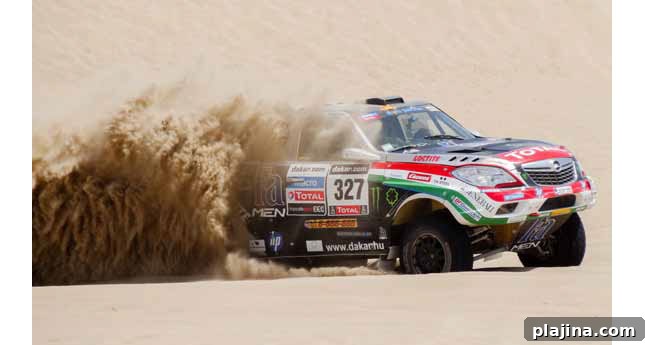
Where is this year’s Dakar Rally being held? It seems an obvious question, yet the answer has shifted with the race’s history. Many people still picture vehicles tackling Saharan dunes en route to Senegal’s capital, but the rally has moved far from its original route. Since 2009 the event has been staged in South America. The 2014 Dakar Rally takes place across Argentina, Chile and Bolivia.
Although the race’s name is now geographically misleading, its core identity remains unchanged. From its start in 1979, the Dakar Rally has been a brutal test of endurance, navigation and mechanical reliability. Competitors in cars, motorcycles, trucks and quads are pushed to extremes, and the event long ago earned the reputation of being “the toughest race in the world.” That reputation is sustained by demanding terrain, punishing distances and the constant strain on both human and machine.
Controversy has accompanied the rally throughout its life. Environmental critics point to the impact of thousands of vehicles crossing fragile landscapes. Observers also raise concerns about the race’s effects on communities along the route and note the tragic human toll that has sometimes accompanied the event. The founder, Thierry Sabine, himself died in a helicopter crash during the 1986 rally, underscoring the risks associated with staging a high-speed contest across remote and hazardous terrain.
Sabine conceived the idea after becoming lost in the Libyan desert while competing in a one-off Abidjan-to-Nice motorcycle race in 1978. Struck by the stark beauty of the dunes and the navigational challenge they presented, he organized the first Paris–Dakar Rally the following year. The initial event attracted a diverse field of amateurs and professionals eager to take on a rally that combined long-distance competition with extreme off-road conditions.
Although the event began with a Paris start and Dakar finish, the route and staging have changed for practical and safety reasons. Paris did not always welcome the parade of racing vehicles, and over time organizers shifted start locations around France and into Spain and Portugal. In 2008 the rally faced a major turning point: threats from an Al-Qaeda affiliate led to the cancellation of that year’s race and raised profound questions about the event’s future.
Organizers sought an alternative location with comparable remoteness and varied landscapes, and they found it in Argentina. The South American debut drew enthusiastic local support; on Jan. 3, 2009, roughly half a million people lined the streets of Buenos Aires to see the start. That year’s field numbered over 500 vehicles and competitors embarked on a roughly 6,000-mile, two-week journey across deserts and mountain ranges.
The 35th edition starts in Rosario, Argentina, and moves north into Bolivia, where competitors face the additional challenge of high-altitude conditions that strain both engines and bodies. Later stages route teams down Chile’s varied coast, culminating in the finish at Valparaíso on Jan. 18. Throughout the event, amateurs and professionals share the same course, and each day’s results, dramas and mishaps are followed by a large international television audience.
The Dakar remains inherently dangerous. Accidents and occasional fatalities continue to occur, a sobering reminder that safety is balanced against the event’s extreme nature. For many participants and fans, that raw danger is part of the rally’s allure. Thierry Sabine’s words still capture the spirit of the event: “A challenge for those who go, a dream for those who stay behind.”