
DUCK WOODS is a private country club just past the Wright Memorial Bridge as you enter Kitty Hawk, North Carolina, the site of the Wright brothers’ first flight. Although the course is private, a quick call to the pro shop will often secure a tee time for visitors, and the staff are welcoming and efficient with payments. Recent winter weather damaged several Outer Banks courses, and Sea Scape and Nags Head Golf Links suffered especially hard hits to their fairways. Sea Scape even offered steep discounts this summer because of playing conditions. Duck Woods, however, seemed largely unaffected. Whether due to protective landscape, excellent drainage, or an outstanding grounds crew, the course was in pristine condition the two times I played there in July. Credit goes to the groundskeeper and the greens committee for maintaining such high standards.
Designed by Ellis Maples and opened in 1968, Duck Woods reflects Maples’ practical, terrain-focused design philosophy. Trained in the tradition of Donald Ross, Maples built courses that work with the natural topography, emphasizing strategy and playability over extravagant earthmoving. That approach is clear throughout Duck Woods. While vacationing in Kitty Hawk, I played rounds with Paul Gosselin, my brother Gerry, and member Mike Askew. The staff are congenial, the pace of play is relaxed, and the course rarely feels crowded.
HOLE 1 | 497 yards, par 4
The opening hole is unforgiving if you don’t hit a straight drive. A canal runs the length of the right side, waiting for any errant shots, while trees on the left are playable but risky. The fairway is split by a branch of the canal about 100 yards from the green, so the second shot requires careful placement. Some shots dribble into the water; others, like Gerry’s adventurous attempt, clear the small bridge. After a good drive I found myself right of the green and chipped on for a bogey, while others struggled with the water.
HOLE 4 | 355 yards, par 4
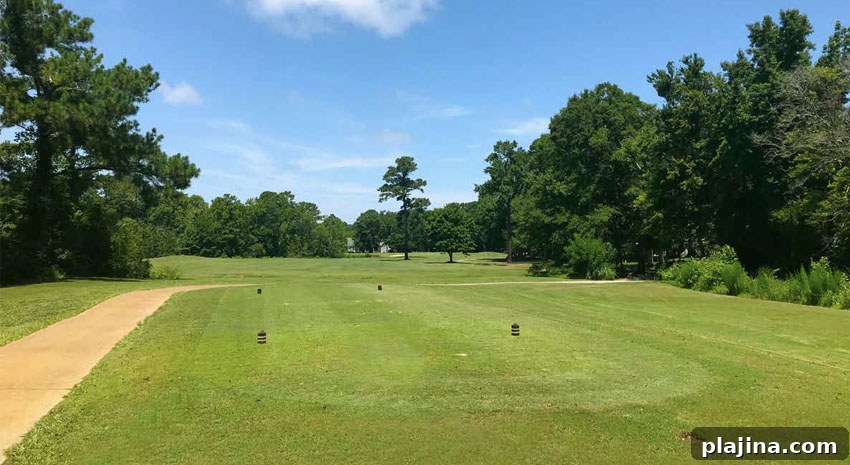
From the tee, the fairway can be deceptive. Two trees on the right appear to be in play, but the left side quickly falls into water. Aim left-center to stay safe; Paul’s drive found the water, and the hazard continues along the left and then bends to form a pond in front of the green, which claimed Gerry’s ball. My drive left-center set me up to miss the green narrowly and settle for a chip-and-two-putt bogey.
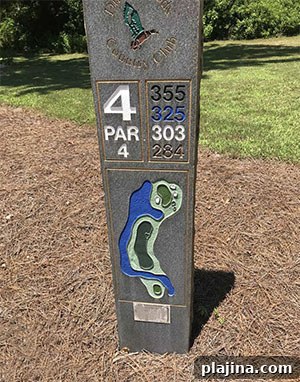
Hole 4 signage showing the water hazard © FRANCIS X. GALLAGHER
HOLE 6 | 403 yards, par 4
Another tee shot that punishes the inattentive. The marsh and water lie left but are not always obvious from the tee. A drive that drifts left nearly guarantees a penalty, as happened to me; Gerry, Paul, and Mike chose a safer right-side line and avoided trouble. I took a drop, found a bunker on the right, and finished with bogeys while my companions posted better scores.
HOLE 11 | 180 yards, par 3
Most par 3s at Duck Woods are straightforward, but this one plays a touch longer than the card indicates. Many players come up short and find the right bunker or the marsh beyond it. I struck a mid-iron to the center of the green for a confident par. Paul matched it, while Mike and Gerry succumbed to the right-side traps. Making par on 11 is a worthwhile reward.
HOLE 15 | 387 yards, par 4
Holes 15, 16, and 18 form a demanding finishing stretch that separates solid ball-strikers from the rest. Gerry, newly stocked with Callaway balls, sent several into the marsh left on 15. Big hitters can reach the water that bisects the fairway about 140 yards from the green; that risk caught a few drives. Paul hit a massive tee shot that ran past the fairway into the rough on Hole 10; trees complicated his approach. Mike and I hit excellent drives and celebrated with high fives. My approach overshot the green, but a reliable lob wedge and one putt salvaged a par, to some amusement from my partners.
HOLE 18 | 516 yards, par 5
The finishing hole is a fitting conclusion to a course that uses the natural site intelligently. Maples carved a narrow, long hole with a small green tucked left. A fairway bunker on the left catches poorly placed drives; that bunker grabbed mine and ruined any hope of a par. Others in the group let nerves get the better of them and found the woods left. The ideal line is right-center, setting up a fairway wood to reach within about 100 yards of the green. Bunkers protect the right side of the green, while a pond wraps the front-left and curves around the back. Occasionally a ball will roll on from the slightly open right throat, but more often shots slip into the water. Balls landing on the green tend to run right-to-left toward the hazard. The hole humbled me and Gerry with double bogeys, while Mike and Paul finished with bogeys, ending a challenging but thoroughly enjoyable round at Duck Woods.
Duck Woods Country Club
50 S. Dogwood Trail
Southern Shores, NC 27949
Tel: 252-261-2744
duckwoodscc.com