
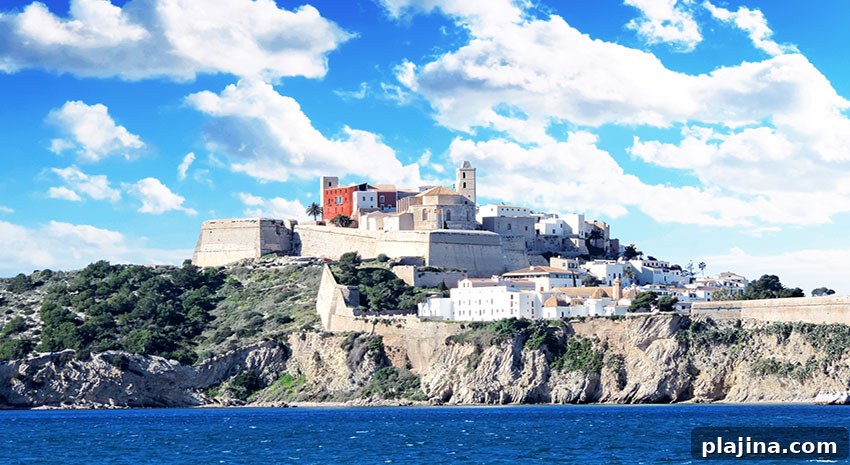
Ibiza’s fortified hilltop Old City, known in Catalan as Dalt Vila (the “upper town”), was designated a UNESCO World Heritage site in 1999 for its well-preserved Renaissance military architecture, including medieval walls, towers and stone fortifications.
The island’s recorded history stretches back to Roman times. Conquered by Rome in 123 B.C. and called Ebusus, Ibiza retained a degree of autonomy as a confederation town rather than becoming fully integrated into the Roman provincial system. Remnants of that era remain visible: near the entrance to Dalt Vila there are reproductions of the original Roman statues, and in the town of Santa Eulalia a restored Roman bridge marks the site where an ancient roadway once crossed a seasonal river.
Over the following centuries Ibiza experienced successive waves of occupation. Vandals, other Germanic groups and the Byzantines left their marks on the island; the underground chapel at Santa Inés is an example of structures that date from this period. In the ninth century the Arabs arrived and governed for almost five centuries, influencing local language and culture — traces of the Ibicenco dialect and additional defensive works can still be found today.
In 1235 the Catalans took control of the island. They demolished the existing mosque and erected the present cathedral on its foundations, renamed settlements after Christian saints, and built numerous churches. Among the oldest religious sites are those in Santa Eulalia, San Antonio, San Miguel and Sant Jordi, which reflect the medieval Christian influence on the island’s landscape.
During the 16th century the fortifications that now encircle Dalt Vila were rebuilt to defend the population against raids by Berber pirates. Seven robust bastions were constructed as part of this program; two of them — Baluard de Sant Jaume and Baluard Sant Pere — now include informative displays describing their construction, historical context and the defensive tactics used by local forces across generations.
Today Dalt Vila remains Ibiza’s principal historical attraction. Its narrow cobbled streets, towering stone walls, drawbridges, massive wooden gates, numerous churches and museums offer a concentrated glimpse into the island’s layered past. Beyond the monuments, visitors can enjoy a wide range of eclectic restaurants, bars, outdoor cafés and boutiques that line the streets, blending cultural heritage with contemporary island life.