
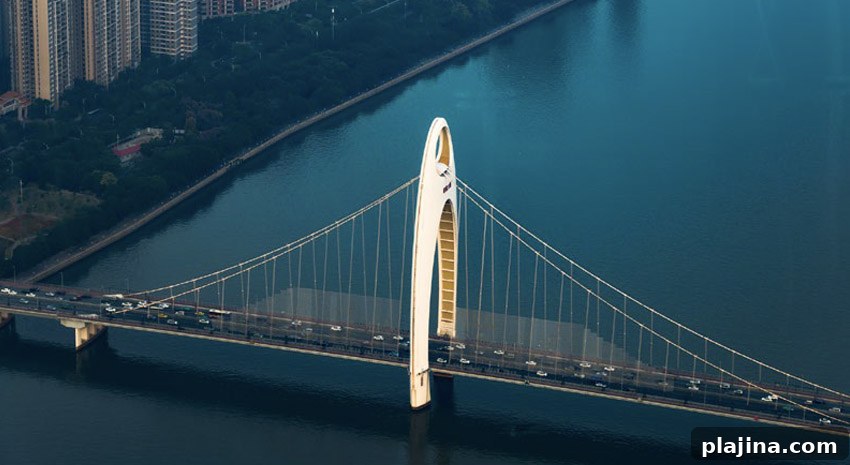
It had been almost 20 years since my last visit to Guangzhou, China. I remembered it as a relaxed city off the usual tourist track, filled with bicycles, single-story family restaurants and shops, and few English-speaking residents. On my recent drive from the airport into the city, I barely recognized anything.
The city has grown dramatically. Guangzhou’s population roughly doubled from about 7 million in 2000 to 14 million by 2017. Where bicycles once dominated, now the number of cars creates heavy congestion and contributes to air-quality concerns. High-rises dominate the skyline; the small-city atmosphere of the late 1990s is largely gone. One constant remains, however: Guangzhou’s focus on business.
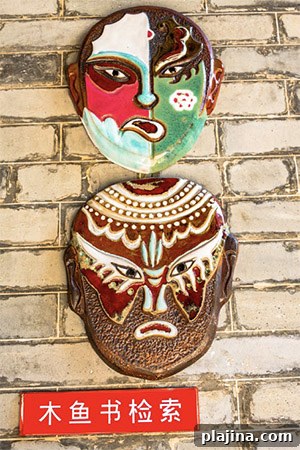
Two masks at the Foshan Opera Museum © ELLEN CLARK
Long before modern economic reforms, Guangzhou—capital of Guangdong Province—was a center of commerce. Its coastal location encouraged outward-looking trade rather than a reputation for architectural beauty. Instead of tree-lined boulevards and pristine facades, Guangzhou’s appeal lies in its energetic streets, lively markets, significant museums, charming temples and outstanding food that offset the city’s rapid urban expansion.
The city’s character carries a certain folklore. Legend says five celestial beings riding flying goats arrived in southeastern China and founded Guangzhou. The image is apt: goats are resilient and self-reliant, qualities that reflect the city’s temperament.
Guangzhou opened to foreign trade in 1685 under imperial decree, attracting British East India Company vessels from India and prompting the creation of warehouses for tea and silk shipments. Although the city’s commercial prominence waned in the mid-19th century after China was forced open, Guangzhou revived as a crucial business gateway to the West following the Communist victory in 1949.
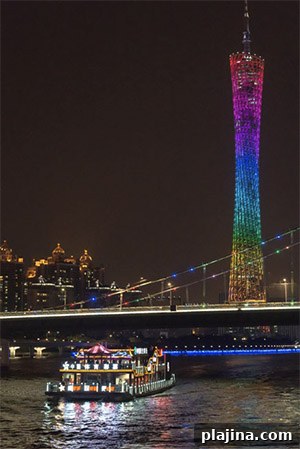
Canton Tower © ELLEN CLARK
By 2017 Guangzhou ranked just behind Shanghai as one of China’s best cities for business. That year the city’s GDP exceeded 2 trillion yuan, reinforcing its role as an international commerce hub. Local authorities have worked to ease restrictions on foreign investment and foster a more market-oriented legal environment, actions that help startups and multinational companies thrive. Investment in scientific and technological R&D rose more than 20 percent in 2017, reflecting a clear push toward innovation.
Looking ahead, Guangzhou expected solid growth, with forecasts calling for an approximate 7.5 percent increase in 2018. City plans included continued tax and fee reductions and ongoing reforms to strengthen the business climate for international companies.
Air quality is a visible challenge. Rapid population growth, industrial expansion and a rising number of private vehicles are major contributors. With estimates of 1.5 cars per family, pollution and traffic congestion are persistent problems. To address this, the city limits monthly vehicle sales and gives priority to electric vehicles, which buyers can often take immediately instead of joining long queues for petrol-powered cars.
Accommodation options have expanded alongside Guangzhou’s business growth. In the past decade the number of international five-star hotels multiplied. The Shangri-La, an early entrant, helped elevate standards, and today almost every major luxury brand has a presence in the city alongside many high-quality Chinese hotels.
Getting around Guangzhou is increasingly convenient. The Guangzhou Metro links the city center with outlying suburbs and the airport. Buses are the most economical option but typically have Chinese-only signage and drivers who rarely speak English. Taxis are affordable for short trips, though drivers may not speak English, so carrying a business card or the destination written in Chinese is advisable.
CHECKING IN WITH JASMINE MIAO
Marketing Specialist, China Southern Airlines, North America Regional Office
What are the most significant changes and improvements China Southern Airlines made in the last three years?
China Southern added onboard WiFi after years without it. In 2017 American Airlines acquired a minority stake in China Southern, opening opportunities for deeper commercial cooperation in sales, airport facilities and codesharing. China Southern and the Guangzhou Tourism Office also established 20 overseas promotion centers to provide information and services to travelers and transit passengers.
Has Guangzhou seen an increase in business travelers over the last few years?
Yes. The improving investment climate and pro-business policies have drawn more business travelers to Guangzhou and the surrounding region. Transit routes through Guangzhou to Southeast Asia reduce travel time for many passengers, and the 72-hour visa-free transit policy simplifies connections.
Have you seen changes in your customer base in the last few years?
Passengers have become more specific about their needs; ticketing trends show increasingly individualized preferences. Market competition has grown, and international transit passenger numbers have risen.
How does China Southern keep up with the competition?
Service remains central: enhancements to call centers, multilingual support, in-flight dining and entertainment, and transit experience continue. China Southern’s E-solution app aggregates travel information and services, and the North America regional office established partnerships with local tourism offices, shops, hotels and restaurants to offer discounts and benefits to members and customers.
What are the company’s plans for the future?
Long-term goals focus on improved service, stronger connections and tailored business solutions for small and medium-sized enterprises.
Things to Do in Guangzhou
Although Guangzhou is primarily a business destination, it offers interesting attractions for those with time between meetings.
The city’s most iconic landmark is the Canton Tower. On clear days the glass-walled observation deck—nearly 1,500 feet above ground—offers exceptional views. For thrill-seekers, the Bubble Tram circles the tower’s top in 16 spherical cabins that run along the structure, providing a dramatic panorama.
Guangdong Museum is an outstanding provincial museum with extensive permanent exhibitions, including a comprehensive history of Guangzhou from prehistoric times to the present. Traditional art lovers should visit the Chen Clan Ancestral Hall and the Guangzhou Folk Art Museum, noted for their detailed, colorful wood carvings on the roofs and ornate interior decorations.
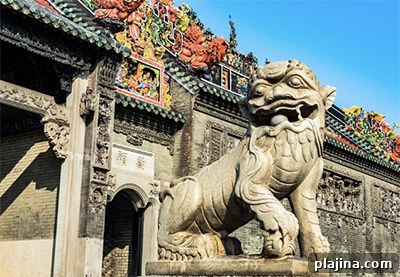
Chen Clan Academy © ELLEN CLARK
Lingnan Impression Park provides a tranquil escape from the urban rush. Modeled like an old town, it features traditional architecture, a lake with a shadow-puppet pavilion and a main street that includes an open-air opera house.
Redtory, opened in 2009 in renovated factory buildings, is an arts complex of studios, galleries and small shops. Admission is free, and the relaxed cafes and casual restaurants make it a pleasant spot for a meal or tea.
After dark, a Pearl River cruise is a popular way to see Guangzhou’s illuminated skyline. Bridges and riverside lights create vibrant reflections, while thousands of LED fixtures color the Canton Tower in shifting hues from pink to emerald to purple, enlivening the nighttime cityscape.
Guangzhou Info to Go
Guangzhou Baiyun International Airport is the city’s main airport and the principal hub for China Southern Airlines. Located about 17 miles from downtown, it offers convenient ground transport options including Metro Line 3, shuttle buses, intercity buses and taxis, with services available around the clock from the terminal.
Guangzhou: Just the Facts
Time zone: GMT +8
Phone code: Country Code: 86 City Code: 20
Currency: Chinese yuan
Key industries: Automotive; electronics; petrochemicals; electrical and thermal energy; appliances and machinery; rail, ship and aerospace equipment; and pharmaceuticals
COMING AND GOING
U.S. citizens need a visa and must have at least six months’ validity remaining on their passport.
OFFICIAL LANGUAGE
Mandarin
Where to Stay in Guangzhou
FOUR SEASONS GUANGZHOU Occupying the top 30 floors of one of the world’s tallest skyscrapers, the Four Seasons offers a 24-hour business center and elevated service for business travelers. 5 Zhujiang W. Road, Pearl River New City, Tianhe District $$$$$
VANBURGH HOTEL Located in the heart of the business district, this five-star Chinese hotel provides advanced multimedia meeting amenities and bespoke conference planning. 126 Huangpu Dadao W., Tianhe District $$$
WHITE SWAN HOTEL Recently renovated and situated on Shamian Island overlooking the Pearl River, the White Swan offers extensive meeting and conference space and a scenic riverside setting. 1 Shamian S. St., Liwan District $$$
Restaurants in Guangzhou
LE LUTECE This revolving restaurant on Canton Tower’s 105th floor features dishes combining local ingredients with French techniques, offering memorable views alongside inventive cuisine. Canton Tower, 222 Yuejiang Xi Lu $$$$$
PANXI RESTAURANT Set beside Liwan Lake, this garden-style restaurant serves award-winning Cantonese dishes in a picturesque setting of willows, rock gardens and water features. 151 Long Jin Xi Lu, Liwan District $$
TAOTAO JU RESTAURANT Established in 1880, this four-story venue is one of Guangzhou’s oldest restaurants. Best known for dim sum, it offers more than 200 authentic Cantonese dishes. 20 Di Shi Fu Lu, ShangXiaJiu, Liwan District $$$