
After the “Big D” and “little a” in the show-tune refrain, the “double l” might just as well stand for landlocked. Dallas is not a seaport—an oddity for a major American city—but its lack of direct access to the sea has not slowed its expansion. In the 1870s, the arrival of rail lines supported thriving cotton and stockyard industries. The discovery of oil in the 1930s, followed by the post–World War II growth of engineering and telecommunications firms, transformed the prairie outpost into a major industrial and financial center. Today Dallas’ diverse economy rests on commerce, technology, energy, health care and medical research, transportation, and logistics. Connected by five interstate highways and two major airports, the city — positioned roughly midway between the East and West coasts — continues to attract significant investment. “Dallas is booming,” says oil and gas businessman Craig Folson.
Winspear Opera House at the AT&T Performing Arts Center © Dallas CVB
Thanks to its central location, the “Queen City of the Southwest” hosts the third-largest concentration of Fortune 500 companies in the United States. The north suburban Telecom Corridor in Richardson is home to major high-tech firms such as AT&T, Alcatel, Nortel, Samsung, Sprint, Verizon, and Texas Instruments. SmartAsset ranks Richardson among the nation’s best cities for high-tech employment, reflecting the strength of the regional technology cluster.
While pioneers once urged people to “Go West,” the Dallas Cowboys organization is moving north to Frisco with a major development called The Star. This 91-acre site will feature the team’s six-story world headquarters, a multiuse event center with a 12,000-seat stadium, two private practice fields, and nearly two acres of outdoor plaza. The master plan also includes a 1,500-space parking garage, retail and restaurant space, offices, and an Omni hotel. In nearby Plano, Toyota is consolidating its U.S. manufacturing, sales, and corporate operations into a single national headquarters expected to open in 2016–17 and employ about 4,000 people.
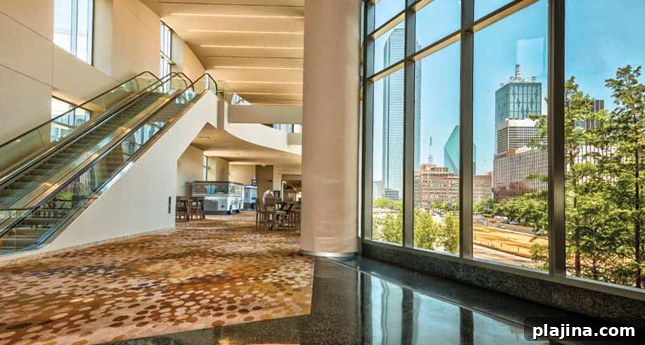
As the third-most popular destination for business travel in the U.S., Dallas offers major convention and exhibition facilities, including the Kay Bailey Hutchison Convention Center with more than a million square feet of column-free exhibit space for auto shows, corporate conferences, sports events, and international forums. Travelers arrive via Love Field, just seven miles from downtown, or through Dallas/Fort Worth International Airport, one of the world’s busiest airports and larger in acreage than the island of Manhattan. Ongoing airport improvements will add a new Terminal F and expand airfield, cargo, parking, and roadway capacity.
Forbes lists more than two dozen billionaires in the Dallas–Fort Worth area, and the region boasts a higher per-capita concentration of shopping centers than most American cities. Downtown’s recent cultural investments include the $354 million AT&T Performing Arts Center, featuring Rem Koolhaas’ vertical theater and an opera house designed by Sir Norman Foster. The George W. Bush Presidential Library, also recently completed, presents interactive exhibits chronicling the 43rd president’s tenure; the former president maintains a residence in the area.
George W. Bush Presidential Library © Dallas CVB
“It’s a great time to be doing business in Dallas,” states a spokesperson for the Dallas Regional Chamber of Commerce. Job-seekers exploring relocation can consult local resources such as the chamber’s DFW Jobs Gateway, where employers post current openings. The site’s message — “Check back frequently. The region is growing quickly, and so is its demand for recruits.” — underscores the fast-rising regional labor market.
SCENIC DRIVES
For travelers seeking a contrast to downtown density, short drives reveal a more rural and historic side of the region. A half-hour drive west brings visitors to Fort Worth, where old and new coexist. The Fort Worth Stockyards National Historic District evokes the Old West, while the nearby Cultural District features major museums: the Amon Carter Museum with American art highlights, the architecturally renowned Kimbell Art Museum, and The Modern Art Museum, which showcases works by artists such as Kiefer, Serra, Motherwell, and Rothko in quiet concrete pavilions. Dining remains a draw: Joe T. Garcia’s popular indoor-outdoor Tex-Mex is a frequent stop, and White Settlement Road is home to Angelo’s, famed for its barbecue.
Another nearby destination is Grapevine, just north of Dallas/Fort Worth Airport. True to its name, the town has a strong wine heritage: historic Main Street’s Victorian storefronts and rustic log cabins sit alongside numerous local wineries offering tastings of both new releases and classic vintages, often paired with cheeses, chocolates, and artisanal condiments.
Within Dallas city limits, a scenic drive around White Rock Lake leads to the Dallas Arboretum and Botanical Garden. The arboretum’s 66 acres surround Rancho Encinal, a Spanish-style mansion built in 1940 for petroleum geophysicist Everette Lee DeGolyer. The grounds feature seasonal plantings, a café, picnic areas, “prairie adventure” replicas, a concert stage, and gazebos. From the gardens and lakefront paths, visitors can enjoy views across the water to the downtown skyline—an everyday reminder of how the city thrived despite being landlocked.