
TWENTY. FORTY. SIXTY.
Seventy was as high as I counted as blacktip sharks glided past our small dive group, moving through the water with effortless grace. They seemed oblivious to our presence about 100 feet below the surface in crystal-clear water. When I reached 70, I had only covered roughly two-thirds of the constantly shifting wall of sharks at Fakarava’s South Pass.
Floating there, what surprised me most was how calm and steady my breathing felt amid so much activity on all sides. My body drifted with the current while the scene around me—so alive and fluid—outweighed any hint of fear. A profound sense of peace settled over me as I watched marine life going about its business in that underwater world.
Bora Bora, Tahiti and much of French Polynesia often top bucket lists thanks to images of turquoise lagoons, white-sand beaches, swaying palms and idyllic overwater bungalows. For scuba divers, the region offers even more compelling reasons to visit. With visibility around 130 feet, water temperatures from about 79°F in winter to 84°F in summer, and less than a one-half-degree difference between the surface and 166 feet deep, diving conditions are consistently excellent.
French Polynesia’s dive sites range from sheltered lagoons to dramatic drop-offs and swift passes, supporting more than 1,000 marine species and roughly 20 shark species. Scientists even call the 2.5 million–square-mile Polynesia sea zone one of the richest aquariums on Earth.
During a week exploring the Islands of Tahiti, I dove at Fakarava, Rangiroa and Bora Bora with TOPDIVE, and each island revealed its own character. Fakarava, in the Tuamotu archipelago, is famous for shark walls, abundant coral systems, vast schools of fish and strong currents that make drift dives feel fast and exhilarating.
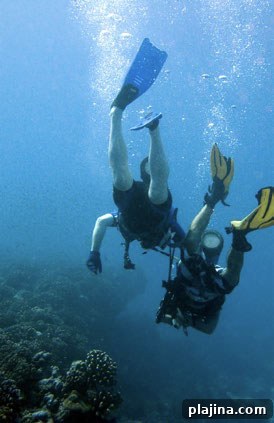
Divers exploring a reef off Bora Bora © MARCO LIJOI | DREAMSTIME.COM
Rangiroa, the world’s second-largest atoll and also part of the Tuamotu Islands, encloses a deep lagoon called Moana-tea, or Peaceful Ocean, with more than 240 islets forming a loop over 110 miles. Beyond that ring lies Moana-uri, or Wild Ocean, where drift dives may bring encounters with whales, manta rays, sharks and dolphins. On one Rangiroa dive, a pair of curious wild dolphins swam up close to inspect our diving group—an unforgettable moment.
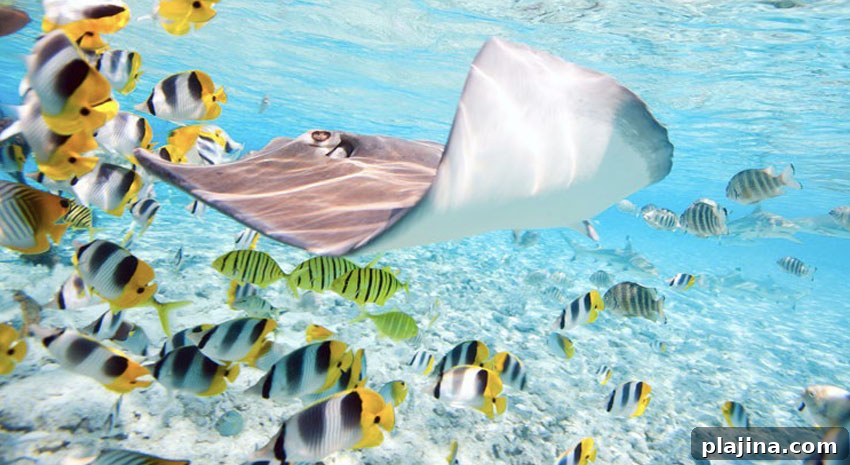
Bora Bora’s calm, clear lagoons in the Society Islands are equally rich in life. Bright tropical fish weave through healthy coral gardens while manta rays glide above underwater canyons, creating effortless beauty in every dive.
There’s plenty to enjoy topside on non-diving days as well. On Fakarava, take a personal island tour with a local like Enoha and visit his lagoon-front art gallery. Try an ATV tour with Fakarava Adventure, pick your own freshly harvested oyster at a pearl farm, or cycle the island at a relaxed pace. Of course, simply lounging and soaking in the scenery after a day of diving is a perfectly satisfying choice.
Accommodation options in French Polynesia suit many tastes and budgets. Stay in a traditional Tahitian guesthouse, or pension, such as Tokerau Village on Fakarava; choose a beachfront hotel like Hotel Kia Ora on Rangiroa; or indulge in a luxury resort such as Conrad Bora Bora Nui.
On the boat back to the north side of Fakarava after two dives in South Pass, TOPDIVE divemaster Mana and I chatted about the wonders we had just seen.
“If I could live my life underwater, I would,” Mana said, staring at the horizon. After a week beneath the waves around the Islands of Tahiti, I understood exactly what he meant. Fakarava—whose name evokes beauty and superb surroundings—has inspired visitors for decades, including French painter Henri Matisse in 1930, and the island is now recognized as a UNESCO Biosphere Reserve.
Tahitian Islands Info to Go
The Islands of Tahiti are reachable via daily direct flights from Los Angeles (LAX) to Papeete, Tahiti (PPT). Inter-island flights within French Polynesia make island hopping simple, so you can spend more time diving and exploring than in transit.