
Home to masters such as Leonardo da Vinci, Michelangelo and Dante Alighieri, Florence has long been celebrated as a world-class cultural center. The exact origins of the “City of Lilies” remain debated: traditional accounts credit Julius Caesar with founding Florentia in 59 B.C. because of its strategic position on the route between Rome and northern Italy, while archaeological evidence points to Etruscan settlement from Fiesole around 200 B.C. Either way, Florence’s place in history is undeniable.
Over the centuries the city grew into a thriving artistic, cultural and commercial hub. Today Florence draws business travelers and expatriates as well as tourists: global companies, technology firms and fashion houses maintain a presence alongside long-established artisan workshops. When offices close for the day, the softly lit cobblestone streets invite visitors and couples to wander and discover hidden corners of the city.
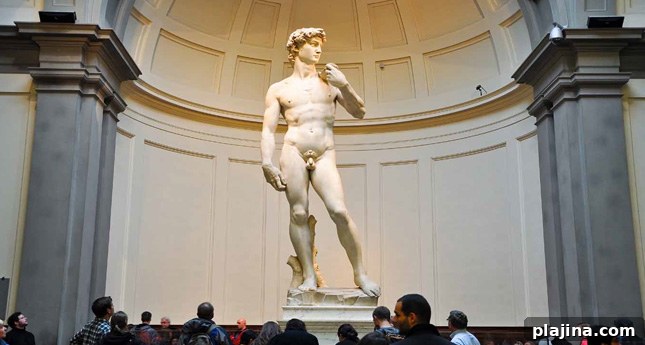
No visit to Florence is complete without seeing Michelangelo’s David at the Galleria dell’Accademia. Aim to arrive early and prioritize this stop—book priority tickets through your hotel or a reputable local tour to bypass long lines. Inside the museum you can view the original David, several unfinished sculptures by Michelangelo and important works by Botticelli and other Renaissance masters.
Many visitors who linger in nearby Piazza della Signoria assume the marble statue outside is the original David. For more than 350 years the original stood there, but exposure to the elements led to deterioration. In 1873 the statue was moved inside for protection and a faithful replica was placed in the piazza to honor the historic setting.
Palazzo Vecchio deserves time on its own. This imposing palace served as Florence’s town hall, the center of political life for generations of leaders and local dignitaries. It overlooks Piazza della Signoria, a lively area filled with shops, cafes and street vendors. Take a relaxed walk through the square and pause at a nearby trattoria for a glass of house wine and fresh pasta.
Basilica of Santa Croce interior © Photogolfer | Dreamstime.com
For a deeper connection to Michelangelo and other figures of the Renaissance, visit the Basilica of Santa Croce. The church may seem unassuming from the outside, but it houses the tombs of Michelangelo, Galileo and Machiavelli, among others. Galileo’s burial here is historically poignant: accused of heresy for his heliocentric views, he died under house arrest in 1642 and was not granted a prominent Christian burial in the basilica until 1737.
As daylight fades over Florence’s museums and churches, head to Piazzale Michelangelo for sweeping panoramic views of the city. Architect Giuseppe Poggi designed the terrace and placed copies of iconic sculptures to honor Michelangelo. The piazza is popular year-round, so expect company, but it remains one of the most romantic vantage points to admire the moonlit Duomo and the Arno River below.
Tourists at Piazzale Michelangelo take in the panorama of the city. © Raluca Tudor | Dreamstime.com
Another must-see is the Duomo—Santa Maria del Fiore—and its spectacular dome. Constructed during the 1400s as Italian city-states competed in a race to build grand cathedrals, the Duomo combines ambitious engineering with exquisite artistic detail. Its scale and ornate mosaics still stop even seasoned travelers in their tracks.
Visitors can climb to the top of the Duomo for an exhilarating up-close view of the dome and the city below. The ascent is challenging: 463 steps wind through narrow, unfinished corridors, and there is no elevator. If you’re able to make the climb, you’ll be rewarded with a close look at Giorgio Vasari’s frescoes of The Last Judgement and a dramatic rooftop panorama over Florence’s bustling piazzas and rooftops.
Florence Info to Go
Florence Airport Peretola—also known as Amerigo Vespucci Airport—is compact and conveniently close to the city center. The terminal offers basic services including a small eatery and currency exchange. Many travelers reach Florence via a European hub such as Frankfurt, Paris or Munich before flying into the city. The most straightforward transfer to central Florence is a fixed-rate taxi, a 10- to 15-minute ride with fares that vary by time and day but generally remain reasonable; expect an additional charge for luggage.
Where to Stay in Florence
FIRENZE NUMBER NINE HOTEL AND SPA Stay in spacious, multi-bedroom apartments within walking distance of major sights, shops and the Duomo. The hotel offers a fitness center and spa for guest relaxation. Via dei Conti 9 $$$
PORTRAIT FIRENZE HOTEL Luxury suites with exceptional service and views of the Arno make this an elegant choice for travelers seeking refined accommodations and personalized attention. Lungarno degli Acciaiuoli 4 $$$$
THE ST. REGIS FLORENCE Set in the historic center, The St. Regis blends modern amenities with classic Florentine charm—request butler service or rooms overlooking the Arno for a special stay. Piazza Ognissanti 1 $$$$
Restaurants in Florence
ENOTECA PITTI GOLA E CANTINA Renowned for its dedication to food and wine, this enoteca pairs small-production, high-end wines with handmade pasta, local cheeses and charcuterie. Piazza Pitti 16 $$$$
KONNUBIO A warm, rustic atmosphere serves traditional Tuscan dishes alongside international options; vegetarian and vegan choices are available. Via dei Conti 8/R, Corso dei Tintori 10/R $$$
RISTORANTE FRANCESCO VINI Housed in one of Florence’s oldest buildings, this family-run restaurant began as a specialty wine shop and now offers authentic Tuscan meals. Dine al fresco for people-watching or enjoy an intimate dinner downstairs. Borgo dei Greci 7/R, Piazza dei Peruzzi 8/R $$