
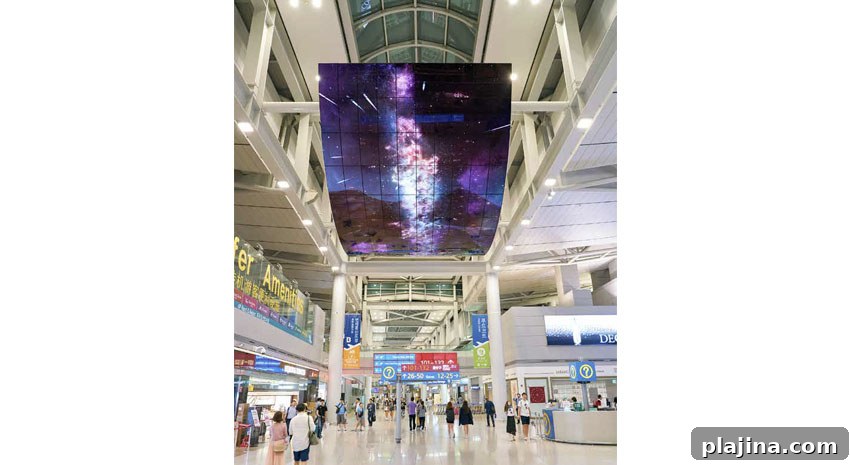
FOLLOWING THE 1988 SUMMER OLYMPICS in South Korea, international air traffic to Seoul rose so rapidly that the main airport at the time, Gimpo International Airport, struggled to cope. Construction began in 1992 on a new facility that would become one of the world’s busiest and most acclaimed airports — a modern gateway well suited for major events such as the 2018 Winter Olympic Games in PyeongChang.
Opened in 2001, Incheon Airport has built an outstanding reputation over the past two decades. As South Korea’s largest airport, the primary hub for carriers like Korean Air and Asiana Airlines, and the main airport serving the Seoul metropolitan area, Incheon ranks among the busiest airports worldwide.
Handling more than 60 million passengers a year, Incheon combines high capacity with premium passenger amenities. The airport features a golf course, spa, private sleeping rooms, an ice-skating rink, a casino, landscaped gardens and a Museum of Korean Culture, all within a single expansive terminal complex.
Airports Council International has consistently recognized Incheon’s quality, and publications and travel surveys frequently rank it among the best airports in Asia and the world. The airport’s customer-focused services and facilities contribute to its strong industry standing.
Incheon’s long-term development plan unfolds in four phases. The most recent major milestone, Phase Three, introduced the new Terminal 2 in January. This 7.4 million-square-foot terminal emphasizes sustainability and technology, featuring a solar-paneled roof to lower energy use, automated boarding systems, and service robots to assist passengers. The terminal also includes sculpture and art exhibition areas, indoor gardens with waterfalls and streams, expanded lounges, new retail and dining options, a transfer hotel, and an aircraft observation deck.
Although Terminal 2’s opening experienced early operational challenges — including some baggage and flight delays — the issues have been resolved and normal operations are now established. Several carriers, including Korean Air, KLM, Delta Air Lines and Air France, have moved to Terminal 2, while other SkyTeam members such as China Eastern Airlines remain at Terminal 1 for the time being.
Phase Three also expanded cargo facilities and other ground infrastructure, including additional parking and an extended railway connection to the city center. The airport authority signed an agreement to develop a large resort complex, Inspire, planned to include luxury hotels, theme parks and a casino to enhance passenger and visitor offerings.
Phase Four, scheduled for completion in 2020, will expand capacity further. Once finished, Incheon will operate two passenger terminals, four satellite concourses, 128 gates and five parallel runways, enabling the airport to handle up to 100 million passengers annually. With that capacity, Incheon is expected to rank among the world’s busiest airports.