
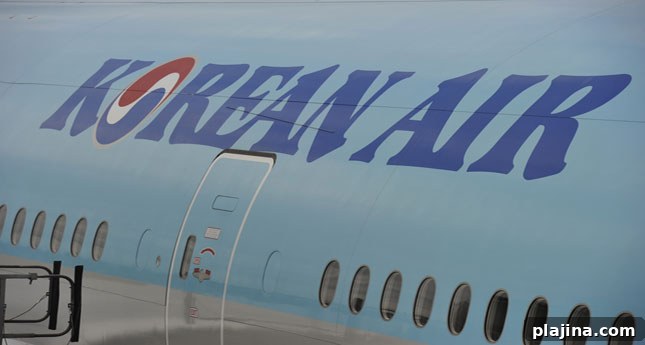
Korean Air and Boeing have announced plans to establish Korea’s largest aviation training campus to strengthen and expand the country’s pilot and technician training capacity. The facility, planned to open in 2015, will be located in Incheon’s Free Economic Zone and is designed to support a growing demand for qualified aviation personnel throughout Korea and the broader Northeast Asia region.
The new campus will feature 12 full-flight simulators dedicated to pilot training, allowing trainee pilots to gain realistic, high-quality experience across multiple aircraft types. This expansion responds to long-term industry forecasts. According to the 2013 Boeing Pilot & Technician Outlook, Korea and the Northeast Asia region are expected to require roughly 18,500 new pilots and 25,500 new technicians by 2032 to meet growing air travel demand and fleet expansion.
Sherry Carbary, vice president of Boeing Flight Services, noted the long-standing partnership between the two organizations and emphasized the importance of collaboration in building advanced training capabilities. “Boeing and Korean Air have a training relationship spanning almost 15 years,” she said. “We look forward to continuing our collaboration with Korean Air as we develop advanced aviation training programs from a new base in Incheon.”
The facility aims to serve a range of training needs beyond initial pilot qualification, including recurrent training, type ratings, and crew resource management. By concentrating multiple simulators and training resources at a single campus, the project is expected to improve training efficiency and accessibility for airlines and individual trainees in the region.
Investment in simulator-based training supports safer, more consistent pilot proficiency by enabling crews to practice emergency procedures and unusual flight scenarios in a controlled environment. The simulators’ advanced technology will mirror current and future aircraft systems, helping trainees transition to new aircraft models more smoothly and reducing the time required for in-service training.
For Korea, the new campus represents both an infrastructure upgrade and a strategic response to regional workforce needs. As air travel demand continues to rise across Northeast Asia, the availability of locally based, high-capacity training resources will help airlines maintain safe operations, manage pilot supply, and support ongoing growth. Collaborative efforts between a major carrier and a global aircraft manufacturer also highlight an industry trend toward integrated training solutions tailored to regional markets.
This initiative builds on nearly a decade and a half of cooperation between Korean Air and Boeing, leveraging Boeing’s flight training expertise and Korean Air’s operational experience to deliver comprehensive programs. The combination of modern simulators, dedicated facilities, and established training curricula is intended to produce better-prepared pilots and technicians who can meet evolving industry standards.
You may also like:
Bruce Dickinson, Vice President And Chief Project Engineer, 747 Program, The Boeing Co.
Korean Air | Prestige Class