In the July 2014 issue of Global Traveler, I wrote about one of my all-time favorite Myrtle Beach courses, The Caledonia Golf and Fish Club. Its sister course, True Blue Golf Plantation, is an excellent complement to a visit to the Caledonia/True Blue complex and stands on its own as a memorable layout.
True Blue consistently ranks among the top courses in South Carolina. Like Caledonia, it was designed by architect Mike Strantz and opened in 1998 to wide acclaim. The course features generous, forgiving fairways with minimal rough; however, Strantz balances that openness with elevated, undulating greens that play fast and demand precise approach shots and good putting.
The name True Blue Plantation reflects the region’s history: indigo was a major cash crop in 18th-century South Carolina. The plantation’s name endured through the centuries, even after the land transitioned to rice cultivation.
Hole 1 | 624 yards, par 5
Stranz starts you off with a challenging opener. The first hole is also the course’s toughest by handicap. The smart play is to favor the right side of the fairway from the tee and on the second shot, because the fairway bends left and doglegs toward the green; hugging the left can block your angle into the green. A large waste bunker runs along the left side and ends just before a creek that crosses in front of the green. Despite warm-up rounds at Caledonia, our group found this hole surprisingly unforgiving and recorded more mishaps than expected.
Hole 3 | 190 yards, par 3
This is a beautiful but demanding par 3. On our day the pin was up front, which let Gerry Patrick play a bold skip across the water and run the ball onto the green. The green itself is amoeba-shaped and set within a pond, with a narrow connection at the back that makes it nearly an island. Any errant shot tends to find the water or the large bunker guarding the front. I overdid my swing and ended up at the back of the green, a distance that made putting feel like signaling from a distance.
Hole 9 | 548 yards, par 5
The finishing hole of the front nine is a test of both nerve and strategy. From the tee the hole appears to dogleg right then left; aggressive players who can cut the corner on the right and avoid the waste area may reach the green in two. We played this hole at dusk, losing light as the group ahead took its time. I played conservatively, treating it as a three-shot hole, positioning my tee shot left and laying up short of the marsh that crosses in front of the green. Several teammates found the marsh; I was left with a bogey and a story.
Hole 10 © Francis X. Gallagher
Hole 10 | 599 yards, par 5
Hole 10 showcases Stranz’s generosity: the fairway is wide with a substantial landing area on the left. That said, some golfers are tempted to flirt with the waste bunkers on the right. The correct strategy is to place the drive left to take full advantage of the room. From there you can attack the dogleg, carrying over finger-shaped bunkers to another broad landing area. A precise approach to the undulating green can make or break your score; those traps off the line can punish overconfidence, as several of our group discovered.
Hole 11 | 184 yards, par 3
The abundance of sand around this green is unmistakable, but the green is very much real. Locals call Hole 11 a straightforward par 3, yet our group found otherwise. The green is two-tiered and only one of us, “Lucky Bob,” noted the correct line—though he landed on the wrong tier. The rest of us rehearsed bunker exits, tacking extra strokes onto our cards as we learned the hard way.
Hole 17 | 449 yards, par 4
Ranked the second-most difficult on the course, Hole 17 appears deceptively simple. My tee shot was nearly perfect—away from the water along the right and giving me a clear look at the green with a 3-wood. Lucky Bob outdrove me but drifted left toward a neighbor’s yard. My approach missed right and flirted with the pond; my recovery fell short, turning what seemed like a birdie opportunity into a frustrating sequence of shots.
Hole 18 | 437 yards, par 4
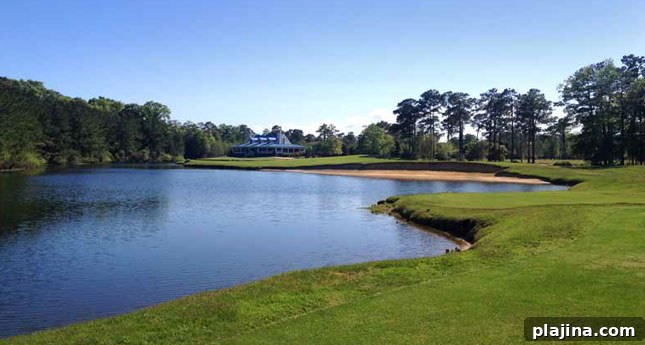
The finishing hole frames the clubhouse with its indigo roof behind the green. A horseshoe-shaped fairway wraps a large body of water guarding the left side, creating a dramatic and sometimes costly finishing hole. Gerry nearly donated a few Titleists to the water; Bob sliced across the fairway and landed among trees on the right. Corky produced a string of exceptional shots and walked off with a par while the rest of us watched. Stranz tilts this green from right to left, and balls that find the putting surface can still roll off toward the drink—testimony to the unforgiving subtleties of his design.
True Blue Golf Plantation
900 Blue Stem Drive
Pawleys Island, SC 29585
tel 843 235 0900
truebluegolf.com