
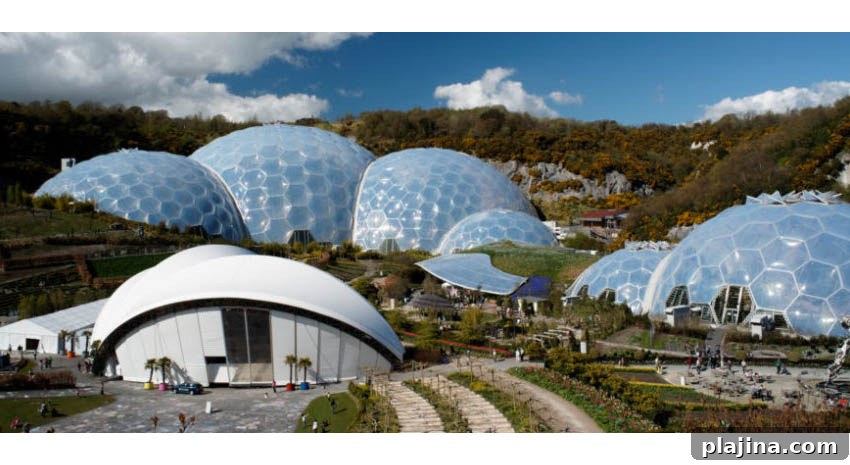
As human activity continues to reshape the planet, it’s important to remember our deep connection to the natural world. The Eden Project is an educational charity dedicated to rekindling that connection by celebrating the diversity and resilience of living systems. Its original visitor site in Cornwall, England, features vast Biomes, a living rainforest under glass, and curated plant displays and exhibitions that invite visitors to learn about ecology, sustainability and the interdependence of people and nature.
This summer, the Eden Project announced the launch of a new organisation to expand its model internationally. Eden Project International will take the charity’s mission and its social and ecological benefits to new locations worldwide. The new entity will address major local and global environmental challenges — including soil, water, food security and biodiversity — by working in partnership with community groups, research institutions, private companies and local governments.
Sir Tim Smit, co-founder of the Eden Project, described the vision: “Eden’s mission is to explore our dependence on the natural world, to use that understanding to excite people into delivering transformation where they live, and to ask serious questions about what a great future might look like for all of us. We want new Edens to act as a heartbeat for those who share our values and to build their capacity to tell the stories that inspire their communities.”
Over its first 16 years, the Cornwall site welcomed more than 19 million visitors and generated over £1.7 billion in economic impact. Building on that success, Eden Project International is already developing several overseas initiatives.
In China, the organisation has three projects underway. Eden Qingdao will focus on water — its role in sustaining life, the pressures on water resources and approaches to conservation and management — with construction scheduled to begin later this year. A second project in the historic city of Yan’an will address land and soil, showcasing ecological restoration and sustainable land use as key tools for the future. A third site at Sheng Lu Vineyard in Beijing will create an urban refuge where people can reconnect with nature.
Beyond China, Eden is advancing projects in the Asia-Pacific region. In Australia, plans are being explored to restore and regenerate a degraded site near the Hobart port, transforming a damaged landscape into a place for nature, learning and community engagement. In New Zealand, Eden is collaborating with a local trust to develop a social enterprise and visitor attraction within an earthquake-affected Red Zone. There, the programme will weave together stories of nature and culture and include restoration of native ecology along the River Avon.
Each international Eden will be adapted to local needs and priorities, combining ecological restoration, education and community-led enterprise to create living places that inspire environmental stewardship. By bringing the Eden model to diverse settings, Eden Project International aims to spark local transformations that contribute to healthier ecosystems, stronger communities and more resilient futures.