
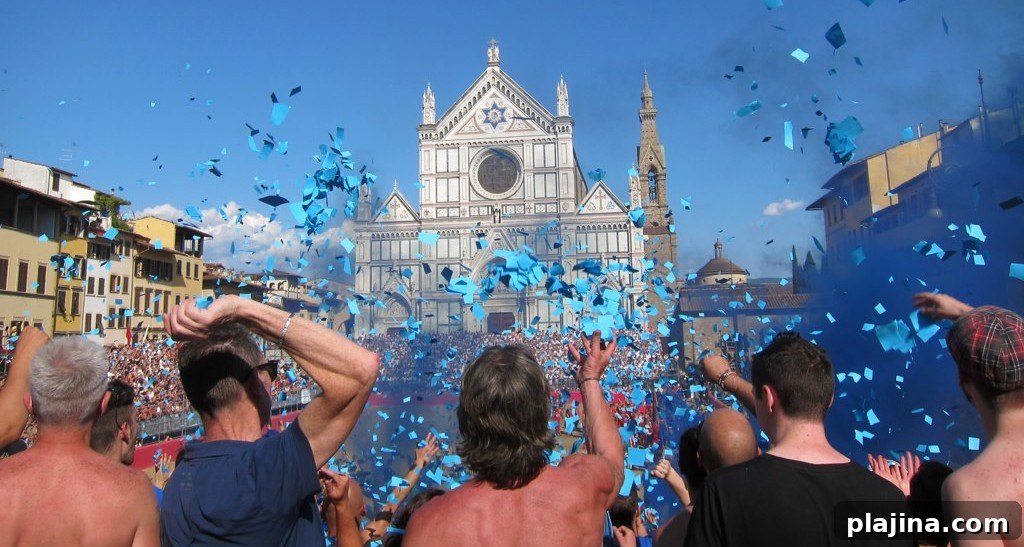
Calcio storico, often called historic football, is an ancient sport with roots stretching back over a millennium. Its origins trace to games played in ancient Greece, which were later embraced and adapted by the Romans. Over time the game evolved, and it became firmly established in Florence as an annual tournament held to honor the city’s patron saint, St. John the Baptist.
Played in period costume and blending elements of soccer, rugby, and wrestling, calcio storico is notable for its physical intensity and deep cultural significance. Matches are traditionally contested between four neighborhood teams—Santa Maria Novella, Santa Croce, Santo Spirito, and San Giovanni—each representing a distinct quarter of Florence. The tournament takes place in Piazza Santa Croce, where a sand-covered field is prepared in front of the basilica and teams compete in a series of elimination matches.
Participants wear historic-style uniforms and play without substitutions, relying on stamina, strategy, and teamwork. Scoring combines goals and throws over the opponent’s heads, while the sport’s rough contact and limited rules make it both a spectacle and a test of endurance. Despite its combative nature, calcio storico remains deeply embedded in Florentine tradition, drawing local pride and international curiosity alike.
Each year the tournament culminates in a final match that attracts passionate supporters, colorful pageantry, and civic ceremony. The event is accompanied by historical reenactments, processions, and celebrations that highlight Florence’s rich cultural past. While modern safety measures and organizational changes have altered some aspects of the game, calcio storico continues to preserve its distinctive blend of athleticism, history, and communal identity.
For visitors and residents, attending a match offers a rare window into Florence’s living traditions—an intense, visceral experience that connects the present city to its medieval and classical past. Whether appreciated as sport, theater, or ritual, calcio storico endures as a powerful expression of Florentine heritage.