
When Commodore Matthew C. Perry and his “black ships” sailed into Edo Bay in 1854 to demand that Japanese ports be opened to American trade, Japan had been largely isolated from the world for more than two centuries. At that time the country was agrarian and feudal, ruled by a shogun, and the industrial revolution that transformed the West had barely touched Japan.
Just over 160 years later, the shogun’s castle and samurai residences have given way to the bustling metropolis of Tokyo. Together with neighboring Yokohama and other cities, Tokyo forms the largest metropolitan area on Earth, home to more than 37 million people. Government ministries, the Tokyo Stock Exchange, major industries, financial institutions and insurance companies are concentrated in and around the city, making Tokyo one of the world’s most influential economic centers.
Tokyo’s rise was not linear. After becoming the nation’s political center in 1868, the city embraced Western industry, architecture, cuisine and fashion. Still, it faced devastating setbacks in the 20th century, suffering catastrophic damage in the 1923 Great Kantō Earthquake and again in 1945 from incendiary bombing. Each disaster caused immense loss of life and widespread destruction, yet Tokyo repeatedly rebuilt itself; by 1964 the city showcased Japan’s recovery to the world as host of the Summer Olympics.
Japan’s postwar economic policies that protected domestic industry helped the nation become Asia’s richest industrial economy by the 1980s. The subsequent asset bubble burst in the early 1990s triggered a prolonged recession, worsened by banking troubles and overextended corporate investments abroad. Further shocks, including the 2008 global financial crisis often called the “Lehman Shock” in Japan and the 2011 earthquake, tsunami and Fukushima nuclear accident, compounded the economic challenges.
Tourism fell sharply after the 2011 disaster, dropping from 8.6 million international visitors in 2010 to 6.2 million in 2011. A concerted government effort to promote tourism helped reverse the decline: by 2014 Japan welcomed a record 13 million foreign visitors, driven largely by travelers from China, Taiwan and South Korea, with North Americans representing a significant share of long-haul visitors. The government set an ambitious target to attract 20 million foreign tourists by 2020, when Tokyo again hosted the Summer Olympics.
“Tokyo offers everything you could wish for—history, art, culture, design, fashion, architecture, technology and more,” says a representative of Tokyo City tourism. “You can enjoy a vast variety of outstanding food. Tokyo consistently holds the most Michelin stars of any city. The public transportation network makes travel easy, and the city is safe, clean and orderly. People feel comfortable traveling alone, and locals are usually happy to help if you get lost.”
Surveys consistently rank Tokyo among the world’s safest major cities. Despite its immense scale, the metropolis preserves neighborhoods with distinct characters across its 23 special wards, blending historical sites with cutting-edge development.
There are signs that Japan’s economy may be emerging from a long period of stagnation. Since early 2015 the Nikkei index has reached multi-year highs, and a weaker yen has helped boost exports to the United States, China and other markets. Prime Minister Shinzō Abe’s economic program—dubbed “Abenomics”—aims to end deflation and achieve a sustainable growth trajectory, with a target inflation rate of around 2 percent. Results have been mixed, and economists continue to debate the program’s long-term effectiveness.
Part of Abe’s strategy is to increase inward foreign direct investment, which remains relatively low in Japan. Surveys by government entities show foreign firms often cite high corporate taxes, steep office rents, complex licensing and administrative hurdles as barriers to entry. The administration has pushed reforms to improve corporate governance, increase transparency and create regulatory relief in designated National Strategic Special Zones, including Tokyo.
The Tokyo Metropolitan Government also created a Special Zone for Asian Headquarters to attract foreign companies and entrepreneurs. A one-stop office streamlines procedures for registration, pensions, taxes, visas and related paperwork, with English interpreters available to assist with Japanese documents.
Finding qualified personnel who can operate in English remains a challenge for foreign firms. Japan faces a shrinking workforce due to low birthrates and a rapidly aging population—roughly 22 percent are aged 65 or older—which constrains labor supply. Greater acceptance of immigration and fuller participation of women in the workforce could help. The government has set goals to increase women’s representation in leadership positions, and Tokyo benefits from a high concentration of universities—more than 100—providing an educated talent pool. Improvements in transport, such as the expanding Shinkansen network, also make long-distance commuting more feasible.
In late 2014 Tokyo’s governor unveiled a long-term vision tied to the 2020 Olympics and beyond, including expanded daycare and after-school programs to enable more mothers to enter the workforce, stronger English instruction in schools and policies to boost employment. He identified growth areas such as drug development, robotics and medical devices as priorities to restore Tokyo’s role as a global business hub.
The 2020 Olympics were promoted as a catalyst for a greener, more technologically advanced city—featuring hydrogen fuel-cell vehicles, enhanced WiFi coverage and multilingual digital signage to improve convenience for residents and visitors. Infrastructure upgrades and construction projects across the city aim to leave a lasting legacy.
Redevelopment continues in major districts: Ginza is seeing new commercial towers replacing older department stores, while Shibuya has already introduced large mixed-use complexes like the 34-story Hikarie, which includes shops, restaurants, a theater and art spaces. Major renovations around Shibuya Station—new skyscrapers, reorganized transit lines and expanded pedestrian areas—are planned to modernize one of Tokyo’s busiest hubs.
Two decades ago it would have been hard to imagine Tokyo hosting more than a thousand Starbucks outlets, Forever 21 shops lining Shibuya and Harajuku, or KFC becoming a popular Christmas tradition. Growing tourism, a friendlier environment for foreign businesses and improved infrastructure are likely to create more opportunities in the coming years—another chapter in Tokyo’s long history of adaptation and change.
Things to Do in Tokyo
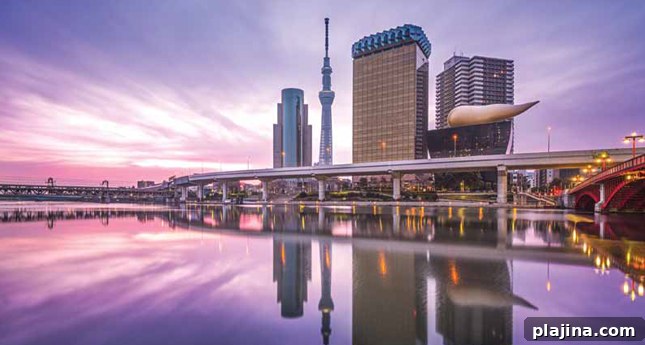
For panoramic views of the sprawling megalopolis, visit Tokyo Skytree, which opened in 2012 as the world’s tallest freestanding broadcasting tower and features two observatories and a rooftop restaurant offering 360-degree vistas. Nearby Asakusa, one of Tokyo’s oldest neighborhoods, is known for Senso-ji Temple, historic shops and a lively atmosphere.
The Tokyo National Museum houses the largest collection of Japanese art and antiquities, from woodblock prints and samurai armor to Buddhist treasures and ancient ceramics. The Edo-Tokyo Museum presents an engaging narrative of the city’s past, covering the era of the shogun, the 1923 earthquake and the 1964 Olympics. For contemporary art, the Mori Art Museum on the 53rd floor of Roppongi Hills offers innovative exhibitions and sweeping city views.
Shopping in Tokyo spans upscale Ginza—home to designer boutiques, galleries and department stores—to Marunouchi’s tree-lined Nakadori avenue, where revitalization has transformed the district into an attractive business and retail area. The Tokyo International Forum hosts the Oedo Antique Market, Japan’s largest, on the first and third Sundays of each month. Omotesando is known for edgy and Japanese-designed fashion.
Dining in Tokyo is world-class, with roughly 80,000 restaurants ranging from formal kaiseki dining to some of the freshest sushi you will find anywhere. Nightlife options include elegant cocktail lounges with panoramic views and lively izakaya-style establishments. For relaxation, Ooedo-Onsen Monogatari offers an atmospheric onsen experience modeled after Edo-period bathhouses, with both indoor and outdoor baths.
CHECKING IN WITH DEBBIE HOWARD
Chairman, The Carter Group
How has the business environment changed for foreigners and women over the past 30 years?
Japan has become more open to foreign businesses. In the mid-1980s consumers and companies were often wary of non-Japanese firms, but the prolonged economic stagnation after the 1992 bubble collapse forced society to adapt. A more entrepreneurial, independent mindset emerged, making it easier for foreigners—men and women—to do business in Japan, especially in Tokyo.
Which industries offer the best opportunities for foreign firms entering Tokyo?
Greater Tokyo accounts for roughly a quarter of Japan’s population, offering diverse target markets. Competition is intense across sectors such as automobiles, electronics and media, but Tokyo consumers expect top-tier products and services. The aging population creates opportunities beyond medical devices and mobility aids—products that help people stay active and youthful, such as haircare, fitness programs, supplements and age-friendly fashion, can find receptive audiences.
Will the Olympics create more opportunities for foreign investment?
Since 2012 there has been renewed energy around Tokyo, amplified by the 2013 announcement that the city would host the 2020 Olympics. Construction projects and optimism have increased demand and opportunity across many fields—food and beverage, healthcare, IT and media among them. Continued international attention will highlight Japanese firms achieving global success.
Tokyo Info to Go
Narita International Airport (NRT) is about 41 miles east of central Tokyo. The JR Narita Express runs twice hourly to Tokyo Station and onward to Shinagawa, Shibuya and Shinjuku in about 56 minutes. The Airport Limousine Bus is a convenient alternative, delivering passengers directly to major hotels but often taking longer. Haneda Airport (HND), closer to the city center, serves an increasing number of international flights and offers both a monorail and limousine bus service. Taxis from either airport are available but expensive, especially from Narita.
Tokyo: Just the Facts
Time Zone: GMT +9
Phone Code: Country code: 81 City code: 3
Currency: Japanese yen
Entry/Exit Requirements: U.S. citizens generally need only a valid passport for stays up to 90 days.
Official Language: Japanese
Key Industries: Electronics, publishing, transport, communications, finance, insurance, wholesale and retail, and food and beverage services
Where to Stay in Tokyo
Andaz Tokyo Toranomon Hills Mesmerizing views from the upper floors of a 51-story tower complement the understated elegance of this 164-room hotel; the open-air rooftop bar is a highlight. 1-23-4 Toranomon, Minato-ku $$$$$
Conrad Tokyo Located within walking distance of Ginza, this 290-room hotel provides excellent views over Tokyo Bay, an extensive collection of Japanese art and one of the city’s largest spas. 1-9-1 Higashi-Shinbashi, Minato-ku $$$$
The Tokyo Station Hotel A restored century-old property offering convenient access to Narita and the Shinkansen, with guestrooms and public spaces returned to their historic splendor. Tokyo Station, 1-9-1 Marunouchi, Chiyoda-ku $$$$
Restaurants in Tokyo
Ten-Ichi Operating since 1930, this tempura restaurant features Zen-inspired décor and traditional service, attracting many notable diners over the years. 6-6-5 Ginza, Chuo-ku $$$$$
Tokyo Shiba Tofuya-Ukai Private tatami rooms overlooking traditional gardens complement beautifully composed set meals focusing on tofu and seasonal ingredients. 4-4-13 Shiba-Koen, Minato-ku $$$$$
Two Rooms Grill/Bar Popular with Tokyo’s urban crowd, this stylish venue serves Wagyu and contemporary cuisine, and includes a terrace and relaxed lounge area. 3-11-7 Kita-Aoyama, Minato-ku $$$$$