
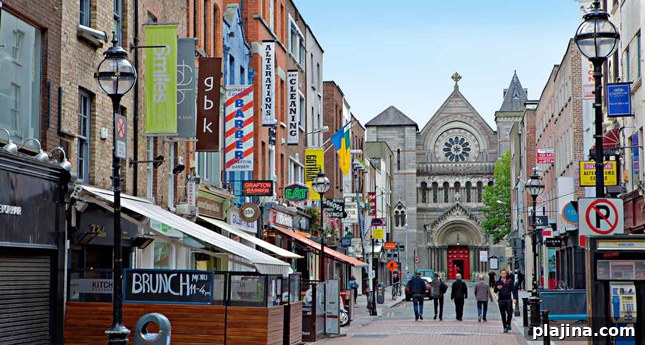
Ireland’s capital evokes two vivid impressions: a literary haven shaped by Oscar Wilde, Samuel Beckett and James Joyce, and a thriving pub culture where a lone guitarist can spark a singalong accompanied by perfectly poured pints.
Today Dublin presents itself as a cosmopolitan city where you will often hear a chorus of languages while strolling Grafton Street. The city has shed its “Dirty Old Town” reputation and embraced modern urban life.
One hundred years ago next month the city center was transformed by the 1916 Easter Rising, when Irish rebels seized the General Post Office. The harsh British response and the execution of 16 leaders shifted public opinion and accelerated the drive for independence. A contested 1922 treaty established the Irish Free State while leaving six northern counties as part of the United Kingdom, and the agreement triggered an 11-month civil war that ended with the death of Michael Collins. Over time political turmoil gave way to constitutional change: a new constitution in 1937 and the 1948 Republic of Ireland Act, which removed the final ties to the British monarchy and formally established Ireland as a republic.
Contemporary debates in Ireland focus more on social and economic issues. Like many nations, Ireland suffered when the property bubble burst in the 2009 crash after decades of rapid growth during the “Celtic Tiger” era. That period was often marked by excess and corruption, but more recent years have seen progress on social issues: in 2015 Ireland became the first country to legalize same-sex marriage by popular vote.
Irish breakfast © Jörg Beuge | Dreamstime.com
Modern trams and buses now move business travelers efficiently around the city, replacing the dust and rubble of an earlier age. A typical Dublin morning often begins with the aroma of a full Irish breakfast—bacon rashers, pork sausage, fried eggs, black pudding, toast and fried tomato, sometimes accompanied by mushrooms and baked beans—a filling start that keeps you energized for a busy day of meetings or sightseeing.
Many business travelers choose to stay around St. Stephen’s Green, a significant public space since the late 17th century when the surrounding plots were first developed. For five-star modern luxury, the contemporary Fitzwilliam Hotel sits on the park’s northwestern corner just off Grafton Street’s shopping thoroughfare. The hotel offers fine dining and a convenient base for exploring the city. For a more traditional experience, The Shelbourne Dublin has hosted many visiting dignitaries and serves a classic afternoon tea in The Lord Mayor’s Lounge, complete with a tea butler—reservations are recommended. The Shelbourne also holds historical significance: its Constitution Room was where Michael Collins and others worked on the Irish Free State’s founding documents in 1922.
St. Stephen’s Green fits comfortably into Dublin’s reputation as a pedestrian-friendly city. Much of what a business traveler needs is easily reached on foot, often the most pleasant way to move between appointments. The area is also well served by public transport and functions as a terminus for the city’s tram network, which is undergoing expansion.
The Convention Centre Dublin © Emeraldgreen | Dreamstime.com
The Convention Centre Dublin, opened in September 2010 after a major construction project, sits about 20 minutes from the airport on the River Liffey and is well connected to the city’s transport network. The centre offers 22 meeting rooms, a 2,000-seat auditorium with stage, roughly 48,000 square feet of exhibition space, banquet facilities for up to 3,000 guests and WiFi. Nearby hotels and restaurants include The Spencer Hotel and the Clayton Hotel, while The Marker Hotel in the Silicon Docks adds contemporary flair and a popular rooftop bar favored for drinks and city views when the weather allows.
For something different, consider a visit to Teeling Distillery, the city’s only operating distillery. It offers tours, tastings and event space—an excellent way to experience Dublin’s warm hospitality and lively conversation alongside the city’s many pubs, bars and restaurants.