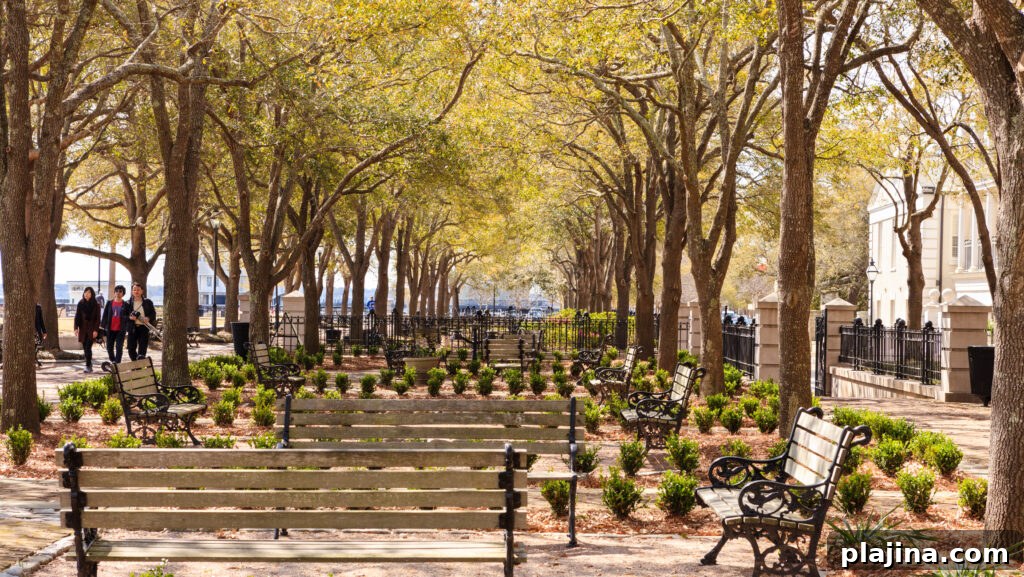
The distinctive architecture of Charleston’s waterfront Historic District is a perfect backdrop for the kind of warm Southern hospitality that draws visitors from across the country. But beyond elegant hotels and well-mannered service, Charleston offers abundant natural attractions. Before the pandemic, South Carolina’s largest city welcomed more than seven million visitors a year. Many arrive for cultural sites and historic streets, but the city’s 120 parks—together covering more than 1,800 acres of largely natural open space—are an increasingly important draw. As travelers discover Charleston’s wilder side, and as the city expands its parks program, visitation tied to outdoor recreation is likely to grow.
“Efforts to update and broaden parks around Charleston allow us to offer more diverse experiences for residents and visitors,” said Doug Warner, vice president of Media and Innovation at Explore Charleston. “The Charleston area is a year-round destination, and our numerous outdoor spaces offer residents and visitors an easy way to enjoy the natural beauty of our coastal location.” He noted that these spaces often host cultural and sporting events, markets and festivals, enhancing both daily life and the visitor experience.
© Cvandyke | Dreamstime.com
Renovations like those underway in North Charleston’s Park Circle will add more than traditional amenities such as sports fields and walking trails. Planned features include a performance and event space that will attract locals and tourists seeking unique, community-focused experiences. These upgrades are designed to make parks active hubs for gatherings, arts, and outdoor recreation.
Updating parks also reflects a modern approach to inclusivity and universal design. Park Circle will be home to the Southeast’s largest inclusive playground, scheduled to open in late 2023. The playground’s design encourages cross-generational play and accommodates people of diverse abilities and sensory needs. The Park Circle project represents a roughly $20 million investment in how the city envisions play and public life, and it is one of several park improvements planned across Charleston and the surrounding counties.
Parks also create opportunities to transform neglected or underused spaces. Inspired by projects like New York City’s High Line, Charleston is developing the Lowcountry Lowline, an ambitious linear-park project estimated at about $30 million. The Lowline aims to convert a former railway corridor into a 1.7-mile park that will provide recreation, safer walking and biking routes, and critical stormwater management for a city long challenged by coastal flooding.
The project has received significant municipal support and is envisioned as a multiphase, roughly 10-year effort. Megan Mills, project coordinator for Friends of the Lowcountry Lowline, explained that the Lowline “will mitigate stormwater flooding by finding ways to store and displace water from major flooding areas and will have ‘pocket parks’ that can be community gathering areas with programming that welcomes everyone.” By linking neighborhoods divided by I–26 since the 1960s, the corridor will offer safer commutes for residents, convenient routes for visitors heading to restaurants and attractions, and pleasant options for anyone exploring the city by foot or bicycle.
© Anthony Heflin | Dreamstime.com
SCENIC DRIVES
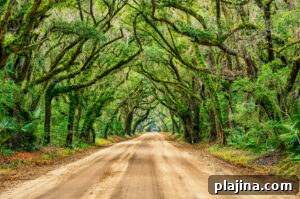
Just over an hour southwest of Charleston, Botany Bay Road offers one of the most memorable driving experiences in the region and makes an ideal half-day escape. This route runs through Botany Bay Plantation Heritage Preserve, a free state-managed park featuring a scenic three-mile loop. The drive is best known for its dramatic tunnel of mature live oaks and king sago palms that arch over a sandy road, creating a shaded, picturesque corridor—especially beautiful on sunny days. Note that the preserve is closed on Tuesdays.
Another must-see is the Angel Oak on Johns Island, one of the area’s most famous trees. Estimated at 400–600 years old, the Angel Oak’s canopy spans more than 17,000 square feet, with branches that extend as far as 187 feet. Less than a half-hour from downtown Charleston, the tree is accessible by several routes; choosing a drive that includes Bohicket Road offers extra scenic value. If you have time, explore more of the 10-mile Bohicket corridor to enjoy dense foliage and local charm.