
On a midsummer day, as the curtain fell on Indira Gandhi International Airport’s 24-year-old Terminal 2, passengers arriving on Air India Flight 102 became the first to enter the airport’s bold new Terminal 3. A water-jet salute highlighted the moment, celebrated by the people of India, the travel industry and more than 10,000 airport staff.
The inaugural flight arrived about 20 minutes late; the second, a Jet Airways service from Kathmandu, was on time. In the hour that followed, seven flights used the new terminal without major incident. Aerobridges, the food court and check-in all performed smoothly. A brief radar glitch and a few minor disruptions occurred, but overall the opening day for the nine-level, 5.4 million-square-foot integrated terminal was impressive.
By its fourth full month of operation in November, T3 had clearly become a realized vision for India and its capital.
Delhi had simply outgrown its previous capacity. Before T3, the airport could handle about 27 million passengers a year while annual traffic was rising by roughly 10 million passengers. Terminal 3 was designed to absorb growth through at least 2013, and plans for Terminal 4—on the site of the former T2—are already underway. Once both new terminals are operational, Indira Gandhi International Airport aims to serve up to 100 million passengers annually by 2036.
With T3’s opening, Indira Gandhi International became India’s largest airport in both scale and design. Official international operations began on July 15, followed by domestic services on July 30, making T3 the third world-class airport launch in the country after Hyderabad and Bangalore.
The project produced remarkable figures from the start. Thousands of tons of steel and concrete went into what is now the eighth-largest airport globally and the third-largest terminal in the world.
Construction drew talent and materials from across the globe: fabric from China and the United Kingdom, granite flooring from Bahrain, carpets from Britain and orchids from Thailand and Mexico. Workers from India and abroad collaborated on the build.
Flora is a defining feature. More than 300 plant and tree species thrive inside the terminal, and thousands more frame the exterior landscaping, creating a lush, welcoming environment.
Technologically, T3 is advanced. Its five-level in-line baggage handling system includes explosive-detection capability and processes luggage faster and more reliably than older systems. The fully automated system scans and moves over 12,000 bags per hour. More than 3,000 security cameras monitor the premises while 800 flight information displays with large LCD monitors present live updates. An expansive public address system with around 8,000 speakers ensures clear audio, and a master clock synchronizes all airport electronics for consistent timing.
Efficiency is central to the terminal’s design. One hundred sixty-eight check-in counters and 95 immigration and customs desks streamline passenger flow, minimizing wait times when paired with the advanced baggage system. A 4,300-capacity parking facility and an additional 2,200-space lot reduce congestion that once plagued the airport.
Major carriers, including Jet Airways and Air India, have established significant operations at T3, making it a key international hub. The terminal is capable of accommodating the world’s largest commercial airliner, the Airbus A380, which made its first visit on July 16 operated by Emirates.
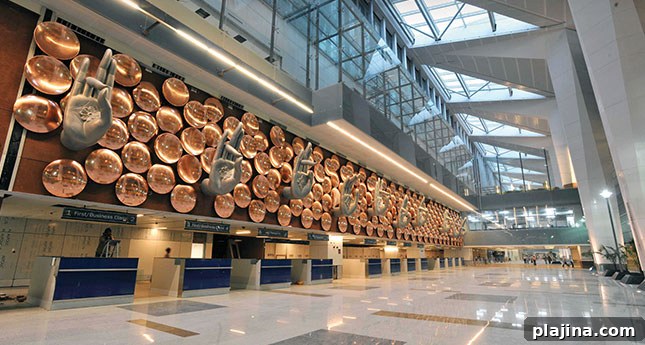
World-class shopping and dining are plentiful, but what sets T3 apart is its distinctly Indian character.
To showcase local culture, the airport commissioned Indian artists to create murals and sculptures throughout the terminal. At the international and domestic arrivals baggage area, Paresh Maity’s 80-foot oil-on-canvas mural, The Indian Odyssey, depicts the people, places and monuments of India. Another notable piece, the 62-foot mural Celebration, portrays music, dance and other cultural scenes and adorns the international arrivals area. In international departures, Satish Gupta’s 13-foot sculpture of Surya, the chief solar deity in Hinduism, greets passengers—reinforcing the terminal’s “Experience India” visual theme.
A 4,000-square-foot Indian bazaar gives arriving travelers a taste of New Delhi. Ten stalls offer handmade handicrafts, spiritual items, ethnic apparel, teas and spices. A smaller version is planned for the domestic departures area, further integrating local retail into the airport experience.
T3 also prompted infrastructure upgrades across New Delhi. In August, a dedicated three-lane road linking the Delhi-Gurgaon expressway to the airport opened, easing city traffic and offering toll-free access. By year’s end, a high-speed rail line connecting the city to the airport was scheduled for completion; trains running every 10 minutes will stop at New Delhi Railway Station, Shivaji Stadium, Dhaula Kuan and Terminal 3.
The arrival of T3 changed how travelers move through New Delhi and elevated the city’s global connectivity. For India, the terminal is more than infrastructure: it is an economic milestone and a welcoming ambassador for the growing numbers of international visitors.
T3 At A Glance
T3 is a nine-story, 5.4 million-square-foot facility.
The terminal can handle up to 34 million passengers annually.
An average of 60,000 domestic and international passengers pass through daily.
168 check-in counters and 95 immigration counters ensure efficient passenger flow.
T3 is equipped with eight passenger boarding bridges, the maximum number for a terminal of this size.
A five-level baggage handling system can process 12,800 bags per hour.
More than 70 escalators and walkways make navigating the terminal easy.
The terminal features the longest moving walkway in Asia.
Indira Gandhi International Airport is recognized as one of the world’s greener airports.
The retail area, Skyline Avenue, includes brands such as Marks & Spencer, Versace, Swarovski and Hugo Boss.
Barrier-free access facilitates mobility for passengers with disabilities.
On average, 95 percent of passengers wait 10 minutes or less at any airport counter.
Indira Gandhi International Airport ranks as the eighth-largest airport in the world.