
In one corner: the peregrine falcon, nature’s supreme athlete, capable of diving after prey at breathtaking speed. In the other: Joe Kittinger of Tampa, Fla., then 32 and now 82.
Which is faster?
It may surprise some, but the peregrine falcon—often cited by the Guinness Book of World Records as the fastest animal—is not the ultimate winner. The bird is constrained by terminal velocity: as its dive accelerates, air resistance builds, and once it reaches roughly 200 mph it cannot speed up further.
On August 16, 1960, Joe Kittinger used a different advantage. Jumping from a balloon at 102,800 feet, he fell through exceptionally thin air and reached 614 mph under the force of gravity alone. After more than 85,000 feet of freefall he deployed his parachute and landed in the New Mexico desert. His 13-minute, 45-second descent set multiple skydiving records—altitude, duration and speed—that remain remarkable decades later.
Skydiving, however, did not remain frozen in that moment. The sport has evolved dramatically since those early feats, shifting from a primarily military practice into a widely accessible recreational and competitive activity.
Parachute concepts date back centuries. Leonardo da Vinci sketched a wooden-framed design in 1485, and later innovators tested parachutes by throwing themselves from towers and cliffs, learning mostly through trial and error. The first documented parachute jump from a heavier-than-air craft occurred in 1797, when André-Jacques Garnerin leapt from a hot-air balloon and survived.
During the two world wars, parachuting techniques advanced rapidly as military aircraft reached higher altitudes and forced improvements in gear and procedures. High-altitude research by the U.S. Air Force eventually culminated in projects like Kittinger’s record-breaking fall from the edge of space.
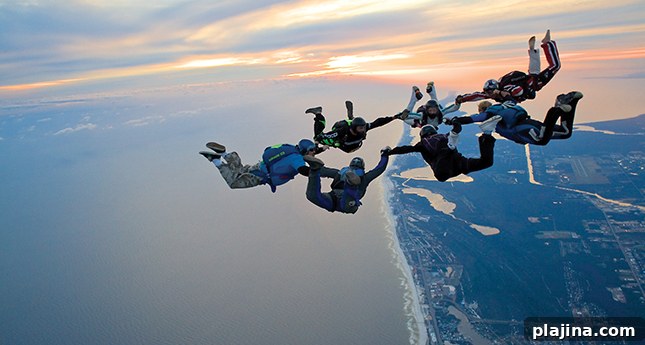
Today, most civilian skydives start from about 13,000 feet. Divers usually adopt a belly-to-earth position with arms and legs spread to stabilize and control their fall, achieving terminal speeds near 120 mph. Around 2,500 feet the jumper pulls the ripcord and the parachute opens—a moment that brings relief and control after the high-adrenaline freefall.
But modern skydiving is not limited to simply jumping and deploying a canopy. The sport now includes competitive disciplines that challenge precision, teamwork and creativity: formation skydiving, freefly, canopy piloting, accuracy landing and artistic routines all push participants to refine technique and equipment.
Beginners typically choose between two primary introductory methods. Static-line jumps are made from lower altitudes and rely on a line to deploy the parachute automatically moments after exit. Tandem jumps pair a novice with a trained instructor, who wears a two-person harness and controls the freefall and deployment, allowing newcomers to experience skydiving with guided reassurance.
Regardless of the chosen route, a first jump is a significant personal milestone. As the aircraft climbs, newcomers often turn quiet and pale, confronting the nervous energy that precedes leaping into open air. Stepping to the door and peering into the vast space below is an instant of intense focus and courage.
That mix of fear and exhilaration echoes what Kittinger felt before his historic plunge. When he stood at the open gate of his balloon gondola he noticed a plaque fixed to the floor by his teammates. Its simple inscription captures the poignancy of that moment and the experience of anyone poised at an aircraft doorway: “This is the highest step in the world.”