
In Zürich, much of the gold lies below ground in the vaults of the city’s major banks, but art fills the streets and public spaces — easily seen, often enticing, and impossible to ignore in places like the reception hall of the Park Hyatt Zürich.
On a gray March day, with snow on the roofs, swans on the lake and the scent of bratwurst drifting through the air, I stepped into the sleek, city-center five-star and stopped in my tracks. A massive mural dominated the far wall of the lobby: Irregular Wavy Colour Bands, an “ink wall drawing” by the late American minimalist Sol LeWitt, created on commission. A multilingual receptionist explained the piece with quiet pride.
The hotel showcased other significant works as well: another LeWitt by the entrance, a case of Murano glass in The Lounge, and a black-and-white piece by Chillida inside my sumptuous third-floor suite — just a few of the 91 originals displayed throughout. The Park Hyatt’s hotel-as-museum concept, present across its properties, suits Zürich in particular; the city’s cool, modern artistic identity feels right at home alongside luxury hospitality.
Zürich also claims a major place in art history: it was the birthplace of Dadaism, the anti-rational, anti-establishment movement that took shape during World War I. Though Dada’s heyday ended in the 1920s, its spirit is still accessible at the shabby-chic Cabaret Voltaire in the Altstadt (Old Town). There Tristan Tzara and others staged the first Dada performances amid a neighborhood now lined with quaint bars, boutique clothing shops, antique dealers and art galleries — and, somewhat ironically, one of the city’s many Starbucks.
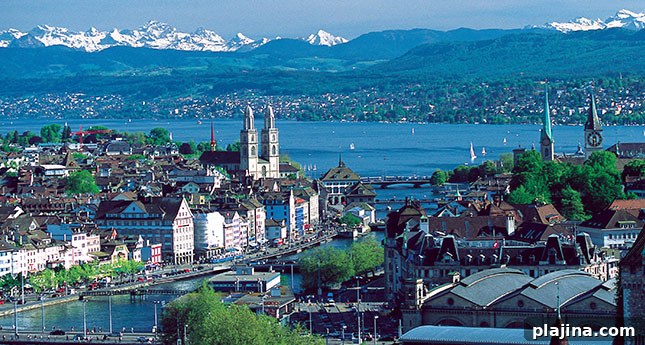
I had arrived by train, crossing the Alps on the Golden Pass Line from Geneva and enjoying panoramic views of pristine slopes. Even a day later, I found myself stopping to photograph mountain silhouettes during a walking tour of the Old Town. Zürich’s charm is inseparable from its backdrop of snowcapped peaks, vistas that make you wonder why you waited so long to visit and promise reasons to return.
One of the best vantage points is Lindenhof Hill, a raised terrace above the Limmat River where Romans once maintained a customs post. In warmer months locals gather to play chess beneath plane trees, and from this terrace you can easily see the Grossmünster across the way. The twin-towered Romanesque-Gothic church, associated with Charlemagne and later with the reformer Ulrich Zwingli, dates back to the 12th century. In 1525 Zwingli famously ordered Catholic statues removed and cast into the river after stripping them of jewels and valuables he then delivered to the town council.
>Zwingli’s actions unintentionally helped reshape Zürich’s future: as religious art was repurposed and ecclesiastical structures changed, the city gradually transformed into a financial center prized for secrecy and stability. Today Zürich marries postcard-pretty streets with a determined focus on money and banking, visible along the gilded Bahnhofstrasse. This thoroughfare runs from the Hauptbahnhof (main train station) to the Paradeplatz, once a medieval pig market and now the home base of UBS and Credit Suisse.
During my visit there was fresh news that UBS might disclose names of Americans suspected of using offshore accounts to evade taxes — a story suggesting the long era of secret Swiss banking could be changing. It cast a quiet shadow over the city even on a sunny day, the kind of development that would make bankers think twice before leaving home.
Just around the corner from banking headquarters sits a different Zürich institution: Confiserie Sprüngli, founded in 1859 at the corner of Paradeplatz and Bahnhofstrasse. The historic chocolatier offers display cases filled with Grand Cru truffles, marzipan fruits, pralines, raspberry carrés and an array of cakes and cookies. Its upstairs café invites leisurely indulgence — ideal as a prelude to an evening at one of Zürich’s acclaimed restaurants.
For contemporary dining and nightlife, head to Zürich West, a former industrial belt between the Limmat and the rail lines that has undergone a cultural revival since the early 2000s. Once-derelict factories have been converted into hip bars, restaurants and clubs, and the area has taken on an energy more reminiscent of Brooklyn or Berlin than of the city’s buttoned-down banking image. The old red-light district has been reshaped into streets of trendy cafés and creative venues.
Yet Zürich’s Old-World elegance remains intact. Few places capture that blend of history and refinement better than Hotel Baur au Lac, located just a short walk from the Park Hyatt. One of the city’s oldest luxury hotels, it boasts a private garden and commanding views of the lake, the mountains and the cityscape that ties together Zürich’s many contrasting strengths.