
We stand in the lobby of the Grand Hyatt Seoul, preparing to visit the lively downtown district of Myeong-dong. So why are we wearing hiking boots and carrying daypacks?
The taxi drivers know before we do. When we step outside, they do not rush over — one look at our gear tells them we won’t be taking the easy option. A taxi would have taken us to our destination in about 10 minutes, but we have chosen to walk. It is only three miles, with a single caveat: to get from here to there we must cross a mountain.
The Grand Hyatt sits on the southern slope of Mount Namsan. We cross a busy road into the Namsan Botanical Garden and begin a winding ascent. The city’s noise fades behind us. The dominant sounds now are the scuff of our boots and birdsong.
We are not alone. Power walkers and joggers overtake us. Chattering schoolchildren cluster at the edge of the path. Couples walk hand in hand, perhaps remembering a romantic scene filmed here — several Korean movies have used these settings.
The trail climbs, then broadens into a paved road. Ahead, the summit is topped by N Seoul Tower, the city’s premier observation point. We take the elevator to the viewing deck and are rewarded with an expansive view of Seoul.
At street level it is impossible to forget you are in a metropolis of 11 million people. Yet from this height a different truth emerges: Seoul is enclosed by nature, compressed within the granite embrace of dozens of mountains.
The Koreans themselves are full of contrasts. On the viewing deck they fiddle with the latest gadgets, pose for smartphone photos to send to friends, and take in the panorama while listening to music on their players. This tech obsession is expected. The other major passion — less obvious to outside visitors — is hiking.
That passion may stem from recent history. Until mid-20th century Korea was largely rural. Although most South Koreans now live in cities, many are only a generation or two removed from village life and maintain a strong bond with the countryside.
photo: Mark Zastrow
Escaping the urban rush doesn’t take long. Mount Namsan offers just a taste; for a more serious outing we take Line 3 on the Seoul Metro from downtown to Gupabal Station.
The subway carriage is packed with commuters in suits at the start. With each stop the mix changes: the office crowd disembarks and more hikers climb on. By our final stop we are shoulder to shoulder with people in outdoor gear.
We follow the flow to a shuttle bus that runs to Bukhansan National Park. At the trailhead the two modern Korean obsessions — hiking and consumer choice — meet: a shopping complex offers everything a fashion- or safety-conscious hiker could want.
With about 5 million visitors annually, Bukhansan is listed as the world’s most visited national park per unit area. At the busy entrance it’s easy to doubt you’ll find solitude. Yet the park’s size and range — it includes two mountain ranges, Bukhansan and Dobongsan — mean quiet is possible if you push beyond the well-trodden paths.
Our goal is Baegundae, the 2,742-foot high point of the Bukhansan massif and the highest peak in Seoul. At first we move with a long procession of hikers. As the trail rises and paths branch off, the crowds thin until, after a few hours, we find ourselves alone — a rare luxury in the city.
Paved walkways give way to rocky tracks, and many Korean hikers rely on two walking sticks to steady their pace. What started as a pleasant stroll turns into a genuine physical challenge.
Dense trees arch over the trail. Woodpeckers drum on trunks. Squirrels and chipmunks dart through the undergrowth. It is easy to imagine the tigers that once roamed these slopes, though they have long since vanished.
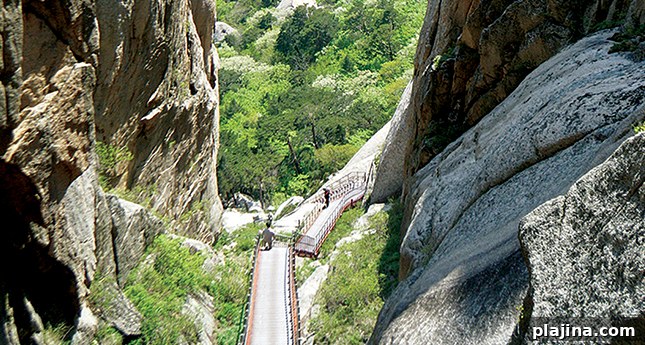
As we near the summit after a rewarding two-hour hike, trails converge and the crowds return. The final stretch climbs a bare granite face with guiding rails, and dozens of chatty climbers queue ahead of us, momentarily breaking the illusion of solitude.
At the top we take in the view. Seoul sprawls to the south; to the north, an unbroken sweep of forested mountains stretches toward the fortified border with North Korea. The spectacle is slightly muted by the chatter of fellow hikers, but the panorama is nonetheless impressive.
Bukhansan is an accessible introduction to Korean hiking, but for a more remote, wild experience you must travel beyond the metro’s reach.
Seoraksan National Park, one of the peninsula’s most beautiful regions, lies about a five-hour drive east of Seoul. It is a mountainous paradise of old-growth forest, sculpted granite spires, rocky streams, waterfalls and demanding summits.
The park is divided into distinct zones. Outer Seorak, near the port city of Sokcho, caters more to tourists with hotels, restaurants and visitor facilities for those who prefer their wilderness with conveniences. Inner Seorak is for serious hikers: trails climb high into the peaks with dramatic views down to the Sea of Japan, and dormitory-style shelters provide basic accommodation.
Hikers in Korea display a strong, welcoming camaraderie that extends to foreign visitors. Encounters on the trail are often warm and helpful — strangers look out for one another. Should you get lost or injured, many people will be willing to assist.
That camaraderie often culminates in lively evening gatherings at mountain shelters. Someone usually produces a bottle of soju, and hikers share shots until the bottle is empty.
A night of noisy celebration is a small price for the profound silence of the following morning. Early risers lift their heads before dawn to tackle the nearest peak in time for sunrise. The crisp light and clean air are the perfect remedy for any lingering effects of the night before.
On Mount Namsan there is no need for overnight shelters. From N Seoul Tower we begin an hour-long descent, mostly down stone steps. Cable cars glide above, offering tourists an effortless way to reach the summit.
From the top downtown Seoul looks miniature beneath us. We peer down on skyscraper roofs and gradually descend to the level of the highest floors. The remainder of the slope leads back to street level.
We arrive with a refreshed perspective. The buildings seem less imposing; traffic feels less suffocating. Looking at our mud-speckled boots, we remember that even in the heart of one of the world’s largest cities a timeless, relatively peaceful wilderness is often just a short walk away.
Info To Go
Incheon International Airport (ICN) lies about 43 miles west of central Seoul. Day trips to Bukhansan National Park from the city are straightforward using the Metro and shuttle buses. Seoraksan National Park offers a wide range of accommodations, from luxury hotels to simple mountain shelters (often inexpensive, with basic dormitory beds available).