
For music lovers visiting Düsseldorf, Germany, there is a rich cultural scene, from the Mitsubishi Electric Halle and the multi-purpose Merkur Spiel-Arena to intimate venues like Jazz Schmiede. Opera and ballet fans currently share performances between two nearby houses: the Theatre Duisburg and the Opernhaus Düsseldorf. But soon, one city will open a brand-new, modern opera house.
Opernhaus Düsseldorf, originally built in 1875, suffered wartime damage and was rebuilt, reopening in 1956. Located on Heinrich-Heine-Allee at the edge of the historic center and within walking distance of the Rhine promenade, the current Düsseldorf house seats 1,342. Theater Duisburg, completed in 1912, also endured war damage and was reconfigured and renovated in 1950; it seats 1,118 and remains a local landmark with a striking white façade evoking a classical temple.
Deutsche Oper am Rhein (German Opera on the Rhine), founded in 1956, is a joint company based in both Düsseldorf and Duisburg. Over decades it has grown into one of Germany’s most productive opera organizations, maintaining a high-quality ensemble, a strong chorus, and the nationally and internationally recognized Ballet am Rhein. The combined program consistently attracts audiences for opera and dance from across Europe.
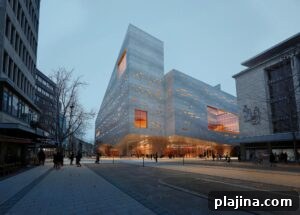
© MIR Snøhetta
Residents and visitors in Düsseldorf will soon have a contemporary opera house designed by the renowned Oslo/New York architecture firm Snøhetta. The proposed building introduces a cave-like ground floor that emphasizes visual and spatial transparency with generous glazing on all façades. This publicly accessible base will foster interaction between the opera and the city.
Snøhetta’s concept, unanimously chosen by a 25-member jury in the Opera House of the Future competition, divides the building into three asymmetrical, trapezium-shaped volumes connected by pathways across the ground floor. This layout allows daylight to penetrate deep into the public areas and encourages visitors to move freely through the space.
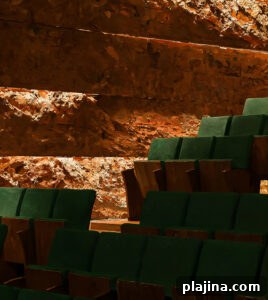
© MIR Snøhetta
The three-part silhouette represents the coming together of three institutions under one roof: the Deutsche Oper am Rhein, the Clara Schumann Music School, and the Music Library. The roof planes tilt in alternating directions, responding to the surrounding urban fabric while rising to announce the presence of the opera within the cityscape.
The Rhine serves as the central inspiration for the building. As the river has sculpted the Rhineland over millennia, shaping the terrain beneath Düsseldorf, the opera’s ground floor is conceived as an eroded cave—an organic, open space forming a new cultural arena. This carved design opens the building on all sides, creating generous connections to the urban environment and inviting the public to enter, linger, and engage.
“When designing the Düsseldorf Opera House, it was essential to us that this central building should not shut itself off from the city, but instead draw the public into the ground floor, creating a public forum where urban life can flow freely in and out,” said Kjetil Trædal Thorsen, a founding partner at Snøhetta. The firm envisions a large, open, and accessible space on the ground floor that stages a gradient from city to stage—rooms for encounters, rehearsal glimpses, informal performances, and moments of pause—so the opera becomes an integral part of everyday urban life rather than a standalone monument.
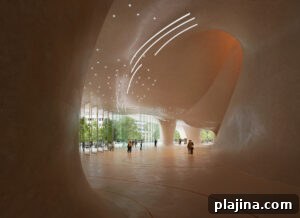
© MIR Snøhetta
“Just as the Oslo Opera House opened up to the fjord and invited people onto its roof, we envision this as a contemporary house that will embrace not only art, but also everyday encounters, conversations, and community,” Thorsen added. By integrating performance, education, and library functions, the building is designed to welcome users of all ages and become a genuine gathering place for Düsseldorf residents.
The façade is planned as a light-colored, rear-ventilated natural stone cladding that complements Düsseldorf’s existing palette while helping reduce summer heat and mitigate the urban heat island effect. Inside, the main auditorium is designed for visual and acoustic intimacy across approximately 1,300 seats, featuring smoked oak paneling and red seating that echo the color scheme of the existing house slated for demolition.
The project is scheduled for completion in early 2034, promising a new cultural landmark that connects architecture, community, and performance along the Rhine.