
Nearly two hours into our visit to Dublin’s Chester Beatty Library, I checked my watch, consulted our must-see list and realized we were behind schedule once more. “Decision time,” I told Jackie, my travel companion. “St. Patrick’s, the Marsh Library and Christ Church are nearby. If we skip the Storehouse, we might still see the jail, have tea at The Winding Stair and visit the Writers Museum.” It was ambitious — it was 2:30 and we hadn’t even had lunch.
We’d arrived in Dublin three days earlier and, despite battling jet lag, barely slowed down. Although I’d made nearly a dozen trips to Ireland, this was my first time in Dublin. Before our trip I researched extensively and reached out to friends for recommendations. Lorraine, a friend from the States, connected me via Facebook with her cousin Vivienne, who generously met us on our arrival day to share insider tips. We also booked a guided walking tour for our second day. After checking into the Westbury Hotel, the concierge suggested we begin with a stroll around St. Stephen’s Green.
Sweet, warm air greeted us as we entered the Victorian park at Fusiliers’ Arch and began exploring its paths and hidden corners. Dubliners on lunch breaks lounged in the sunlight by the pond, enjoying sandwiches and the pleasant weather. “It’s Dublin’s Central Park,” Jackie said. She paused at a memorial to Robert Emmet and asked, “Who’s he?” When I shrugged, a passerby offered a short explanation about the leader of the 1803 Irish Rebellion who was executed for high treason.
Hunger lured us from the park down Grafton Street, Dublin’s pedestrian thoroughfare, and into Davy Byrnes Pub. By chance we’d chosen the literary landmark where Leopold Bloom, James Joyce’s character in Ulysses, ate a gorgonzola sandwich. Joyce’s prose praises the bar’s handsome counter and craftsmanship; we appreciated both the atmosphere and the sandwich. The pub’s literary history sharpened our appetite for more literary sites.
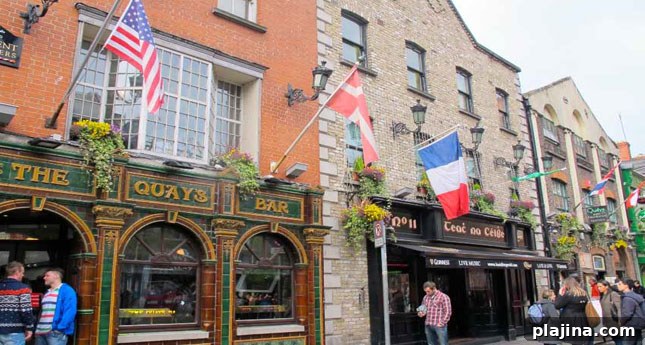
Armed with a city map, we wandered the narrow, cobbled lanes of Temple Bar, a medieval quarter where Handel’s Messiah premiered in 1742. Today Temple Bar is known for cultural venues and lively pubs, often bustling with visitors. Live music drew us into Oliver St. John Gogarty Pub, where Jackie picked up a brochure advertising a literary pub crawl. “We have to do this,” she declared.
Put two writers in Dublin and they’ll chase the city’s literary landmarks — the libraries, plaques and haunts tied to Joyce, Swift, Wilde and Nobel laureates like Yeats, Shaw and Beckett. Our plan shifted from casual sightseeing to a literary quest after meeting Vivienne. On the way to the Shelbourne Hotel for tea, she guided us into the National Library. “I used to come here every week as a child with my father,” she said as we climbed the stairs to the Reading Room. I was struck speechless by the horseshoe-shaped room with its cherub frieze and nearly 50-foot domed ceiling. Vivienne lured us downstairs to a Yeats exhibit, and Jackie immediately lit up with the kind of excitement only a great writer’s collection can inspire. We planned to return and spend more time with the displays and videos drawn from the library’s family-donated collection.
A display at The National Library’s Yeats exhibit © Hilary Nangle
Over tea at the Shelbourne, our itinerary shifted further toward literary and historical highlights: the Guinness Storehouse (touristy but fun, with great views and a tasting), Christ Church (I was keen to see the food-vendor market), Kilmainham Gaol (a chilling but important visit) and the Book of Kells at Trinity College. Vivienne added more stops: the Marsh Library, attached to St. Patrick’s Cathedral and linked to Jonathan Swift, and the Chester Beatty Library, founded by a collector of Asian books and artifacts.
After a walking tour with guide Sean Finegan the next day, our list grew again. We’d seen the National Museum’s Celtic gold exhibit and wanted more time for the National Art Gallery. Sean encouraged a visit to Sweny’s Pharmacy, where the lemon soap mentioned in Ulysses is still sold, and pointed out Georgian townhouses on Merrion Square — No. 1 was Oscar Wilde’s home, No. 82 Yeats’s. He also recommended the Writers Museum and lunch or tea at The Winding Stair, conveniently located just across the Ha’penny Bridge.
We sketched a cram-it-all-in plan over a shared seafood platter at The Cliff Townhouse and, following the concierge’s tip, arrived early at Trinity College to see the Book of Kells in the Old Library before the tour buses. Founded in 1592, Trinity is one of the world’s oldest universities. What was meant to be a quick stop stretched longer as we read about the manuscript’s creation and history.
The smell of old books kept us rooted when the Kells exhibit emptied into the Long Room — a 40-foot-wide, 209-foot-long hall lined with busts of Homer, Plato, Aristotle and Swift. Clerks scrambled up spiral stairs to reach upper stacks while exhibits on rare books and printing drew us in. “We’ll make up for it at the Yeats exhibit,” Jackie said, though we both knew it might be optimistic.
After lingering over Yeats, we hurried to the Chester Beatty on the grounds of Dublin Castle. In “The Art of the Book” exhibition we admired rare books, scrolls and manuscripts from Asia, the Middle East, North Africa and Europe. Sir Alfred Chester Beatty selected pieces for their artistic merit: Egyptian books of the dead, elaborately illustrated Islamic manuscripts, Chinese jade books, Japanese picture scrolls and Old Master prints. Unlike the crowded Kells display, this exhibit felt intimate and we spent more time than planned appreciating each treasure.
St. Patrick’s Cathedral, dating to 1225 and the burial place of Jonathan Swift, provided peaceful music from a rehearsing boys’ choir as we explored. We then visited the Marsh Library, founded in 1701 and largely unchanged since its opening. More than 25,000 rare volumes sit on original oak bookcases, each with carved gables. The scent of centuries-old leather and the experience of trying a quill pen made the visit unforgettable.
Rushing to Christ Church Cathedral, we trimmed the list further, skipping the Guinness Storehouse and Kilmainham Gaol. In Christ Church’s 12th-century crypt we found a mummified cat and rat noted by Joyce in Finnegans Wake, and accepted that the Writers Museum would have to wait. Instead we toured Dublinia in the cathedral’s old synod hall — a survey of Viking Dublin that, despite some dated displays, brought that era to life. The climb to the 17th-century stone tower rewarded us with worthwhile views.
By the time we crossed the Ha’penny Bridge and peered into The Winding Stair, it was after 5 p.m. — too late for tea, too early for dinner. We wandered back toward the hotel through Temple Bar, exhausted but reluctant to abandon plans. Jackie suggested a quieter alternative: visit pubs with genuine literary history. We settled on The Duke, Neary’s, Davy Byrnes and McDaids.
Over pints of perfectly poured Guinness, as artful as any prized book in Dublin, we toasted what we’d seen rather than what we’d missed. “We’ll come back,” I said. “For a week,” Jackie replied. Seeing how easily our list expanded and how long we lingered at each stop, I suggested, “Better make it two.”
INFO TO GO
International flights arrive at Dublin Airport (DUB). A taxi to the city center generally costs about $26–40. City Sightseeing Dublin’s Hop-on Hop-off bus (around $24) makes getting around easy; an airport-transfer combo ticket (about $32) includes transport from the airport and a two-day city tour.
Where to Stay in Dublin
The Cliff Townhouse Housed in a late-17th-century townhouse, this nine-room property blends Georgian style with contemporary touches, featuring Irish linens and Donegal tweed blankets. 22 St. Stephen’s Green $$–$$$
The Shelbourne Dublin The 265-room Shelbourne is an elegant, historic 5-star hotel where the Irish Constitution was drafted in 1922; it offers refined service and a genealogy butler. 27 St. Stephen’s Green $$$–$$$$
The Westbury Hotel A Leading Hotels of the World member, this 205-room 5-star hotel mixes contemporary décor with a notable art collection and sits just off Grafton Street. Grafton Street $$$–$$$$
Restaurants in Dublin
The Cliff Townhouse Modern Irish cuisine with an emphasis on fresh seafood is served in an Art Deco-accented Georgian dining room with an oyster and Champagne bar overlooking St. Stephen’s Green. 22 St. Stephen’s Green $$$–$$$$
Davy Byrnes Pub Celebrate Leopold Bloom and enjoy traditional pub fare and fresh seafood at one of Dublin’s most famous literary pubs. 21 Duke St. $$
The Winding Stair Named after a Yeats poem, The Winding Stair sits above the bookstore of the same name, overlooks the River Liffey and serves dishes made from artisan producers. 40 Lower Ormond Quay $$–$$$