Egypt is a land where time feels layered and vast. While the 2011 uprising is a recent chapter, the monuments of the pharaohs and the slow flow of the Nile remind you that this country’s rhythms extend far beyond modern headlines. The Sahara’s dunes continue their subtle, ancient shifts, and visiting here puts contemporary turbulence into perspective.
Travel in Egypt forces you to recalibrate your sense of scale. The country’s history and landscapes are older and broader than you can easily imagine. The familiar must-see sites are just an introduction; the real sense of place comes when you leave the main routes and travel into the desert hinterland.
One long day we drove southwest from the Mediterranean toward the Libyan border, crossing a flat, featureless expanse. The monotony raises the obvious question: what makes this journey worth the hours in a hot SUV? Desert travelers past and present—Alexander the Great and Cleopatra among them—must have asked the same.
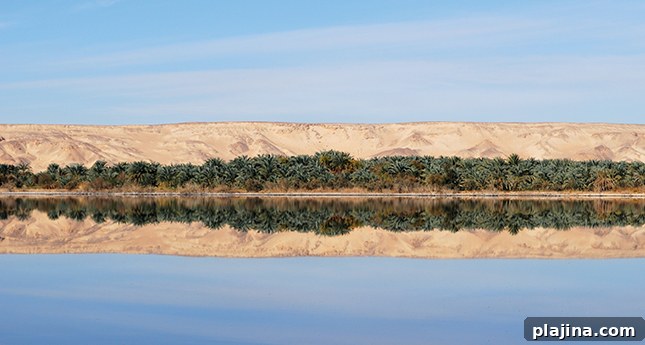
The view remained unrelenting until late afternoon, when the horizon softened and the endless yellow sand gave way to an unexpected band of greenery surrounding a shining sheet of water. That sudden flash of life—the first sight of Siwa Oasis—made every mile worthwhile.
Siwa is the best-known of five major oases in Egypt’s Western Desert and a gateway to the country’s remarkable interior. More than a biological refuge, Siwa is a cultural island with its own language, Siwi, and distinct customs. The local population largely descends from Berber nomads who settled here long ago, though human presence in the area goes back far further: in 2007 the oldest known human footprint—about three million years old—was discovered nearby.
In the morning we explored palm groves in a donkey-drawn cart, a gentle and timeless way to travel. Under dappled shade and the steady sway of the cart, the outside world felt very distant. In the center of Siwa stand the ruins of Shali, a 13th-century fortified settlement built of mud that the weather has slowly eroded—an emblem of how fragile human habitations can be in a harsh desert environment.
By midday the heat pressed down and we cooled off at the town’s best-known spring, Cleopatra’s Bath. Siwa’s many pools—some fed by hot springs, others by cold—offer welcome relief. The warm, crystal-clear water is soothing; soon, local boys turn the pool into their playful domain with splashy dives, and we made way for them to enjoy the water.
After lunch we drove out of the oasis into the wider Sahara, which reveals itself as a mosaic of landscapes rather than a single uniform desert. South of Siwa lies the Great Sand Sea: vast dunes running across an area the size of New Mexico. We skirted its edges, watching the rolling sand and, at sunset, climbed a high dune to watch the sky change, then camped beneath a canopy of stars before setting off again at dawn along an off-road route.
We paused at Farafra Oasis and then entered the White Desert, where bleached, sculpted chalk formations create a bright, surreal terrain that seems almost otherworldly. A few hours later the landscape shifted again to the Black Desert, where dark, cone-shaped hills give the impression of a planet in miniature—one companion quipped that it felt like Mars.
After several days in these remote interiors, the transition back to Cairo is startling. In a short distance the desert highway drops you into the dense suburbs and then into the city’s constant traffic along the Nile. The serenity of the interior feels suddenly far away.
The Nile remains Egypt’s lifeblood, shaping the fertile floodplains that supported one of the world’s earliest civilizations. Scattered along its banks are the material traces of the pharaohs. The Egyptian Museum at Tahrir Square helps put modern politics in perspective by displaying artifacts spanning seven millennia. But the past is more visceral at the Giza plateau, where you can crawl into the burial chamber of Khafre’s Pyramid—an intense, claustrophobic experience that contrasts sharply with the sweeping, postcard view of the pyramids and the Sphinx outside.
From Cairo we flew to Luxor, often called the world’s greatest open-air museum. Temples, colossal statues, obelisks and tombs stretch along both banks of the Nile; many sites have stood for close to 4,000 years. Popular highlights include Karnak, Luxor Temple, Hatshepsut’s temple and the Valley of the Kings, the royal necropolis that includes Tutankhamen’s tomb. The abundance of sites means one must choose thoughtfully—Luxor rewards time and patience.
To finish our trip we took a short flight across the Red Sea to the Sinai Peninsula and the resort town of Sharm el Sheikh. For many European visitors Sharm represents Egypt: polished resorts, nightlife and water sports. Yet the country’s diversity—desert interiors, ancient sites and the Mediterranean coast—means there is far more to discover than the standard beach holiday suggests.
DIVERSIONS
Egypt holds many lesser-known treasures beyond its headline attractions. The Mediterranean coast, long overlooked by mass tourism, is gaining attention. Mersa Matruh is emerging as a coastal resort with white-sand beaches and growing hotel options; it also played a role in World War II, and local caves once used by Field Marshal Rommel are preserved as a museum.
Mersa Matruh is a convenient jumping-off point for expeditions inland to Siwa Oasis, about 183 miles from the coast. Alexander the Great famously traveled to Siwa to consult the Oracle of Amun—ruins of the Temple of the Oracle lie three miles east of the town. Deep desert safaris are best undertaken with specialist operators experienced in the region’s challenges and hazards.
Cairo can be a cultural shock: modern and medieval life coexist vividly in a dense urban landscape. For a full taste of local life, explore the time-worn alleys of Khan el-Khalili market and climb the ramparts of the Cairo Citadel for sweeping views of the city. The Pyramids of Giza remain a must-see day trip, and nearby archaeological sites, including the ruins of ancient Memphis, add depth to a visitor’s understanding of Egypt’s long history.
In Luxor, don’t miss attractions beyond the best-known temples: the Mummification Museum, for example, explains the funeral rites and techniques that sustained Egyptian beliefs about the afterlife. In the Sinai, Sharm el Sheikh offers both Red Sea diving and inland heritage: Mount Sinai and St. Catherine’s Monastery are important spiritual and historic sites that supplement the beach resort experience.
Info To GoCairo International Airport (CAI) is the main gateway with direct flights from the United States to Cairo. There are regular direct services from many European hubs to Luxor International Airport (LXR) and Sharm el Sheikh International Airport (SSH). Flight schedules and carrier options change seasonally, so check current timetables when planning travel. NOTE: Security conditions fluctuate. Travelers should consult their government travel advisories and monitor local guidance when planning trips to Egypt. |
LodgingADRÈRE AMELLAL DESERT ECOLODGEOverlooking a secluded oasis near Siwa, this luxury desert lodge operates without electricity; 40 traditionally built guestrooms are lit by beeswax candles. Sidi Jafaar, Siwa. MENA HOUSE OBEROIFamous for its location beside the Great Pyramids of Giza, this historic hotel offers pyramid-view rooms and an atmospheric setting close to the archaeological sites. Pyramids’ Road, Giza, Cairo. SOFITEL WINTER PALACE LUXORAgatha Christie’s preferred hotel in Luxor, the Winter Palace overlooks the Nile and evokes colonial-era elegance. Corniche el Nile Street, Luxor. FOUR SEASONS RESORT, SHARM EL SHEIKHA lavish resort on the Red Sea with extensive leisure facilities and a well-regarded spa. Ideal for travelers seeking comfort after inland exploration. 1 Four Seasons Blvd., Sharm el Sheikh. |
DiningAL BAB INSHAL RESTAURANTPerched on the roof of the Al Bab Inshal Hotel near the Shali fortress, this restaurant serves excellent food with an atmospheric panorama of Siwa. Midan el Souk, Siwa. EL-FANAR |