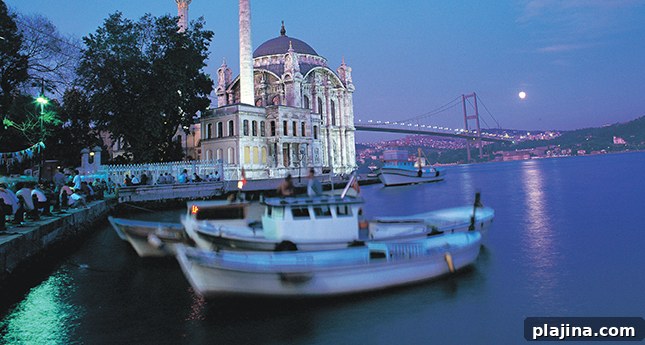
In the era when travelers approached great port cities by sea, Istanbul—straddling the Bosporus Strait between two continents—must have appeared utterly enchanting. It still does. Domed buildings and slender minarets cascade down the city’s hills, and stately Ottoman palaces press to the water’s edge, framing the famed harbor known as the Golden Horn.
Today most international visitors arrive by air, speeding from Atatürk International Airport along modern motorways toward the center. Their first views often include hastily constructed suburbs that helped the metropolitan population grow from 2.8 million in 1980 to nearly 13 million today, making Istanbul Turkey’s most populous city. Those suburbs give way to upscale neighborhoods, then to glass-and-steel towers of condominium and office complexes. Although Istanbul ceased to be the political capital nearly a century ago, it remains Turkey’s economic heart, producing roughly one-fifth of national GDP and handling the majority of the country’s imports and exports.
Mustafa Kemal Atatürk founded the Republic of Turkey in 1923 as a secular, parliamentary state and moved the political capital to Ankara the same year. He associated the city then called Constantinople—named for the fourth-century emperor Constantine, who established his seat there—with the Ottoman sultans’ decadence and the previous caliphate’s traditions. The Ottoman sultans had ruled from Constantinople for nearly 500 years after 1453. In 1930 Atatürk gave the city its modern name: Istanbul.
With political life centered in Ankara, Istanbul focuses on commerce and culture. The city markets its economic strengths to business executives while showcasing Greek, Roman, Byzantine and Ottoman monuments to visitors. Most foreign travelers enter Turkey through Istanbul, one of the Mediterranean’s busiest cruise ports. The port handles textiles, clothing and tobacco exports while receiving machinery, chemicals and transport equipment. Despite global ups and downs, Turkey has attracted substantial foreign direct investment in recent decades, with Istanbul receiving a large share. Major multinational companies maintain offices here, contributing to a dynamic business environment.
Prosperous districts such as Nişantaşı and the modern Levent financial quarter are dotted with elegant shops, and contemporary shopping centers have opened across the city, including high-profile mixed-use complexes. From the ancient hills that overlook 21st-century shipping lanes, visitors can watch oil tankers and container ships threading the Bosporus—continuously moving between the Black Sea and the Sea of Marmara en route to the Mediterranean. Istanbul continues to expand its infrastructure: the metro network has grown in recent years, and ambitious projects such as rail tunnels beneath the Bosporus are underway to improve connections between the European and Asian sides.
Since Atatürk’s era, Turkey has pursued modernization, and Istanbul is the country’s most modern and cosmopolitan city. Turkey is a WTO and NATO member and has sought closer integration with Europe, working to align laws and policies with EU standards. Geographically, about three percent of Turkey’s landmass and roughly 70 percent of Istanbul lie on the European side of the Bosporus, with the remainder in Asia, giving the city a rare transcontinental character.
Locals are generally courteous and welcoming, and Istanbul’s cosmopolitan atmosphere is reflected in its lively street life. Petty crime—pickpocketing and occasional taxi scams—can affect tourists in busy areas such as Taksim Square and the Grand Bazaar. Use licensed yellow cabs and insist the meter is used. Major hotels maintain security at entrances, and central avenues are usually safe, with outdoor activity continuing late into the evening, especially during summer months.
Istanbul is often compared to Rome for its depth of antiquities, and its monuments justify that reputation. The Hagia Sophia is unmatched in its monumentality: built in 537 as a Christian cathedral, converted into a mosque after the Ottoman conquest, and now preserved as a state museum. Ongoing restoration work reveals mosaics and calligraphy while preserving the building’s vast interior and dramatic dome. Nearby in the historic Sultanahmet quarter stands the Blue Mosque, completed in 1616 by the architect Sedefkâr Mehmet Ağa. Though intended to rival the Hagia Sophia, the Blue Mosque remains a distinct masterpiece—lavishly tiled, softly carpeted and illuminated by chandeliers and stained glass.
Other essential sites include the sprawling Topkapı Palace Museum, the former residence of Ottoman sultans for four centuries, and the Basilica Cistern, an atmospheric Roman-era underground reservoir supported by columns and featuring sculptural details that recall the city’s long history.
Shopping in Istanbul ranges from modern malls to centuries-old covered markets. The Kanyon and other contemporary centers host international brands and upscale boutiques, while the labyrinthine Grand Bazaar and the Egyptian Spice Market offer traditional shopping experiences—sweets like Turkish delight, spices, textiles and handicrafts. Contemporary art galleries cluster around İstiklal Avenue and adjacent streets, where Art Nouveau architecture blends with vibrant cultural offerings.
Info to Go
Atatürk International Airport (IST) is about 14 miles from the European side of the city and features an international terminal. Short-term U.S. visitors require a visa, available on arrival in many cases. Taxis to the city center typically cost more during busy periods and take 30–75 minutes depending on traffic; the metro also links the airport to parts of the city and is a reliable option. Visitors should check official sources for the latest entry and transport information.
Diversions
Many locals and visitors say the best way to see Istanbul is from the water, especially at dusk. Ferries and private Bosporus cruises depart from docks such as Eminönü beside the Golden Horn. Options range from larger tourist boats with dining and entertainment to municipal ferries that stop at multiple points along the route, allowing you to disembark and explore waterfront neighborhoods and seafood restaurants.
A short, 90-minute Bosporus cruise gives a concentrated view of the city’s skyline, revealing shores, palaces and bridges that are less visible from land. Evening cruises are particularly memorable as lights along the Bosporus and the bridges come alive, casting a warm glow on the water and highlighting the city’s layered silhouettes.
Lodging
Conrad Istanbul
A long-standing favorite for business travelers, this five-star hotel offers a full-service business center and views of the Bosporus. Cihannuma Mahallesi, Saray Caddesi 5, Beşiktaş, tel 90 212 310 2525, $$$$
Park Hyatt Maçka Palas
Housed in a restored grand apartment building in the Nişantaşı district, this upscale hotel offers refined rooms and some suites with hammams (Turkish baths). Teşvikiye, Bronz Sokak 4, Şişli, tel 90 212 315 1234, $$$$
Pera Palace
Originally built in 1892 to serve Orient Express passengers, this historic hotel reopened after extensive renovation and retains old-world charm alongside modern comforts. Mesrutiyet Caddesi 52, Beyoğlu, tel 90 212 377 4000, $$$$
Dining
Corvus Wine & Bite
A stylish two-level wine bar and bistro pairing Turkish small plates with wines from the Corvus cellar. Şair Nedim Caddesi 5, tel 90 212 260 5470 $$
Pandeli Restaurant
A family-run institution above the entrance to the Egyptian Bazaar, known for traditional Turkish dishes and a selection of local and imported wines. Mısır Çarşısı 1, Eminönü, tel 90 212 527 3909 $$
The Prime
The Park Hyatt’s signature restaurant offers Western-style steaks and seafood alongside an impressive wine display. Park Hyatt Maçka Palas, Tesvikiye, Bronz Sokak 4, Şişli, tel 90 212 315 1234, $$$