
One of the first things an observant visitor will notice when comparing Tokyo and Osaka is how people use escalators: in Tokyo, commuters typically stand on the left so those in a hurry can pass on the right; in Osaka, people do the opposite and stand on the right. The origin of this left-right split is debated. One theory links it to the Edo period (1603–1867), when samurai in Edo (now Tokyo) reportedly kept to the left side of crowded streets to maintain quick access to their swords. Merchants in Osaka, by contrast, are said to have hugged the right side of the road near buildings and walls to protect valuables held in or near their right hands.
Another explanation offered is cultural distinction: Osakans may simply have adopted the opposite practice to distinguish themselves from Tokyoites.
Both theories are plausible. During the Edo period, Osaka was one of Japan’s most important castle towns and a bustling commercial center. As a major distribution hub for rice and goods destined for the shogunate in Edo, Osaka developed a distinct mercantile culture. At the same time, a long-standing rivalry between Osaka and Tokyo fuels regional differences in custom and identity.
Today Osaka, Japan’s third-largest city after Tokyo and Yokohama, remains a key industrial and business center for the Kansai region. Over the past two decades the city has shed much of its older, gritty image through urban renewal and striking contemporary architecture, especially around Osaka Station and the Tennoji/Abeno area. Attractions include Japan’s tallest building with an observation deck, the first Universal Studios in Asia, a world-class aquarium, and a restored Osaka Castle.
Reflecting its trading history, Osaka is home to many department stores, specialty shops and districts focused on specific goods—from electronics to kitchenware. Historically a food distribution hub, Osaka earned the nickname “Japan’s kitchen” and is celebrated for its culinary scene. Modern and stylish, the city retains deep ties to its merchant past.
Local residents are often described as hardworking, financially savvy, frank and outgoing. The region has produced many of Japan’s most popular comedians. Osakans take pride in a strong community feeling, even within a population of around 2.6 million, with many families tracing roots in the area over generations—unlike Tokyo, which is more of a national melting pot.
Named by The Economist in 2015 as one of the world’s safest cities, Osaka is a convenient choice for business travelers. Kansai International Airport offers services like rental mobile phones and free Wi-Fi and connects to central Osaka in about 40 to 60 minutes via the JR Airport Express Haruka or the private Nankai Line.
From Tokyo, the Shinkansen bullet train reaches Shin-Osaka Station in under three hours. Most travelers continue seven minutes on the Midosuji subway line to Umeda, adjacent to Osaka Station, where many quality hotels are located. Notable options include The Ritz-Carlton, Osaka, with classic décor, and the modern InterContinental Osaka, situated in the Grand Front Osaka complex. Grand Front Osaka played a major role in revitalizing the area and combines offices, residences, shops, restaurants, green space and corporate showrooms.
Four stops south on the Midosuji line is Namba, often regarded as the city’s heart. Swissôtel Nankai Osaka sits atop Namba Station, offering direct airport access and connections to nearby destinations such as Kyoto. Hotel New Otani Osaka, located in Osaka Business Park across the river from the park surrounding Osaka Castle, is another solid option. For dramatic skyline views, the Osaka Marriott Miyako Hotel occupies high floors of Abeno Harukas, Japan’s tallest building, and offers contemporary rooms overlooking the Kansai plain.
Many luxury hotels provide club floors with private concierge services and lounges serving complimentary breakfasts, afternoon tea and evening cocktails—useful for business breakfasts and meetings. Hotel restaurants also serve as reliable venues for client meals: Tavola 36 at Swissôtel Nankai offers elegant city views and an excellent buffet, while Live Kitchen COOKA at the Marriott Miyako provides a relaxed atmosphere and scenic panoramas.
For private business dining, hotels offer meeting rooms and private dining spaces. The Marriott Miyako has several rooms for up to ten guests, some with striking views, and Hotel New Otani features large conference facilities with views of Osaka Castle. La Baie at The Ritz-Carlton is widely regarded as one of the city’s best French restaurants. For a blend of Western and Japanese cuisine, Restaurant ZK on the 57th floor of the Marriott Miyako is popular for teppanyaki-style cooking performed tableside.
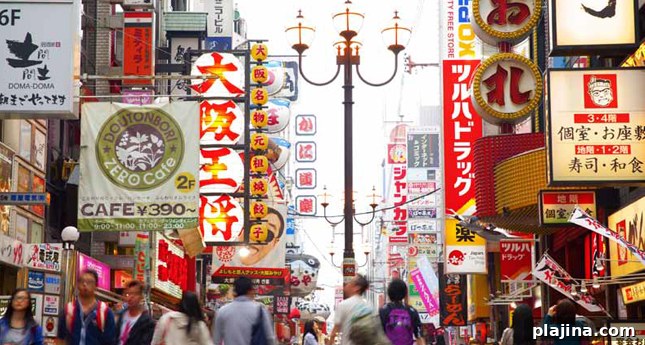
For after-work drinks, hotel bars like The Bar at The Ritz-Carlton, which stocks an extensive selection of malt whiskeys and presents live music, are excellent choices. But nightlife thrives most vividly in Dotonbori, a lively pedestrian area in Namba along the Dotonbori Canal. With a history spanning four centuries, Dotonbori pulses with bars, izakaya, restaurants and live music venues—Rug Time Osaka for nightly jazz and long-standing pubs such as Murphy’s Irish Pub being local favorites.
Getting around Osaka is easy via its efficient subway network and the JR Loop Line that circles central Osaka. Various transit passes offer unlimited travel within the city or across the broader Kansai region, including Kyoto. While commuting, you may notice another difference between Tokyo and Osaka: Tokyo riders tend to be quiet and reserved on trains, whereas Osakans are often more talkative and animated. And one final practical tip: when using escalators in Osaka, remember to stand on the right.