
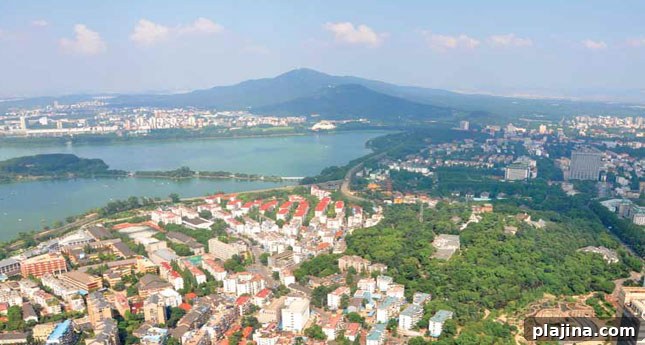
With China’s recent leadership transition now settled, cities across the country are reassessing their roles. Nanjing—often shortened to “Ning”—the capital of Jiangsu Province, recently ranked by Forbes among China’s top 10 business cities, is one such hub drawing attention.
Framed by peaks with names like Stone Mountain, Zhong Mountain and the evergreen-covered Mount Zijin (Purple Mountain), Nanjing spreads across the calm waters of Lake Xuanwu and Lake Mochou. Each natural landmark carries its own legends and history; for example, Lake Mochou is said to be named after Mo Chou, a talented singer-dancer who traveled far to marry there.
Location has long been one of Nanjing’s strengths. Positioned between Beijing and Shanghai, the city offers convenient connections by high-speed rail and air. The Shanghai–Nanjing route is among the world’s busiest, with trains departing frequently and completing the roughly 200-mile trip in under two hours.
Home to about 8 million people, Nanjing has a deep historical pedigree. It served as the capital for six dynasties and was the seat of the Republic of China in the early 20th century. Strategically situated inland along the Lower Yangtze River, the city benefits from protection from the east coast while tapping into the economic vitality of the Yangtze River Delta.
Nanjing city center © Wangkun Jia | Dreamstime.com
Translated as “southern capital,” Nanjing is a major production and commercial center. Its central location and expanding infrastructure—an extensive transportation network supported by modern technology—connect the city to national and international markets.
Covering roughly 2,500 square miles, Nanjing links the region to the rest of the country and is the second-most important international urban center in the Yangtze River Delta after Shanghai. Jiangsu Province’s economic strength is now considered second only to Guangdong.
Shipping is central to Nanjing’s economy. The Nanjing Port, regarded as the largest inland port in Asia, handles over 60 million tons annually and links to around 160 ports worldwide. The Yangtze River east of Nanjing can accommodate ocean-going vessels of up to 50,000 tons, making it well suited for heavy cargo transport.
Nanjing Yangtze River Bridge © Wangkun Jia | Dreamstime.com
Nanjing’s transport network supports rapid movement of goods and people. Major rail lines include the fast Beijing–Shanghai express and national links such as Nanjing–Wuhu and Lianyungang–Urumqi. Important bridge projects—like the Jiangyin Yangtze River Highway Bridge, once China’s longest suspension bridge, and the iconic Nanjing Yangtze River Bridge, a 1960s double-deck design built entirely with Chinese engineering—underscore the province’s infrastructure achievements.
Rapid urban expansion has also driven airport improvements. Nanjing Lukou International Airport added a second passenger terminal to meet growing demand. The airport currently serves millions of passengers annually, with forecasts expecting significant increases in the coming years.
According to trade and provincial statistics, Nanjing’s economy has seen strong growth. The city ranks among Jiangsu’s top economies and has reported robust year-over-year increases in gross domestic product and industrial output.
Nanjing is a major industrial and educational hub, attracting talent across China and beyond. The city hosts more than 40 universities, including the Hopkins-Nanjing Centre. Over two million residents hold post-secondary degrees, representing a significant share of the population and fueling innovation and skilled labor.
Since 1978, Jiangsu’s economic reforms have turned the province into a development powerhouse. Key sectors include petrochemicals, information technology, automotive, iron and steel, and power generation. In recent years, electronics and high-tech products have accounted for a large share of the province’s exports.
As an early IT pioneer, Nanjing hosts more than 800 software firms and offices of multinational companies. Telecommunications infrastructure is advanced, with extensive fiber-optic and microwave networks providing broad mobile coverage across the province.
Government stimulus has encouraged software parks and development zones, such as the Nanjing Software Park, Jiangsu Software Park and the Nanjing Jiangning Economic Technological Development Zone. These areas cluster industry, research, hospitals and hotels and are well connected by subway. Hundreds of international projects and major corporations have established operations here.
Cultural projects and arts institutions have also grown. The Jiangsu Art Museum, which opened with the inaugural Nanjing Biennale, has helped bring the local art scene to international attention.
Preparing to host the 2014 Youth Olympics, Nanjing has taken a pragmatic approach to event planning: reusing existing buildings, adapting infrastructure and minimizing extravagant new construction. Nevertheless, the city commissioned high-profile architects for key venues, including the Nanjing Youth Olympic Centre in Hexi New Town, an emerging central business district.
NANJING: JUST THE FACTS
Time Zone: GMT +8
Phone Code: Country code: 86 City code: 25
Currency: Chinese yuan (renminbi)
Entry/Exit Requirements: U.S. citizens need a passport valid for at least six months with one blank page and must obtain a visa before travel.
Official Language: Mandarin; English is increasingly common in business and tourist areas.
Key Industries: Electronics, automotive, steel, electrical equipment, chemicals
Checking in with Francis Yuk
Chief Representative in Asia for the International Apparel Federation
WHAT DOES NANJING OFFER BUSINESS TRAVELERS?
Nanjing is an important destination for both business and leisure travelers. Located in eastern-central China, it is about two hours by air from Hong Kong and one hour by high-speed train from Shanghai. As a designated business center, Nanjing provides professional translation services, international hotels, diverse dining options and a welcoming environment for international delegations. The city also hosts major industry events and conventions.
WHAT DO YOU RECOMMEND VISITORS SEE AND DO IN NANJING?
Nanjing is rich in culture and historic sites. Autumn (September–November) is the most pleasant season. Key attractions include the Mausoleum of Dr. Sun Yat-sen, the Ming City Wall built in the 14th century, and numerous relics from the city’s centuries as a political center. Exploring these landmarks reveals much about China’s past and the evolution of its modern identity.
WHAT ARE TWO THINGS YOU LOVE ABOUT THE CITY?
The city blends ancient history with modern urban life, and it offers excellent shopping. Visitors can experience traditional culture and find well-priced souvenirs within the same city.
HOW HAS NANJING CHANGED IN THE TIME YOU HAVE KNOWN IT?
In the 1950s, travel to Nanjing was slow and infrequent. Over decades, the city transformed dramatically—modern transportation, high-rise buildings, hotels and public services have replaced the more rural conditions of the past. Today Nanjing ranks among the most modern cities in China and Asia.
Restaurants in Nanjing
Crowne Plaza Nanjing Hotel & Suites Located in the Xinjiekou business and entertainment district, this 58-story landmark is a convenient base for meetings and sightseeing. 89 Hanzhong Road
Grand Metropark Hotel Nanjing Adjacent to the Nanjing Museum and well connected to major roads and subway lines, this hotel offers easy access to cultural sites. 319 E. Zhongshan Road
InterContinental Nanjing Occupying one of the city’s highest vantage points, the InterContinental is known for panoramic views and full-service luxury. 1 Zhong Yang Road
Where to Stay in Nanjing
Finnegan’s Wake Irish Pub A popular casual spot for Western-style burgers and pub fare. South Zhongshan Road No. 400 Cinnalane
Plum Garden Renowned for Jinling cuisine, especially duck and Huaiyang specialties. Jinling Hotel, Xin Jie Kou Square
Summit Restaurant Serving upscale Huaiyang cuisine with dramatic views of lakes and mountains. InterContinental Nanjing, 1 Zhong Yang Road, Gulou District
INFO TO GO
Nanjing Lukou International Airport (NKG) lies about 19 miles south of the city. A range of transfers connect the airport to downtown: hotel shuttles, public buses and taxis operate regularly. Transfer times and fares vary by service and destination.
Things to Do in Nanjing
Explore the Ming City Wall, one of China’s best-preserved ancient city walls, and visit the Ming City Gates. For natural scenery, visit the Zhongshan Hill Scenic Area in Zhongshan Mountain National Park and enjoy Plum Blossom Hill’s seasonal beauty.
The sacrificial hall of Dr. Sun Yat-sen’s Mausoleum © Jinfeng Zhang | Dreamstime.com
The Mausoleum of Dr. Sun Yat-sen draws many visitors to its award-winning architecture and dramatic stairway. The Ming Tomb at the base of Purple Mountain is one of China’s largest imperial tomb complexes, flanked by stone statues of lions, camels, horses and elephants. The restored Confucius Temple area offers riverside views, nightlife and a lively market. Yuejiang Tower overlooks the Yangtze River and provides access to numerous historic sites around the ancient Wanxian Pavilion.
Nanjing’s cultural offerings include cloud brocade, a traditional textile craft showcased at the Nanjing Museum of Cloud Brocade where craftsmen demonstrate techniques and sell samples. The Nanjing Museum houses a vast collection—hundreds of thousands of artifacts—that chronicles the region’s history and its role as an imperial and cultural center.