
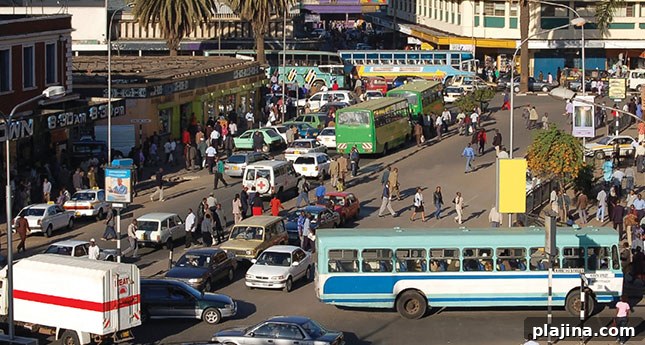
On my last trip to Nairobi in October, I found myself stuck in traffic on university graduation day, which coincided with a three-day holiday honoring Jomo Kenyatta, Kenya’s first president. The city, recently surpassing 3.5 million residents, can become gridlocked, and that day the streets resembled a parking lot. I stepped out of the taxi with a friend and walked back to our hotel. A graduate, noticing my American accent, stepped up and asked, “Obama did well on the last debate, don’t you agree?”
Obama fever has swept through Kenya as it has through the United States—understandable given his Kenyan heritage. Nairobi newcomers are often surprised by how readily strangers strike up intelligent conversations that can stretch late into the night over rounds of Tusker beer. Many first-time visitors arrive with outdated impressions of Nairobi as a dusty backwater rife with petty crime—a reputation that came from a wave of thefts in the late 1990s that earned the city the nickname “Nairobbery.”
Today, with the post-election violence of January 2007 behind it, Nairobi stands as a relatively safe, cosmopolitan hub of East Africa. That said, avoid walking through city parks at dusk and stick to major boulevards like Kenyatta Avenue, where imposing government buildings overlook planted medians and tree-lined sidewalks. You’ll pass a proud mix of people: migrants from rural regions, expatriates working in travel and finance, and long-established Indian Kenyan families whose ancestors helped build the railway. Each morning, workers emerge from informal settlements to walk to nearby factories and offices, blending with a growing middle class and affluent residents whose gated homes in suburbs such as Karen and Langata resemble those in upscale communities elsewhere.
To learn how Nairobi began, visit the Railway Museum on Station Road. In 1896 the British started building a line from Mombasa toward Uganda, a project nicknamed the “Lunatic Express” because construction was often interrupted by dangers such as drawn-to-the-train rhinos, man-eating lions (famously depicted in the film The Ghost and the Darkness), and masses of caterpillars that made tracks slippery. By the early 1900s Nairobi had become a regional center for the British Empire and was named the capital of East Africa by 1907. At the museum you can see the railway carriage used by Theodore Roosevelt during his 1908 African expedition and the carriage connected to the tragic death of builder Charles Ryall.
The Kenya National Museum on Museum Hill is another essential stop. Recently refurbished and reopened, the museum showcases the paleontological discoveries of Richard and Mary Leakey, who in the 1960s recovered bones and skulls near Lake Turkana that helped define the Great Rift Valley as a crucial site in human origins. The museum also features contemporary Kenyan art and displays related to natural history and culture.
For souvenirs and local crafts, head to City Market on Muindi Mbingu Street. Open daily, this market sells African masks, wood carvings and fresh fruit. If you want authentic Maasai beadwork and spears, visit the Maasai Market on Saturday morning in the parking lot adjacent to the Law Courts, where Maasai traders gather to sell their handmade goods.
Nairobi is more than a safari gateway; it offers several excellent wildlife experiences within or near the city. The David Sheldrick Wildlife Trust’s elephant orphanage in Langata cares for baby elephants orphaned by poaching. Keepers live on site and nurture the young animals until they’re ready to return to the wild. The orphanage is open daily from 11 a.m. to noon and provides a moving and educational visit.
Close by is Nairobi National Park, established in 1945 as Kenya’s first national park. The park’s grassy plains are home to lions, cheetahs, black rhinos, buffalo, giraffes, zebras and wildebeests, with Nairobi’s skyline visible on the horizon. Wildlife move in and out of the park seasonally, and visitors can enjoy game viewing without leaving the capital.
LODGING
FAIRMONT THE NORFOLK HOTEL
First opened in 1904, the Norfolk is a well-known colonial landmark that has hosted figures such as Theodore Roosevelt, Ernest Hemingway and Karen Blixen. Located across from the University of Nairobi near Kenyatta Avenue, the hotel has been refurbished by Fairmont Hotels and Resorts. Guestrooms feature updated beds, new carpeting, courtyard views, flat-screen TVs and modern showers. Several suites offer sitting areas and contemporary Kenyan art.$$$
FAIRMONT THE NORFOLK HOTEL
Harry Thuku Road
tel 254 20 221 6940
THE GIRAFFE MANOR
At the six-room Giraffe Manor, part of the Giraffe Centre grounds, you can wake to a giraffe peering into your window. Built in 1932 like a Scottish hunting lodge, the manor has views of the Ngong Hills, includes meals, and offers airport transfers for an additional charge.$$$
THE GIRAFFE MANOR
Koitobos Road
tel 254 20 891 078
HOUSE OF WAINE
Set on 2.5 acres of landscaped gardens, House of Waine is an intimate 11-room guest lodge. Rooms are individually decorated and feature internet access and marble bathrooms with abundant natural light. This family-owned property emphasizes gracious service, including traditional afternoon tea by the pool or on the terrace.$$$$
HOUSE OF WAINE
Masai Lane and Bogani Road
tel 254 20 891 820
DINING
THE CARNIVORE
A Nairobi institution, The Carnivore serves a wide variety of meats, carved Brazilian-style from large skewers. Expect beef, chicken, lamb and pork alongside more adventurous options such as ostrich and crocodile. The meal includes soup, bread, salad and dessert; diners eat as much as they like and signal they’re finished by lowering a flag at the table.$$
THE CARNIVORE
Langata Road
tel 254 20 605 9337
IBIS RESTAURANT
Located at the Norfolk Hotel, Ibis Restaurant emphasizes fresh, locally sourced ingredients. Executive Chef Abdalla Masoud maintains an on-site herb garden and collaborates with local farmers. Menu highlights include butternut squash soup, tender ostrich and a five-spice crème brûlée with cardamom and ginger.$$
IBIS RESTAURANT
Harry Thuku Road
tel 254 20 221 6940
TALISMAN
Situated in Karen, Talisman offers an eclectic mix of Indian and Middle Eastern flavors in a relaxed garden setting. Popular dishes include feta and coriander samosas, lamb kebabs and flavorful stir-fries.$$
TALISMAN
320 Ngong Road
tel 254 20 883 213
Diversions
The Karen suburb, about a 25-minute drive from central Nairobi, is named after author Karen Blixen (Isak Dinesen). Visit the Karen Blixen Museum, the author’s former home from 1913 to 1931, set on grounds dotted with candelabra cacti and offering sweeping views of the Ngong Hills. The house contains Blixen’s belongings and film props that recall her life and relationships in Kenya.
Near the elephant orphanage in Langata is the Giraffe Centre, established in 1979 to protect endangered Rothschild giraffes. Visitors can take nature walks and feed giraffes by hand—an unforgettable encounter.
INFO TO GO
Jomo Kenyatta International Airport (NBO), nine miles east of Nairobi, is the largest airport in East and Central Africa and provides connections to Europe, the Middle East, Asia and other African destinations. Transport services between the airport and city hotels start at about $20. Walking around Nairobi’s compact city center is usually straightforward, but in some neighborhoods it’s safer to take a taxi. Nairobi taxis typically have a yellow stripe along each side and are not metered; agree a fare with the driver before setting off. Large buses and matatus (minibuses) run on fixed routes across the city.