
Which important Spanish city in the Americas was destroyed by pirates? What is the Big Ditch? Where can you see more than 300 different bird species in a single day? Can you sleep inside a radar tower? Who discovered that yellow fever is transmitted by mosquitoes? How many people does it take to lift a cruise ship? What is Panamax?
Panama answers those questions and many more. During my visit to this remarkable Central American nation I often heard fellow travelers exclaim, “It’s like stepping into the Discovery Channel.” That sense of curiosity is easy to understand: Panama blends dramatic history, engineering feats and astonishing biodiversity in a compact, accessible setting.
I arrived on a Friday evening and drove into Panama City along the Corredor Sur, a toll road that crosses the swampy expanse of Panama Bay. Ahead, the downtown skyline glittered with glass and steel. More than 80 banks are based here, and for many people Panama is synonymous with offshore finance. My hotel room could have been anywhere in the world; it was only the next morning, when I opened the curtains, that the city’s distinct character emerged. Colorful buses decorated with murals rolled by. Gaudy tropical birds flitted among lush vegetation. Mist clung to the forested hills beyond the business district.
My guide met me in the lobby and said, “Today, we will begin at the beginning.” We drove east to Panama Viejo, the site of the original Panama city founded on the Pacific shore in 1519. For 150 years it prospered as the transfer point for gold and silver from Peru, and that wealth drew the attention of pirates. In 1671 the notorious Welsh privateer Henry Morgan led some 1,200 men overland from the Caribbean and sacked the city. Today only ruins remain: a crumbling four‑story bell tower beside the main plaza stands as stark evidence of the real danger and brutality of the era.
After that attack, the city was relocated and rebuilt within strong fortifications that form what is now Casco Viejo. With its 300‑year‑old houses and churches, shaded narrow streets and atmospheric plazas, Casco Viejo is the most evocative neighborhood in Panama City. Declared a UNESCO World Heritage site in 2003, it has been restored and revitalized while retaining its colonial charm.
In the heart of Casco Viejo stands an elegant colonial building that once housed Panama’s Grand Hotel and later served as the French canal company’s headquarters during the ill‑fated 1880 attempt to build a waterway between the oceans. Today this building contains the Panama Canal Museum, an excellent introduction to the country’s most famous engineering accomplishment.
The canal, popularly called the Big Ditch, reshaped global shipping when it opened in 1914. Museum maps make clear why engineers chose the route between Panama City and Colón: the isthmus narrows to about 48 miles, allowing builders to slice through hills and flood valleys to connect the Pacific and Atlantic. That narrowness also makes Panama a biological bridge between North and South America, producing extraordinary biodiversity.
On Pipeline Road, which runs roughly parallel to the canal through Soberanía National Park, birdwatchers once recorded 385 species in a single day — a world record. The Panama Rainforest Discovery Center, at the start of Pipeline Road, offers interpretive exhibits for visiting school groups and access to a 100‑foot observation tower that provides a panoramic view of the forest canopy.
Within Soberanía you can spot hummingbirds, toucans and eagles, and often howler monkeys and capuchins swinging through the trees. For children and adults curious about nature, the Panamanian rainforest is mesmerizing.
For a deeper forest experience, consider staying at the Canopy Tower, a converted 1960s U.S. Air Force radar facility turned eco‑lodge. The tower allows guests to observe wildlife from an elevated perch overlooking rainforest canopy and the steady procession of ships transiting the canal. Note that the lodge welcomes guests over the age of 13 and attracts dedicated birdwatchers who value quiet and focused observation.
The history of the canal’s construction reflects immense human cost and scientific progress. During the failed French effort more than 20,000 workers died, many from malaria and yellow fever. When the United States resumed the project in the early 20th century, U.S. Army physician Dr. Walter Reed demonstrated that yellow fever is transmitted by mosquitoes. A systematic mosquito control program eliminated the disease among workers and dramatically improved public health.
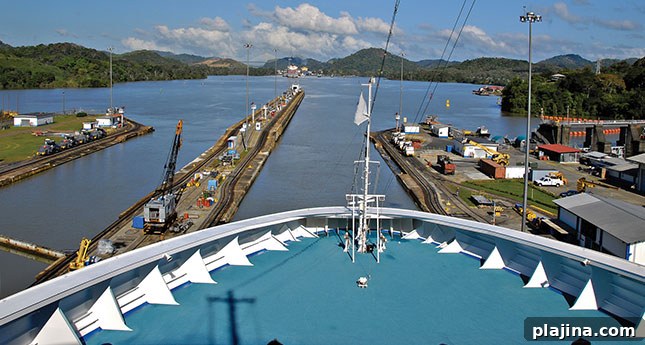
Engineers still faced daunting tasks: cutting a manmade canyon through the continental divide and building enormous locks at each end to raise and lower ships between sea level and the man‑made lake. At Miraflores Locks I watched massive vessels enter the lock chambers, guided by steel cables attached to locomotives called “mules.” Once a ship was positioned—sometimes with only inches to spare—six‑story gates sealed and 50 million gallons of water flowed into the chamber to raise the vessel.
From the lock control room a single operator can control the valves and mechanisms that lift a 50,000‑ton ship. Those locks define Panamax, the maximum ship dimensions that could transit the original canal. A major canal expansion, including a new, larger set of locks, was built to accommodate bigger vessels and has influenced ship design worldwide.
During my time in Panama I toured the ruins at Panama Viejo, scanned a dazzling variety of birds along Pipeline Road and stood within touching distance of a cruise ship being raised 54 feet at Miraflores. Each experience stirred the imagination. Whether visitors arrive with a technical curiosity about engineering or a childlike hunger for discovery, Panama delivers a mix of history, nature and ingenuity that consistently inspires wonder.
Info To Go
International flights arrive at Tocumen International Airport (PTY), about 15 miles east of Panama City. Taxis to downtown typically cost around $25 for one to two passengers, with approximately $10 for each additional passenger. Domestic and tourism information is available locally.
Lodging
Canopy Tower Ecolodge
View wildlife from rooms in this converted radar tower set in the jungle; guests are asked to maintain silence and calm. Apartado 0832‑2701 WTC, Panama City, tel 507 264 5720 $$$$
Country Inn & Suites Hotel
Spectacular views of the Panama Canal entrance and comfortable two‑room suites suitable for families; children under 12 stay free. Fort Amador, Panama City, tel 507 211 4500 $$
Gamboa Rainforest Resort
A luxurious family resort about 30 minutes from Panama City, set at the edge of Soberanía National Park and offering close encounters with rainforest wildlife. Tel 507 206 8888 $$$$
Dining
Los Lagartos Restaurant
A family‑friendly restaurant with verandas overlooking the Chagres River where it meets the canal—great for watching wildlife and passing ships. Gamboa Rainforest Resort, tel 507 314 5000 $$
Restaurante Miraflores
Located at the Miraflores Locks Visitors Center, the restaurant offers panoramic views of lock operations and ships transiting the canal. Clayton, Panama City, tel 507 232 3120 $$$
El Tambor de la Alegría
Known for nightly folkloric dance shows that invite patron participation—bring your dancing shoes. Brisas del Amador Shopping Mall, Panama City, tel 507 314 3360 $$