
IF YOU DECIDED TO BUILD a city for 16 million people, you probably wouldn’t choose swampy land beside a tropical coastal lagoon in West Africa. Yet Lagos (pronounced LAY-goss), Nigeria’s largest city, defied planners and politicians and grew into a vast, energetic metropolis.
Despite efforts to shift the nation’s administrative center—Abuja replaced Lagos as the capital in 1991—Lagos continues to expand and prosper. It is now one of Africa’s wealthiest cities, ranking behind Johannesburg, Cairo and Cape Town. That prosperity, however, sits alongside sharp contrasts.
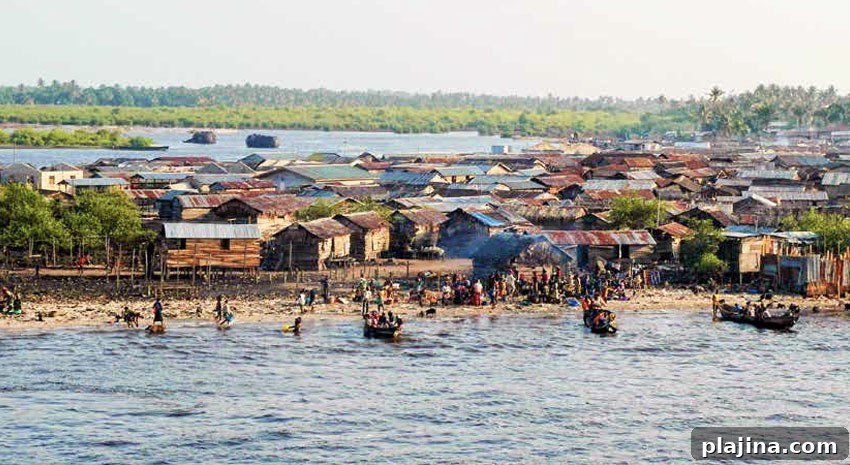
Much of Lagos is made up of dense, smoke-tinged informal settlements where around two-thirds of the population live. Makoko, one of the city’s most famous communities, spreads over the lagoon in a crowded tangle of wooden houses on stilts. The area looks precarious at first glance, with dwellings patched from corrugated iron and plastic sheeting and water that is often polluted.
At the same time, a dramatic, high-end development is rising on reclaimed land off Victoria Island. Eko Atlantic aims to house hundreds of thousands of residents and to present a skyline comparable to Dubai or Singapore. This project represents the aspirations of Lagos’s growing middle and upper classes, but it has also changed local coastal currents and increased the risk of ocean surges along other parts of the shoreline.
Which district best represents Lagos — ramshackle Makoko or futuristic Eko Atlantic? For many, the answer is clear: Makoko captures the city’s character. While Eko Atlantic symbolizes progress and aspiration, the majority of Lagosians live in informal neighborhoods and survive on daily resourcefulness rather than long-term security.
Makoko, despite its apparent hardships, is far from lifeless. Beneath the surface of poverty there is a vibrant and resilient community. Floating churches and schools provide gathering points and social structure, and small shops and services meet everyday needs. Canoes carved from dugout logs remain the main mode of transport through the water-bound lanes.
Accurate population figures are hard to pin down; some estimates suggest Makoko may house as many as 300,000 people. Whatever the exact number, the settlement’s residents demonstrate extraordinary adaptability and resourcefulness. Their daily efforts and community networks reflect the larger spirit of Lagos — a city of contrasts, improvisation and relentless energy.
In Lagos the future is being built alongside improvised lives. Eko Atlantic may point toward a modern skyline, but the heart of the city still beats in places like Makoko, where people make a life amid uncertainty and find ways to thrive together.