
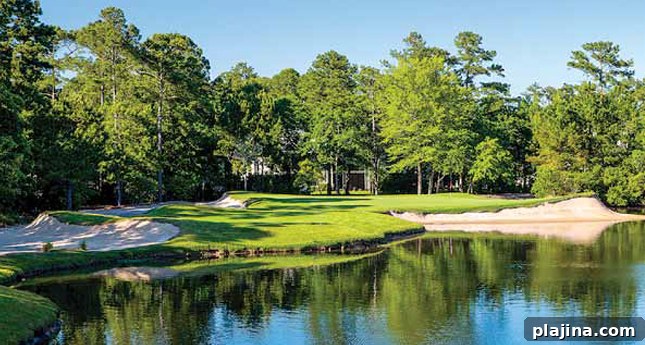
Golf outings to Myrtle Beach are a year-round tradition. With more than 200 sunny days annually and daytime winter temperatures that rarely fall below 50°F, the city offers excellent odds for an enjoyable golf getaway in any season.
The Grand Strand’s primary draw is 60 miles of wide, family-friendly beaches and the warm Southern hospitality found along U.S. 17, which parallels both the ocean and the Intracoastal Waterway. The area’s scale is impressive: roughly 425 hotels, 1,700 restaurants, 300 outlet stores, eight live theaters with more than 11,000 seats, about 100 golf courses and around 30 miniature golf venues.
While every warm-weather sport is practiced on the Strand, golf dominates — accounting for about 3.4 million rounds annually. Courses by renowned architects weave through lakes, marshes, oak and pine forests, and along former rice and indigo plantations. Many courses sit close together, making it common to play 36 holes in a day and refuel with Lowcountry cuisine in a clubhouse between rounds. With such a wide selection, players can find courses and packages to suit varying handicaps and budgets.
Golfers travel to Myrtle Beach from across the country. For example, Julie Johnson and Mark Fugett, who live near Milwaukee, Wisconsin, flew in to play 13 rounds in eight days. First-time visitors often return convinced they’ve discovered a true golf haven.
“We were fans of the Golf Channel’s Big Break Myrtle Beach,” says Johnson, “so we planned our trip at the Barefoot Resort & Golf Club, where the show was filmed. The contestants praised the four courses there, and staying on property felt ideal.” She adds that planning was straightforward: “After contacting Barefoot Golf Vacations and Myrtle Beach Golf Holidays, course information and tee times arrived quickly. The package was an excellent value, the accommodations were top-notch, and everything met our expectations.”
Johnson notes the convenience: “When you plan to play 36 holes a day, it’s great to have many course options without driving an hour between rounds.” Indeed, you can drive the length of the Strand in about an hour, and most courses are easily accessible from U.S. 17. Designers represented along the coast include Jack Nicklaus, Arnold Palmer, Robert Trent Jones, Rees Jones, Davis Love III, Tom Fazio, Greg Norman, Gary Player, Pete Dye and P.B. Dye. Though they worked with similar terrain, each produced a distinctive layout. Below are some of the area’s most popular courses.
THE DUNES GOLF & BEACH CLUB was created in 1948 by Robert Trent Jones and later renovated by his son, Rees Jones, preserving the course’s classic design. The Dunes has hosted PGA, LPGA, USGA and Champions Tour events and consistently ranks highly in golf publications. Greens tend to be large and elevated, with deep bunkers placed on slopes below the putting surfaces. The signature 13th hole, nicknamed “Waterloo,” is a par 5 that doglegs around Lake Singleton to a severely tiered green, often with alligators sunning on the banks.
Grande Dunes Golf Club © Founders Group International
GRANDE DUNES GOLF CLUB features a Roger Rulewich links-style design with seven holes playing along the Intracoastal Waterway and 34 acres of lakes influencing nearly every other hole. Water hazards are demanding, while fairways are generous and greens are fair. At 7,578 yards from the back tees, Grande Dunes ranks among the longest area courses, and ocean winds can affect play. The par-3 14th, played across a water-filled gully to a bunkered green above the Intracoastal, is a standout hole.
CALEDONIA GOLF & FISH CLUB welcomes golfers with a dramatic drive under live oaks draped in Spanish moss to a clubhouse evoking the Old South. Built on a former rice plantation, Caledonia is noted for its floral displays, forced carries and often small greens. The par-3 ninth requires a shot over a waste bunker to an elevated, shallow green, while the par-4 18th borders a former rice field and demands a tee shot that sets up a water carry to a shallow finishing green. Unique touches, like a cup of seafood gumbo at the turn, reinforce the course’s Lowcountry character.
TRUE BLUE GOLF CLUB, also designed by the late Mike Strantz, contrasts with neighboring Caledonia. Strantz evoked the feel of Pine Valley and Pinehurst No. 2 with wide fairways, sculpted greens and native grasses. Laid out on former rice and indigo lands, True Blue feels natural but features aggressive bunkering that can require steps. Notable holes include a par-3 island-style third and a finishing hole where the fairway wraps around water, demanding a bold tee shot.
Glen Dornoch Waterway Golf Links © Glen Dornoch
GLEN DORNOCH WATERWAY GOLF LINKS, designed by Clyde Johnson, uses natural 35-foot elevation changes to create a narrow, strategic course that navigates lakes, marshes and mature oaks, pines and magnolias. Several holes run along the Intracoastal Waterway. Deep, grass-faced pot bunkers provide challenge and character. The closing stretch is exciting: a marsh-crossing par-4 16th, a vegetation-encircled par-3 17th protected by a deep bunker and tree, and a par-4 18th with a lake guarding the front and right of a green that overlooks the Waterway.
TIDEWATER GOLF CLUB, a Ken Tomlinson design, occupies a hilly peninsula bordered by Cherry Grove saltwater marsh, an ocean inlet, and the Intracoastal Waterway. Wetlands, water features and large bunkers create a visually striking but demanding course that meanders through a community of impressive homes. The signature 12th hole is a par 3 played across a marsh and a string of bunkers to a green with the Waterway behind it, where wind and club selection become critical considerations.
BAREFOOT RESORT & GOLF CLUB includes four courses by Davis Love III, Tom Fazio, Greg Norman and Pete Dye. The Fazio and Dye layouts are among the toughest; the Love course is popular for its wide fairways and avoidable bunkers. The Norman course is sometimes criticized for visible housing but still provides an interesting challenge. Many visitors, including the Milwaukee couple mentioned earlier, favor the Dye Course for its visual drama and fun but demanding design. At over 7,300 yards from the back tees, the Dye Course features pot bunkers set into mounded faces and a memorable 471-yard par-4 finishing hole with water left and heavy bunkering right.
Myrtle Beach Info to Go
Myrtle Beach International Airport is located just a mile from the beach and serves numerous destinations. Regional airfields include Conway-Horry County Airport, Grand Strand Airport and Loris-Twin Cities Airport. Rental cars are widely available, and Interstates 95 and 20 connect to highways that lead to U.S. 17, the Grand Strand’s main thoroughfare.
Where to Stay in Myrtle Beach
Inlet Sports Lodge — This boutique property offers 34 deluxe studios and a pleasant courtyard. It sits near Murrells Inlet’s lively Marshwalk. 4600 Business Highway 17, Murrells Inlet $$$
Marina Inn at Grande Dunes — A centrally located resort with 200 guestrooms and suites, many with terraces overlooking the marina or Intracoastal Waterway. Golfers and boaters mingle at the marina’s Anchor Café. 8121 Amalfi Place, Myrtle Beach $$$
North Beach Plantation — On 7.5 acres, accommodations range from cottages to beachfront condos in 18-story towers, with easy access to pools, a spa, a restaurant and golf concierge services. 719 North Beach Blvd. Suite 3, North Myrtle Beach $$$
Restaurants in Myrtle Beach
Aspen Grille — Chef-owner Curry Martin blends influences from Paris and California with Carolina flavors. Standout dishes include seared sea scallops with wild mushroom risotto and fried spinach. 5101 N. Kings Highway, Myrtle Beach $$$
Bistro 217 — Known for dishes made from scratch and fresh seafood. The shrimp, scallops and grouper in basil-Parmesan cream sauce over fried eggplant is a favorite. 10707 Ocean Highway, Pawleys Island $$$$
New York Prime — While fresh fish is available, the restaurant is best known for USDA prime steaks and an extensive wine selection. 405 – 28th Ave. N., Myrtle Beach $$$$$