
What is that shade of blue? The unusual color catches my eye from the road, so I pull into a gravel lot for a closer look. Big as houses, icebergs float in a quiet lagoon, their iridescent hues reflected in still water. Are they turquoise? Aquamarine?
Much of what I saw in Iceland defies easy description. Its geological wonders stage a dramatic natural spectacle: boiling pools of mud, rivers of solid ice, steaming vents and black lava fields spilling from ice-capped volcanoes that could awaken at any time.
Icebergs floating in Jökulsárlón Lagoon © Alexey Stiop | Dreamstime.com
At Jökulsárlón Lagoon, though, everything feels calm. The only sounds are gulls crying and seals barking as they play at the water’s edge, tempting me to come closer. The ice is ancient—glacial remnants compressed over millennia that have calved into dense blue-green bergs. They melt slowly, sculpting curious shapes and revealing black streaks of volcanic ash and grit carried in the glaciers’ long journey toward the North Atlantic.
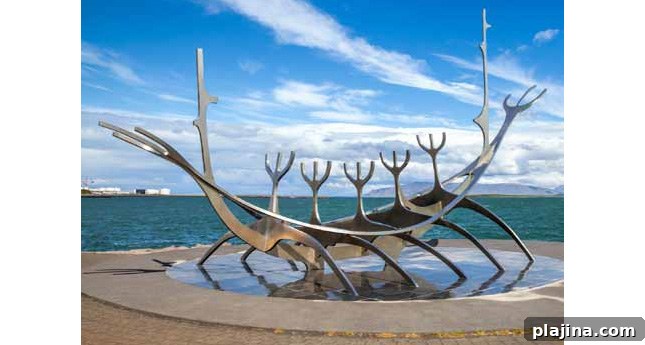
I arrived in Iceland for a conference in Reykjavik, Europe’s northernmost capital, and vowed to explore as much of the country as possible between meetings at the Hilton Reykjavik Nordica, one of the city’s largest convention hotels. Reykjavik itself blends modern design with deep-rooted history. The stainless-steel Sun Voyager sculpture on the waterfront evokes the seafaring Norse past, and a statue of Leif Eriksson in the plaza outside Hallgrímskirkja—gifted by the United States—commemorates the 1,000th anniversary of Iceland’s parliament, the world’s oldest. Inside Hallgrímskirkja, an elevator takes you up the tower for a sweeping view of the city.
Another vantage point is The Pearl, an unusual structure built atop hot-water tanks that regulate the city’s geothermal system. A revolving restaurant crowns the building and hosted one of my conference dinners. The glass façade of the Harpa Concert Hall and Conference Center lights up the waterfront at night with a striking honeycomb pattern.
A waterfall at Thingvellir National Park © Tomi Tenetz | Dreamstime.com
On a daytrip outside the city, I joined Reykjavik Excursions’ Golden Circle Tour, which covers three major sites. Thingvellir National Park, a UNESCO World Heritage site, was the original open-air meeting place of Iceland’s parliament. A rift valley cuts through the park where two tectonic plates move apart—one drifting toward Europe, the other toward North America—at a rate of about a third of an inch per year.
Geysir, with its steaming hot springs, boiling mud pots and geysers, shows the island’s geothermal energy up close. Our guide advised us to stand upwind of Strokkur and wait; after a few minutes a column of water and steam erupted skyward, reaching roughly 115 feet. The day ended at Gullfoss, a powerful waterfall that drops across a broad staircase of rock into a deep, dramatic gorge.
When the conference wrapped, my husband and I rented a car and began exploring Iceland’s Ring Road, Route 1, which encircles the island. Driving the entire 828-mile route would take at least a week, but with only four days available we focused on the scenic southern coast, staying at Icelandair Hotels along the way.
About the size of Kentucky, Iceland has roughly 320,000 residents, two-thirds of whom live in and around Reykjavik. Beyond the capital, the island remains sparsely populated, dotted with fishing villages and small hamlets nestled along fjords. The Ring Road connects these communities like links on a bracelet.
Often we had the road to ourselves. The two-lane highway is well maintained, but one-lane bridges, blind summits and the absence of shoulders keep drivers attentive. Headlights are required at all times and the speed limit is generally 55 mph. Gas stations are infrequent, many unmanned and requiring chip-and-PIN cards, so it’s important to monitor the fuel gauge.
Despite those cautions, driving was straightforward and we rarely needed GPS. Along the route we saw ice caps crowning the mountains and waterfalls spilling down cliffs. Beneath one ice cap lies Eyjafjallajökull, the volcano that erupted in 2010 and disrupted air traffic across Europe and the North Atlantic; today it sits quiet.
Hiking up the glacier at Skaftafell National Park © Meghan Crosno | Dreamstime.com
We detoured to Skógafoss, where a 200-foot cascade often produces a vivid double rainbow in the mist. Near the village of Vík, a black-sand beach meets jagged sea stacks, the surf thundering around them. Further along, expansive coal-black flood plains attest to eruptions beneath ice caps that unleashed torrents of meltwater toward the sea.
A hike in Skaftafell National Park brought us to the glacier’s edge. We walked carefully across hard ice and frozen river formations, mindful of the visitor center’s sobering exhibits that document the dangers of venturing too close to unstable ice.
As we prepared to return to Reykjavik, the blue ice at Jökulsárlón called to me once more. At the lagoon’s edge I picked up a jagged fragment of a berg and wondered how old it might be, how many centuries of pressure and cold shaped it on a journey through this dramatic land of fire and ice.
Iceland Info to Go
Keflavík International Airport serves Reykjavik and the region; Icelandair operates many flights to and from the airport. Flybus, run by Reykjavik Excursions, shuttles between the airport, the city bus terminal and hotels. Other transfer options include the Airport Express and metered taxis. Travelers should plan transfers in advance and be prepared for seasonal schedules and limited services outside the capital area.