
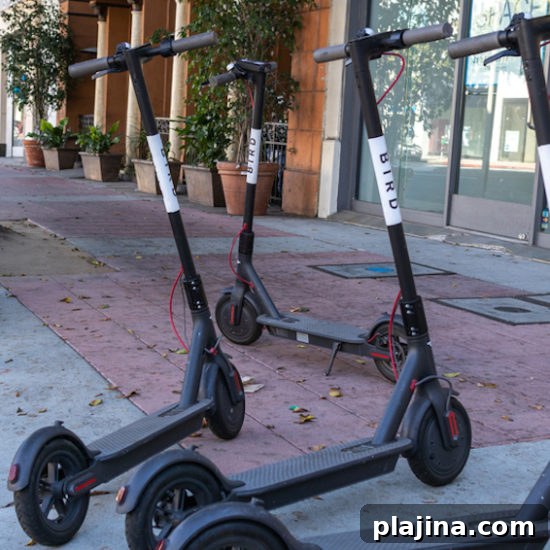
If you live in or have visited any of the 65 U.S. cities where public electric scooters are now available, you likely already have an opinion about this mode of transportation. In March, scooters suddenly appeared across San Francisco by the hundreds, seeded onto sidewalks and street corners before city officials removed many of them.
San Francisco’s initial rejection was driven by a lack of coordination, permits and planning, but other cities embraced the convenience. Public scooters quickly took hold in places like San Diego and Los Angeles, where residents and visitors commonly find them parked on sidewalks and near transit hubs — and some scooters have since returned to San Francisco under more regulated conditions.
Electric scooters used for shared transportation are straightforward devices. Companies such as Bird, Spin, Skip and Lime provide motorized, battery-powered scooters that resemble the two-wheel scooters of childhood but travel much faster. Typical top speeds reach about 15 mph, which may not sound fast, but on busy sidewalks or at intersections that speed can create real safety concerns.
The business model behind shared scooters is also simple and consumer-friendly. Riders create an account in the provider’s mobile app, add a payment method, then locate and unlock a nearby scooter using the app. Charging is usually by the minute, making short trips cheaper than taxis or many rideshare options and faster than walking. When the trip ends, riders park the scooter and end the session in the app.
Part of the appeal is the pick-up-and-go convenience. Unlike traditional transit or docked bike-share systems, most shared scooters do not require returning to a fixed station. Riders leave them where it’s convenient, which increases flexibility but also contributes to clutter on sidewalks and public spaces.
Opinions about shared scooters break down along predictable lines: frequent riders appreciate their convenience, while others find the scooters intrusive. Because scooters are often left in walkways or piled near storefronts, pedestrians and drivers must navigate around them. Combined with scooter speeds that exceed typical walking pace, this raises the risk of collisions and forces pedestrians to remain more vigilant.
Helmet use is an important safety issue. Since these scooters are shared and not personally owned, many riders do not carry helmets, despite laws requiring them in some jurisdictions. One solution for commuters is a compact, portable helmet that can be carried easily in a bag. For example, folding helmets exist that are designed to collapse for storage, making consistent helmet use more practical for frequent riders.
As shared electric scooters continue to expand in urban areas, city planners, operators and riders must work together to improve safety and reduce sidewalk congestion. Clear regulations, responsible parking practices, rider education and practical helmet options can help integrate scooters into city transport systems while minimizing hazards for pedestrians and other road users.