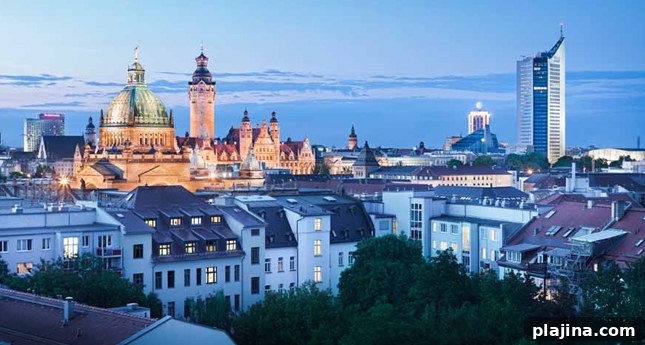
Twenty-five years after the fall of the Berlin Wall, differences in quality of life between eastern and western Germany have largely disappeared. While East Berlin led the initial wave of revitalization after reunification, two major cities in Saxony—Leipzig and Dresden—have rapidly reinvented themselves. Today they attract young tech entrepreneurs, innovative real estate developers, Michelin-rated chefs and internationally recognized designers, becoming vibrant cultural and business destinations and excellent side trips from Berlin or Prague.
Leipzig has drawn notable architecture and high-tech investment: Zaha Hadid designed a striking BMW plant, and the Bio City district has become a biotechnology and biomedicine cluster hosting more than 60 companies and 36 research institutions. In Dresden, the state capital, the new 5G Lab Germany opened as a collaboration between Technische Universität Dresden and Vodafone, signaling the region’s commitment to advanced telecommunications research.
Alongside cutting-edge industries, Saxony still preserves historic, high-quality craftsmanship. The bespoke watchmaker A. Lange & Söhne, founded in Glashütte in 1845, and the long-established Meissen porcelain manufactory, producing fine porcelain in Meissen since 1708, both remain icons of the region’s artisanal tradition. Meissen offers tours of its workshops and museum, while Schloss Proschwitz, a winery near Zadel, is Saxony’s oldest private wine estate, producing Riesling and Pinot Gris for centuries and offering a manor-house restaurant ideal for sampling local wines.
As inner-city neighborhoods in Leipzig and Dresden filled with new restaurants, hotels, boutiques and galleries, both cities became must-see destinations. Leipzig has earned the nickname “the new Berlin,” and Dresden’s Altmarkt-Galerie redevelopment received a nomination for the 2013 Global Award for Excellence from the Urban Land Institute.
Bach statue in front of Thomaskirche in Leipzig © Claudiodivizia | Dreamstime.com
On a visit to Leipzig for its annual Bach Festival—celebrating the composer who worked in the city from 1723 to 1750—I attended concerts in several historic venues and explored cobblestone streets lined with 15th- and 16th-century landmarks. Thomaskirche (St. Thomas Church), where Bach served as cantor, and Auerbachs Keller, a cellar tavern dating to 1438 that Goethe frequented and later referenced in Faust, are among the highlights for history and music lovers.
After World War II Leipzig became part of the Soviet-controlled German Democratic Republic and endured decades of dreary, utilitarian architecture and industrial pollution. The city slowly transformed when local citizens organized peaceful demonstrations in the 1980s—the early spark of the “Peaceful Revolution” that helped topple communist regimes across East Germany and Eastern Europe.
Economic revival accelerated in the 2000s when Porsche and BMW opened major plants near Leipzig, attracting skilled workers and high-tech suppliers. This industrial investment catalyzed a range of cultural and culinary developments, including the city’s first Michelin-starred restaurant, Stadtpfeiffer, in the Gewandhaus concert hall. The Plagwitz district, once an industrial suburb, has been reborn as a creative quarter with renovated brick buildings converted into lofts, galleries and design studios. Houseboats line the canals, and a lively dining scene includes vegan options like Vleischerei as well as traditional cafés and beer bars.
The Spinnerei, a former 19th-century cotton mill near Plagwitz, now hosts around 120 artist studios, a café, an art cinema and affordable, well-designed guest lofts called Meisterzimmer. For visitors seeking luxury, the five-star, 176-room Steigenberger Grandhotel Handelshof, opened in 2011, offers upscale accommodations within walking distance of the city center.
Leipzig’s cultural revival has attracted many young Germans. University of Leipzig applications have doubled in recent years, new music clubs appear within historic settings, and the UT Connewitz theater—one of the city’s oldest surviving cinemas—has been transformed into a major film and dance venue drawing crowds from Berlin and Prague.
Dresden © Seqoya | Dreamstime.com
Dresden lies about an hour from Leipzig by train and shares a similar population and impressive downtown revitalization. Both cities rose from wartime destruction and decades of communist rule to become eclectic, modern destinations.
The Dresden State Art Collection comprises a dozen museums, many housed in a restored palace on the Elbe River, featuring collections that span paintings, coins, porcelain and clocks, some dating back to the 17th century. These works were removed for safekeeping before World War II bombing raids, preserving many priceless pieces even as much of the city’s architecture was severely damaged.
After the war, Dresden rebuilt many of its most significant landmarks to their prewar appearance: the Zwinger palace, the Semper Opera House, Frauenkirche (Church of Our Lady), the Hauptbahnhof and the commercial strips along Prager Strasse. The German Hygiene Museum, with a complicated history tied to earlier political regimes, now attracts visitors with exhibitions on health and the human body in an updated, expanded venue.
Modern development in Dresden gained momentum in the early 2000s with projects such as Altmarkt-Galerie and Volkswagen’s Transparent Factory. Altmarkt-Galerie revitalized the central core with around 200 shops, restaurants and office spaces near museums, hotels and the central station. Nearby hotels like the five-star Hotel Taschenbergpalais Kempinski and the deluxe Bulow Palais in Neustadt—home to the Michelin-starred Caroussel restaurant—offer premium lodging options.
Volkswagen’s Transparent Factory, designed by Gunter Henn, sits in a central urban garden and features a glass-walled assembly line where visitors can observe the production process. The factory’s maple floors and sustainable materials highlight modern, eco-conscious design integrated with industrial functionality.
For travelers driving from Berlin (about two hours) or Prague (about two hours to Dresden and three to Leipzig), Saxony offers scenic countryside dotted with castles and picturesque river towns: Torgau on the Elbe with a 16th-century center; Meissen, home to Albrechtsburg Castle and the famous porcelain works; Bautzen, with medieval walls and hilltop churches above the Spree River; and Grossenhain, founded in the 1200s on the Grosse Röder.
Dresden Opera House © Sean Pavone | Dreamstime.com
Saxony Info to Go
The fastest and most convenient ways to reach Leipzig and Dresden from Berlin or Prague are by driving on the autobahn or taking Deutsche Bahn’s Intercity-Express (ICE) trains. Leipzig Hauptbahnhof, opened in 1915 and restored multiple times, is one of the world’s largest rail stations with 24 long-distance platforms and numerous shops and eateries. Frequent ICE trains link Leipzig to Berlin in about one hour and 12 minutes and to Prague in roughly three and a half hours.
Dresden Hauptbahnhof, dating to 1898, has 18 platforms and was carefully reconstructed after wartime damage and the 2002 floods, winning an international heritage award in 2007. ICE service connects Dresden with Berlin in about two hours and six minutes and with Prague in approximately two hours and 15 minutes.