
What a difference a name can make. Just over a decade ago, the more than 80-mile stretch of pristine beaches and lush jungle along the east coast of Mexico’s Yucatán Peninsula was commonly called the Cancún–Tulum Corridor. Functional, yes—the name points to its endpoints along Highway 307, from Cancún in the north to Tulum in the south—but it lacked imagination and appeal.
By the late 1990s, Cancún had long been an established tourism hub, and Tulum at the southern end of the highway began attracting growing numbers of day-trippers eager to see its well-preserved Mayan ruins. Few travelers, however, paused to enjoy the unspoiled coastline, mangroves and authentic fishing villages in between. It was then that Miguel Ramón Martín Azueta, mayor of Solidaridad (the municipality that stretches from Playa del Carmen to Tulum and inland to the Yucatán border), launched an effort to rebrand the region as the Riviera Maya.
In retrospect, many consider Azueta a marketing visionary. His initiative not only changed a name but helped shape a different trajectory for development. Planners and developers learned from Cancún’s rapid high-rise expansion and aimed for more controlled, sustainable growth. That hasn’t been without conflict—developers and environmentalists have often clashed—but the region today shows progress toward a more balanced model.
Community Tours Sian Ka’an (tel 52 984 871 2202) illustrates how development and conservation can collaborate profitably. This alliance of local tour operators shares the Sian Ka’an Biosphere Reserve in an ecologically responsible way. The Mayan name Sian Ka’an means “where the sky is born.” The reserve covers some 1.3 million acres of diverse tropical ecosystems, including lowland forest, flooded savannas, mangrove swamps and part of the Mesoamerican Barrier Reef, the world’s second-largest coastal barrier reef. The area supports around 800 plant species and provides habitat for about 350 bird species as well as jaguars, pumas, ocelots, spider and howler monkeys, crocodiles and various turtles. Nearly two dozen pre-Columbian archaeological sites are also found within the reserve.
Established in January 1986 and designated a UNESCO World Heritage site in 1987, Sian Ka’an is part of UNESCO’s Man and the Biosphere program, a global initiative that sets up protected reserves to study and monitor biodiversity. As a biosphere reserve, Sian Ka’an faces the ongoing challenge of integrating human activities without harming the ecosystems it protects. Community Tours Sian Ka’an has built its mission around that balance.
I joined a guided excursion led by Alberto Cen Caamal, a Community Tours naturalist who speaks Mayan, English and Spanish. Soft-spoken and clearly devoted to the natural world, Alberto led us along shaded woodland paths and raised boardwalks, past ancient ruins and through forested wetlands, highlighting plant and animal life and explaining the area’s cultural and ecological importance. When asked about the group’s goals, he explained the social and economic impact of responsible tourism in the region.
Before organized tourism reached Riviera Maya, many residents around Tulum worked in agriculture for minimal pay, performing backbreaking labor with few protections and often speaking only the Mayan language. Today, tourism in and around Sian Ka’an provides the primary income for an estimated 80 percent of the local population. That shift has allowed residents to earn a sustainable living while protecting the land they consider their ancestral home—a responsibility they take seriously.
Community Tours emphasizes awareness and stewardship. As the company notes, both locals and visitors must understand the potential for irreparable harm to wildlife and fragile ecosystems such as coral reefs. To reduce impact, the company favors multi-passenger transport over individual cars, plants a tree for every 5,000 miles driven in company vehicles and hires knowledgeable guides trained to minimize environmental disturbance during tours.
On our tour, we left the forest and reached a riverbank where boats awaited to carry us across open water into a maze of marsh channels. We briefly donned lifejackets—Alberto suggested wearing them backward for a more comfortable float in shallow water—then one by one stepped off the dock and drifted down a slow-moving river. After an hour or so, small boats that had been following at a distance came alongside to ferry us back to shore, where we enjoyed a home-cooked meal prepared in a local kitchen.
That excursion felt a world away from the high-energy, hawker-filled beaches of Cancún, just 80 miles to the north. The contrast—so near yet so different—captured why many visitors prefer Riviera Maya’s more deliberate, nature-focused experience.
Transportation Update
Earlier this year, Mexican officials opened the bidding process for construction and management of a proposed Tulum airport. If the project proceeds as planned, the airport could begin operations in 2012 with capacity for roughly 700,000 passengers in its first year. The proposal has reignited debates between developers and conservation advocates. Ideally, the two sides will reach compromises that bring economic benefits while protecting the region’s environmental integrity.
Info To Go
Cancún International Airport (CUN) is the primary gateway to Riviera Maya. The airport sits about 16 miles southwest of Cancún and 31 miles north of Playa del Carmen. Major car rental companies operate at or near the airport; taxis are available but can be costly. Highway 307 is a modern four-lane divided road from Cancún through to Calica (six miles south of Playa del Carmen) and continues as a two-lane route from Calica to Tulum. Check with your hotel for airport shuttle options.
Diversions
Playa del Carmen serves as the unofficial capital of Riviera Maya. Once a small fishing village, it retains a relaxed beachfront character while offering a wide range of dining options. Stroll along the pedestrian-only Fifth Avenue to browse shops and restaurants. When shopping for silver, look for .925, .950 or .970 stamps that indicate sterling quality.
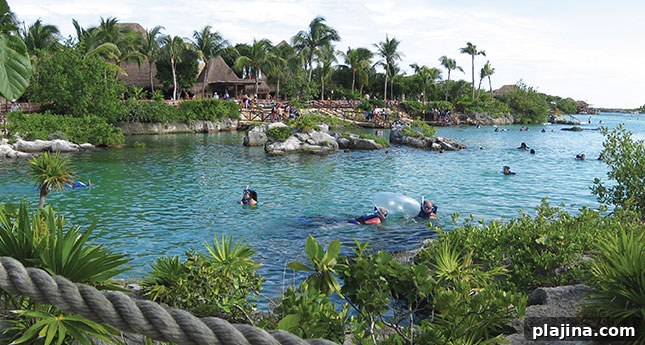
About 30 miles south of Playa del Carmen, Xel-Há (tel 52 998 884 7165) is known as a “natural aquarium” where visitors can swim among many species of colorful fish. Further south, Dos Ojos (“Two Eyes”) features twin circular cenotes—freshwater sinkholes and caverns popular with divers and snorkelers. El Eden, roughly 15 miles south of Playa del Carmen, offers a gentler swimming experience amid jungle surroundings.
Riviera Maya is also a notable golf destination and hosts the annual PGA Mayakoba Golf Classic. The region features courses designed by prominent architects such as Jack Nicklaus, Greg Norman, P. B. Dye, Nick Price and Robert Trent Jones Jr.
Lodging
Banyan Tree Mayakoba
This luxury beachfront resort blends Thai elegance with Mexican hospitality. Carretera Cancún–Tulum, Playa del Carmen, tel 52 984 877 3688.
Grand Velas All-Suites and Spa Resort
An all-suite, all-inclusive property offering both family-friendly and adults-only options, with dining that exceeds typical resort standards. Carretera Cancún–Tulum Km. 62, Playa del Carmen, tel 52 984 877 4400.
Zoëtry Paraíso de la Bonita Riviera Maya
An intimate luxury retreat with 90 suites set across 14 acres, including a private beach. Carretera Chetumal 328, Puerto Morelos, tel 52 998 872 8300.
Dining
Blue Parrot Beach Club
A relaxed beachfront spot where you can dine with sand between your toes. Calle 12 Norte, Playa del Carmen, tel 52 984 206 3350.
Di Vino
Contemporary Italian-Mediterranean cuisine in a prime people-watching location on Fifth Avenue. Calle 12 and Fifth Avenue, Playa del Carmen, tel 52 984 803 1270.
John Gray’s Kitchen
Chef-owner John Gray, formerly of the Ritz-Carlton, emphasizes local produce and fresh-caught fish to craft a popular menu. Av. Niños Héroes, Lote 6, Puerto Morelos, tel 52 998 871 0665.