
Penang, an island shaped like a turtle in the Strait of Malacca, is anchored by its provincial capital George Town, Malaysia’s second-largest city with about 1.25 million residents. Founded in 1786 by Captain Francis Light of the British East India Company, George Town is one of Asia’s best-preserved colonial trading ports. Its inner city—an ensemble of colorful shophouses, street markets, warehouses, docks, churches, temples and mosques—contains more than 1,700 historic sites and was inscribed as a UNESCO World Heritage Site in 2008. That blend of multicultural heritage, sandy beaches and a celebrated culinary scene makes Penang a compelling destination for leisure and business travelers alike.
While shipping has diminished in importance over the decades, Penang developed thriving tourism and electronics industries. Cargo activity shifted to Singapore and Port Klang, but Penang’s Free Trade Zones south of George Town, near the airport, now host factories and facilities for global technology companies such as AMD, Dell, Intel, Motorola, Osram and Seagate. That industrial base, together with a strong tourism sector, helps sustain George Town’s economy.
George Town benefits from both high-tech manufacturing and steady tourism. The city consistently ranks among Asia’s most livable urban centers, thanks to its seaside resorts and beaches—especially Batu Ferringhi—and the colonial-era charms of the central district. The vibrant ethnic mix, predominantly Chinese, Indian and Malay, is visible in neighborhoods, street food stalls and family-run restaurants. English is widely understood, so visitors from the West generally find it easy to communicate with shopkeepers, drivers and trishaw operators.
Navigating George Town’s heritage zone is best done on foot or by trishaw, though the Rapid Penang free shuttle bus offers a convenient loop between KOMTAR and the Pengkalan Weld ferry terminal every 20 minutes. Walking through the inner city reveals surprises around each corner, yet several landmarks stand out and reward focused exploration.
The northeast tip of George Town showcases many grand colonial monuments from the era when the city served as the first British Straits Settlement. The 60-foot Queen Victoria Memorial Clock Tower, erected in 1897, marks this end of town. Nearby Fort Cornwallis, built soon after Light’s arrival, retains cannons, fortifications and a small museum that recall the city’s early days. Along the waterfront are distinguished neo-Palladian buildings such as Town Hall (1880), the Court Building (1809) and City Hall (1903), plus the white mansion of banking magnate Yeap Chor Ee, now a museum and restaurant. St. George’s Church (1818), the oldest Anglican church in Southeast Asia, and the Penang State Museum, housed in a former 1816 school, provide context on the island’s multi-ethnic history.
Closer to the core of old George Town is a dense collection of religious sites and historic residences. The Goddess of Mercy Temple (1728) predates major Western trade in Malaysia. The Sri Mahamariamman Temple (1801) is notable for its sculpted display of Hindu deities, while the Kapitan Keling Mosque impresses with its tall minaret and welcomes visitors outside prayer times. Khoo Kongsi, a richly decorated clan house, and the Pinang Peranakan Mansion, a museum showcasing Peranakan heritage, highlight the island’s Chinese cultural traditions.
Among George Town’s many mansions, the Cheong Fatt Tze Mansion—known as the Blue Mansion—stands out. With 38 rooms, five courtyards, 220 windows and ornate woodwork and furnishings, it is among the most elaborate Chinese-style mansions outside China. The residence reflects the life of Cheong Fatt Tze, an influential Chinese entrepreneur often called the “Rockefeller of the East,” and its interiors have even been used for international film productions.
On the west side of Little India, artisans and street vendors preserve traditional trades and culinary practices. Joss-stick makers, garland weavers, goldsmiths, signboard carvers, spice sellers, haberdashers, fortune-tellers and food vendors keep long-standing crafts and recipes alive. Street treats include Straits Chinese cakes, samosas, string hoppers, pulled tea (teh tarik), apom and coconut tarts—an ideal area to sample authentic Penang flavors.
Weld Quay on the southeast waterfront provides access to the historic clan jetties—houses and shops built on stilts over the Penang Channel in the 19th century. The Chew clan jetty is a particularly evocative example, with timber homes, small shops, boat docks, fish vendors and simple cafés; one jetty even operates a homestay. North of the waterfront, the KOMTAR tower area mixes modern shopping, offices and an observation deck that offers views over the city.
Chowrasta Market is a must-visit for fresh produce and local ingredients. Operating since the 1890s, it remains George Town’s main wet market and showcases a wide array of spices, herbs, garden produce and Penang specialties. The present market building dates from 1981, while its Penang Road façade hails from the 1920s. Nearby, the George Town Jewish Cemetery on Jalan Zainal Abidin preserves a small, well-kept burial ground reflecting another thread of the island’s diverse past.
Beyond the city, Penang’s natural attractions are within easy reach. Penang Hill offers cool retreats, gardens and temples; a funicular railway provides a quick ascent when operational, otherwise the hike to the peak takes several hours. At the summit and along the hillside, visitors can find panoramic views and notable religious sites, including Kek Lok Si, one of Malaysia’s largest Buddhist temples with a seven-story pagoda blending Thai, Burmese and Chinese architectural influences.
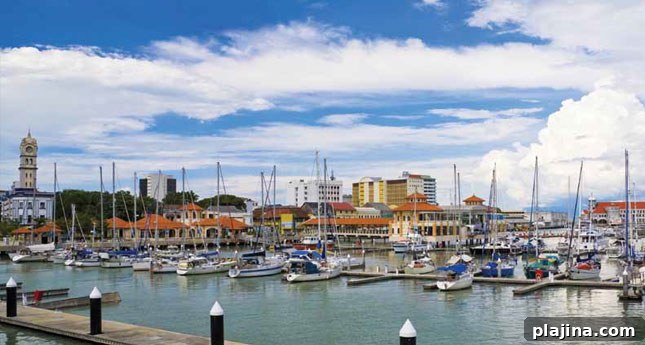
The coastal drive north to Batu Ferringhi leads to the island’s best beaches and resort areas. The trip takes around half an hour and passes modern developments and beachfront resorts. Midway lies Straits Quay, a waterfront marina and retail precinct with dining options and a performing arts center—an appealing stop for lunch or coffee. Batu Ferringhi’s shores offer water sports, beachside cafés and family-friendly resort pools. For a quieter nature escape, Penang National Park near Teluk Bahang provides secluded beaches and rich coastal scenery about an hour from George Town.
Info To Go
Penang Bayan International Airport (PEN) is south of George Town. Rapid Penang bus 401E runs from the airport to KOMTAR about every 30 minutes (roughly one hour). Airport taxis should use the meter and take about 45 minutes. Within George Town, explore on foot, by bicycle or by trishaw; trishaw rides are negotiable. Taxis and Rapid Penang buses provide affordable local transport, and many hotels offer shuttle services to destinations such as Batu Ferringhi.
Lodging
Eastern & Oriental Hotel Penang
Built in 1885, this grand colonial all-suite hotel blends historical elegance with modern amenities. 10 Lebuh Farquhar, George Town
Parkroyal Penang Resort
Located on Batu Ferringhi Beach, the resort offers comfortable rooms and resort-style facilities ideal for leisure and business travelers. Batu Ferringhi Beach
Traders Hotel, Penang
A well-regarded international business hotel in George Town offering a convenient location and professional services. Magazine Road, George Town
Dining
No Eyed Deer Restaurant
Known for its Laotian laksa, seafood dishes and a popular weekend crowd. 98-1-26 Prima Tanjung, Tanjung Tokong
The Sire Museum Restaurant
This heritage mansion serves Peranakan dishes, salads and seafood in an antique-filled setting. 4 King St., George Town
That Little Wine Bar
Intimate wine-and-food pairings and personalized service make this a favorite for upscale dinners. 54 Jalan Chow Thye, George Town
Weblinks
Cheong Fatt Tze Mansion
Golden Sands Resort, Penang
Khoo Kongsi
Penang State Museum
Penang Tourism Office
Pinang Peranakan Mansion
Rasa Sayang Resort & Spa
Straits Quay Marina