
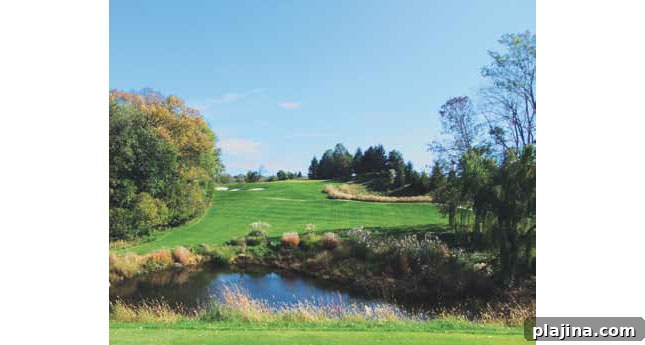
Jasna Polana, which means “bright meadows” in Polish, was the country estate of J. Seward Johnson of the Johnson & Johnson family and his wife, Barbara Piasecka Johnson. Barbara, often called Basia, arrived in the United States from Poland in 1960 and later became one of the wealthiest art collectors in the world. After her husband’s death, she leased the 230-acre property to the Tournament Players Club in 1986, commissioning legendary designer Gary Player to transform the grounds into a private championship golf course.
The mansion on the property was designed by Wallace K. Harrison, who also contributed to the design of the United Nations building. Built in the 1970s at a cost of about $30 million, the home was one of the most expensive in the country at the time. The sprawling residence features lavish details including a wine cellar capable of holding up to 10,000 bottles, 15 fireplaces and numerous bathrooms. Security was a major concern for Johnson; the house was constructed with thick poured concrete walls and bulletproof glass, and its defenses are still so robust that cell phone reception inside is effectively blocked.
The Johnsons’ story reads like a novel: Basia rose from a modest background to an extraordinary life alongside Johnson, and the couple amassed a remarkable collection of art and tapestries that remain on display. Although Mrs. Johnson now spends much of her time abroad — notably in Monaco — she visits the estate periodically. Staff say she is famously particular about details such as lighting and energy use. The house continues to showcase priceless art and historic textiles collected by the couple over decades.
The private course at Jasna Polana is widely regarded as a must-play for serious golfers, with immaculate conditioning and dramatic, parkland-style routing. Expect a premium experience and a corresponding fee.
Hole 2 (145 yards, par 3)
This short par 3 runs alongside the estate’s access road and serves as an elegant introduction to the course. The elevated tee provides a sweeping view of the green below, with a stream guarding the front. The hole is more intimidating than technically difficult; several players in our group came up short and found trouble. I missed left but scrambled for a bogey.
Hole 3 (534 yards, par 5)
Another standout, this par 5 reveals the Annex — one of two guest accommodations — behind the green. The fairway bends left then right toward an elevated, stream-protected green. I pulled my drive into the neighboring fairway behind some trees, then risked a 3-wood through the foliage. The ball kissed some leaves and made it back to the fairway about 90 yards out, leaving a straightforward wedge and two-putt for par. Others in the group were less fortunate and found the stream.
Hole 6 (452 yards, par 4)
Ranked the No. 1 handicap on the course, this long par 4 combines length with a series of bunkers that punish errant tee shots. From the tee you can clearly see the fairway bunkers, including one hanging bunker on the right. Aggressive players who clear the bunker on the dogleg have a chance to reach the green in two; those who miss risk bogeys. One teammate cleared the corner and walked away with a par while others struggled.
Hole 9 (491 yards, par 4)
Holes 8 and 9 form a beautiful pair. The par-3 eighth features water along the right side and partially in front of the green. The ninth finishes the front nine with an elevated tee showing a valley and pond below. There’s a demanding 220-plus-yard uphill carry to the fairway. Powerful hitters can use the slope to their advantage and sometimes clear the front bunkers, while mid-distance players should aim right of center to avoid high rough and the trees on the left. A conservative approach rewards a playable approach to the green.
Hole 10 (432 yards, par 4)
Rated the course’s No. 2 handicap, this intimidating par 4 features a narrow driving corridor from the tee. Successful tee shots that find the fairway open up a straightforward second shot to a green protected by a bunker at the front right. Despite the bunker-lined approach, solid drives set up manageable scoring opportunities.
Hole 15 (440 yards, par 4)
This dogleg-left requires a short carry over a natural hazard to reach the ideal part of the fairway. Drives that gently favor the left side gain a strategic advantage. I found a spot just beyond the bunkers and played a bump-and-run that left a tap-in for par. Other players who tried unusual lines occasionally ended up out of play.
Hole 17 (200 yards, par 3)
This long par 3 can play much longer depending on the day’s wind. Water wraps around the front and right of the green, so precise distance control is essential. Some shots on the day found the water; others missed left. A well-executed long club and a confident short game can save par, as one of our group demonstrated by chipping close and two-putting for a solid score.
Hole 18 (549 yards, par 5)
The finishing hole is a dramatic downhill par 5 with a green tucked left and a stream that cuts across the landing area before wrapping into a pond on the right. Strategic play and course knowledge pay dividends here. My drive found a fairway bunker, and an over-ambitious attempt to reach the green resulted in a costly penalty and a double bogey. It remains a memorable closing hole on an exceptional course. After the round we retired to the Johnsons’ library, now serving as the club’s 19th hole, for a well-earned refreshment.
TPC Jasna Polana
4519 Province Line Road
Princeton, NJ 08540
tel 609 688 0500
www.tpcatjasnapolana.com