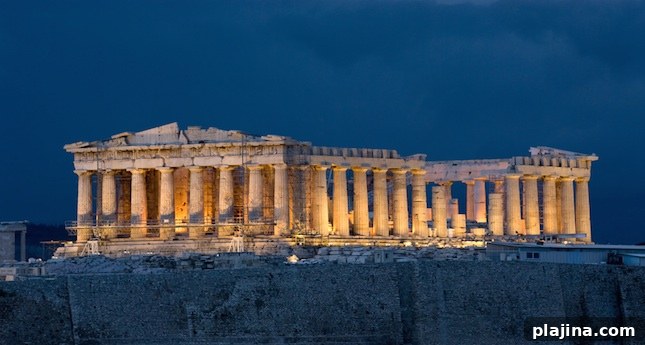
Home to some of the world’s most celebrated archaeological treasures, Greece invites visitors to wander through landscapes that once inspired myths and mighty civilizations. Beneath turquoise skies and along crystalline seas, more than 100 ancient archaeological sites and numerous UNESCO World Heritage locations await exploration, offering tangible reminders of Greece’s cultural legacy. Dominating modern Athens, the Acropolis stands on a rocky outcrop and contains some of the nation’s best-known monuments, including the Parthenon, built to honor the goddess Athena. Nearby ruins such as Hadrian’s Gate, the Roman Agora, the Kerameikos potters’ quarter, and Hadrian’s Library further illustrate the city’s long, layered history.
In central Greece, the sanctuary at Delphi on Mount Parnassus preserves the remains of the Temple of Apollo, where the Oracle once delivered her prophecies. First erected around the 7th century B.C.E., the temple was rebuilt multiple times after successive destructions; its Doric columns and stone foundations today stand as powerful symbols of ancient Greek religious and cultural achievement. On the Peloponnese peninsula, visitors can explore the well-preserved sites of ancient Messene and the Byzantine city of Mystras, as well as the renowned theater of Epidaurus, famous for its exceptional acoustics and classical architecture.
The island of Crete is indispensable to any survey of Greece’s ancient past. Crete preserves the remains of the Minoan civilization, and the palace at Knossos is among the most visited and evocative of these sites, originally comprising more than 1,200 rooms. Although Knossos suffered destruction from natural disasters and later rebuilding, many rooms have been reconstructed to convey the palace’s former grandeur. Other significant Minoan centers include the palaces at Phaistos and Malia. For a glimpse into everyday life, the excavated town at Gournia reveals the layout and homes of a working-class settlement. In eastern Crete, archaeological finds at Palaikastro and sites around Sitia highlight regional variation in Minoan and later cultures; the area also contains notable features such as Peristera Cave and the ancient site of Praisos.
Across the country, Greece’s archaeological sites span a wide range of periods and functions—sanctuaries and temples, theaters and administrative centers, towns and burial grounds—each offering insights into ancient daily life, ritual practice, art, and architecture. Whether exploring the monuments of the mainland or the island palaces, visitors encounter layered histories that connect classical myths to the archaeological record. These sites are not simply ruins but living evidence of civilizations that shaped Western art, philosophy, politics, and religion.
Planning a visit to Greece’s archaeological highlights offers opportunities to combine history with landscape: mountain sanctuaries and coastal sanctums, urban forums and rural settlements, all set against an unmistakable Mediterranean backdrop. To make the most of your trip, allow time for major museum collections that house artifacts recovered from excavations, and seek out local guides at individual sites to deepen your understanding of their context and significance. Respecting preservation rules and seasonal opening hours will ensure these remarkable places endure for future generations to study and enjoy.