
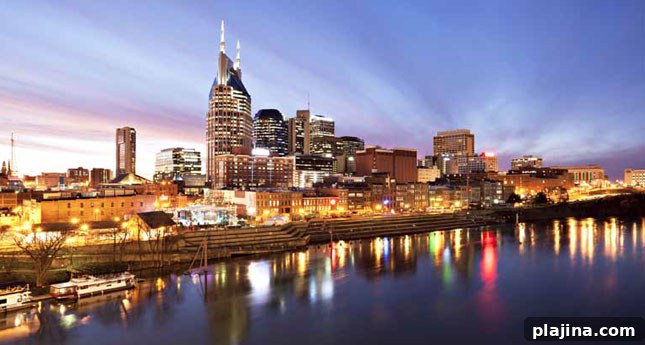
Nashville has long been an iconic American city. Nicknamed “Music City,” it rose to prominence through country music while also becoming a major recording and industry hub for many genres. From Roy Acuff and Patsy Cline to Kings of Leon and Taylor Swift, countless country stars recorded here. Artists from other styles — including Bob Dylan, Elvis Presley, Robert Plant, R.E.M., Neil Young and the Rolling Stones — have recorded in Nashville as well.
The ABC drama series Nashville brought the city additional national attention, and visitation has reflected that profile. In 2012 Nashville welcomed roughly 11 million visitors, and that number continues to grow as new developments and cultural attractions open.
In recent years, Nashville’s food scene has emerged alongside its musical reputation. Long celebrated by locals and well-informed visitors for hot chicken, classic meat-and-three Southern meals and outstanding barbecue, the city is now recognized for “haute Southern” cuisine that highlights local farms and modern takes on traditional recipes. Once called the “Buckle of the Bible Belt,” Nashville is increasingly viewed as a culinary hub stretching eastward toward Charleston.
One of the newest and most talked-about restaurants is Husk Nashville, from James Beard award-winning chef Sean Brock of Charleston. Located in a historic 1895 building listed on the National Register of Historic Places, Husk overlooks downtown and brings a farm-driven approach to Southern cooking.
Construction on the new Music City Center concluded recently. The convention complex, part of a larger development that includes multiple hotels, features a 350,000-square-foot exhibit hall and a 57,000-square-foot grand ballroom, making it suitable for most conventions. The center was designed with sustainability in mind and is on track for Silver LEED certification from the U.S. Green Building Council. Stormwater capture systems will be used for toilet flushing and landscape irrigation, the roof includes an acre of solar panels and plantings help reduce heat gain. The convention center also houses the street-facing Nashville Songwriters Hall of Fame.
Unlike many convention centers set on the outskirts of town, the Music City Center sits at the heart of downtown, adjacent to the Country Music Hall of Fame and within easy walking distance of an NHL arena, Riverfront Park and the famed honky-tonk district along Lower Broadway. Staying downtown you can walk to the Ryman Auditorium, home of the original Grand Ole Opry, or attend a symphony concert at an upscale venue. Dining options nearby range from casual pulled pork and a longneck beer at Jack’s Bar-B-Que to elevated fare like moulard duck and truffle mac and cheese at the Capitol Grille in the historic Hermitage Hotel.
The center was also designed to be inviting when no events are scheduled. A broad green pavilion wraps the building, encouraging pedestrian movement and offering public space for art and live music.
Downtown Nashville already offers a mix of chain and independent hotels, and additional properties are opening to accommodate growing demand. A major new addition is the 800-room Omni Nashville Hotel, which joins existing walking-distance options including DoubleTree, Hilton Suites, Renaissance, Sheraton and an expanded Hotel Indigo.
Cultural offerings downtown continue to expand. Two new museums opened in the spring: The Johnny Cash Museum on Third Avenue South and the Musicians Hall of Fame & Museum on Fourth Avenue. The Musicians Hall of Fame occupies the former Municipal Auditorium, honoring influential music scenes in cities such as Detroit, Memphis, New Orleans and Nashville.
A detail of the Parthenon replica in Centennial Park © Patricia Shrout |
Dreamstime.com
If you prefer to cover more ground without excessive walking, the Music City Trolley offers sightseeing routes that stop at multiple attractions, or you can take a short taxi ride; most major sites lie within a few miles of the city center. West End Avenue leads to Centennial Park, home to a full-scale replica of the Parthenon and a statue of Athena. The Frist Center for the Visual Arts is housed in an elegant Art Deco former post office. Cross the Cumberland River to explore Five Points in East Nashville, where a vibrant dining and nightlife scene occupies streets lined with early 20th-century Craftsman bungalows.
The Nashville metropolitan area is now the most populous in Tennessee. Much of the region’s growth reflects employment gains in sectors beyond tourism and music. Nashville is a major center for healthcare—HCA is headquartered here—and many corporations are based in nearby office suburbs such as Brentwood. Vanderbilt University, close to downtown, is one of the largest local employers.
Several well-known national brands maintain a major presence in the region, including Nissan, Bridgestone, Cracker Barrel, Gibson Guitars, Gaylord Entertainment, Dollar General and numerous restaurant chains.
Few mid-sized American cities combine such strong daytime business opportunities with a lively after-hours entertainment scene. Whether you are in town for work or leisure, take time to settle into the local rhythm: listen to a talented performer who could be tomorrow’s star, sample the evolving Southern cuisine, and enjoy why Music City rewards lingering a little longer.