
In the decade since Macau returned to Chinese sovereignty, this quiet enclave near Hong Kong has been remade. While it has firmly established itself as the “Asian Las Vegas,” Macau has broadened its appeal beyond glittering casinos to become a leading destination for recreation and historical discovery. It was here that the West first established sustained trade with Cathay, and today Macau blends that legacy with rapid modern growth.
That duality hit me as soon as I arrived by a 45-minute hydrofoil from Hong Kong International Airport. I had not set foot on these shores in twenty-five years, and the geography itself had changed. A large area of reclaimed land called the Nape now fronts the ferry terminal, and on this newly built ground a range of attractions has sprung up. Fisherman’s Wharf, an entertainment strip near the docks, mixes architectural replicas—from a Roman-style colosseum to a Bourbon Street motif—and even a regularly erupting faux volcano, reflecting Macau’s appetite for spectacle.
In earlier, pre-handover days Macau felt like a maze of narrow lanes, dotted with aging gambling halls, colonial monuments and a few casinos moored offshore. Since the 16th century it served as the portal to China for early Western traders, missionaries and naval expeditions, but much of its Portuguese heritage had dimmed. Today the city is actively restoring its colonial past even as modern commercial development transforms its shoreline and skyline.
I stayed at the Mandarin Oriental’s Grand Lapa Resort, a refined downtown hotel without a casino. Just blocks from the ferry and Fisherman’s Wharf, it proved an excellent base for exploring Macau’s outdoor offerings and colonial landmarks. The Grand Lapa is an oasis amid the newly erected gambling palaces and even provides views of Macau’s popular sporting spectacle, the Formula 3 Grand Prix, which races through the city streets each November.
Three bridges now link the Macau peninsula with the southern islands of Taipa and Coloane—formerly rural outposts that have become centers for outdoor recreation. Taipa and Coloane are joined by a vast reclaimed area called Cotai, a major hub for casino resorts. Instead of diving into Cotai’s enormous complexes, I caught a free shuttle and headed to Coloane, which feels remote and mountainous in contrast. The Westin on Coloane sits beside a championship golf course where I enjoyed a peaceful seaside round, far removed from baccarat and blackjack. Later I followed a coastal hiking trail that overlooks the black-sand beaches of the South China Sea. In the evening I dined at Fernando’s on Hac Sa Beach, a beloved red-brick restaurant where generous platters of clams and crabs pair naturally with Portuguese wines.
Western-style recreation has seeped into surprising corners of Macau, even downtown. The next morning I visited the Macau Tower, one of the world’s tallest structures. From the 764-foot platform, thrill-seekers can bungee jump from what Guinness certifies as the world’s highest commercial decelerator descent. I skipped the jump and walked instead along Avenida de Almeida Ribeiro, a charming, banyan-shaded boulevard that leads to the Inner Harbour and old Macau. About 25 historic monuments sit within a UNESCO World Heritage zone established in 2004, and these remnants of the Portuguese era have been carefully restored. Highlights included the East India Company Cemetery, fragments of the original 1569 city walls, and numerous churches, temples and pastel neo-classical buildings clustered around Senado Square (Largo do Senado), the commercial heart set up by the Portuguese nearly four centuries ago.
Most of Macau’s architectural treasures are an easy walk from Senado Square, provided one avoids the narrow, disorderly alleys that remain. In the past I occasionally lost my way in that colorful labyrinth; this time I simply asked locals for directions to São Paulo—the ruins of St. Paul’s Church—which still dominate old Macau. Only the ornate stone façade of that 17th-century church survives, a towering “sermon in stone.” Behind the façade is the Museum of Sacred Art, one of my favorite collections in the region, and the crypts filled with paintings, grave markers and relics of early Catholic martyrs.
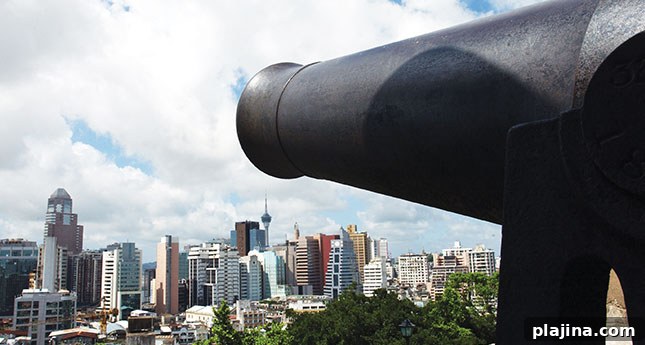
From St. Paul’s I climbed an open-air escalator to the Mount Fortress (Fortaleza do Monte), the 17th-century stronghold built by Jesuit missionaries to deter pirates. Today the fort stands above the city and offers views rivaling those from Macau Tower. Inside, the museum provides a concise history of Macau’s evolution, from colonial outpost to modern city. As evening approached I dined on the terrace of Pousada de São Tiago, a boutique hotel tucked within the fortress walls, where the setting reinforced a sense of continuity with the past.
Walking through Macau’s historic center, I felt the city’s commitment to preserving its distinctive legacy. Conversation at my table turned to proposals for a new ocean bridge that would shorten the drive to Hong Kong, and it was clear that while Macau embraces development, there is also a deliberate effort to protect its inner-city monuments and outdoor spaces. The result is a place where the bright lights of modern entertainment coexist with carefully preserved reminders of the first Western foothold in the Far East.