
Exotic India is a land of dazzling variety and constant surprises, so vast that one trip can only reveal a fraction of its charms. With limited time, the challenge is deciding which slices of this rich tapestry you want to explore.
After some thought, I chose Kerala in South India.
Kerala attracts travelers for many reasons: miles of Arabian Sea coastline, more than 40 rivers and extensive backwaters, lush tea plantations, vibrant festivals, Ayurvedic wellness centers and diverse wildlife sanctuaries.
A chalk painter and elephants at the Kalpathy Festival © Ellen Clark
As a photographer, I timed the trip to coincide with the famous Kalpathy Festival, but the festival was only one highlight. My itinerary also included a stay at an Ayurvedic resort, a few tranquil days on a houseboat through the backwaters and a wildlife visit in search of tigers.
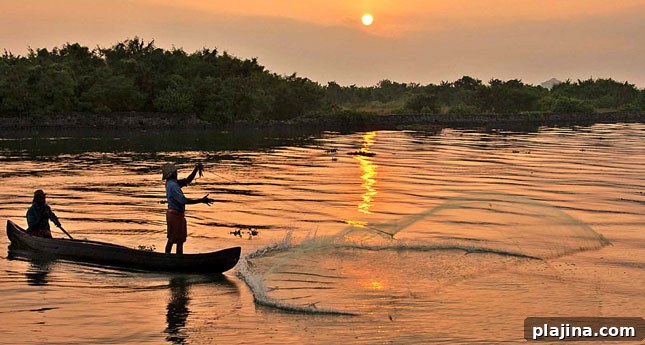
Cochin (Kochi), the main airport hub, is a major port on the Arabian Sea and is effectively divided into two parts. Modern Ernakulam features high-rises and a busy urban atmosphere, while across the water the old districts of Mattancherry and Fort Cochin preserve the city’s layered history. In those historic quarters you’ll find spice markets, colonial-era buildings, 17th-century Dutch houses, India’s first European church, a synagogue and a Portuguese palace. The iconic Chinese fishing nets also line the shore: enormous, horizontal nets sometimes spanning 65 feet or more, each operated by a team of fishermen. At sunset, these nets make striking silhouettes against a colorful sky.
That evening I attended a traditional Kerala Kathakali performance, watching male dancers apply elaborate, colorful makeup and don extravagant costumes and headdresses. The dance itself is highly stylized, accompanied by percussive, discordant music that heightens the drama.
In Kalpathy I witnessed Ratholsavam, the week-long Chariot Festival centered on the ancient Kalpathy Temple, dating from the early 15th century. The festival’s peak moment is when devotees pull three massive, flower-bedecked chariots through the streets. Musicians played across town, artists created vibrant chalk paintings on the roads, townspeople added finishing touches to the chariots, and elephants occasionally emerged from side lanes to join the procession.
A night view of the festival © Ellen Clark
By the time the sun set on Kalpathy, my memory card was full and I was ready to swap the festival’s energy for a quieter country retreat.
Traveling along a dark rural road, rice paddies flanked us and the occasional modest home peeked through dense foliage. I assumed the driver was lost—how could a resort be out here? But then huge wrought-iron gates and an ornate white stucco entrance appeared. Two uniformed guards welcomed me into Kairali Ayurvedic Healing Village.
Set across 50 acres of tropical gardens, meandering paths and streams, the resort’s Kerala-style cottages are built from local materials and named for astrological signs. Trees planted near each cottage follow astrological principles.
The next morning I experienced a traditional Ayurvedic herbal oil massage.
The treatment was deeply relaxing and thoroughly oily, but my soft-spoken therapist in a green sari assured me it would rejuvenate body and mind and reduce signs of aging. Afterward she gave me a special cleansing powder to wash the oil away in the shower. My skin felt wonderfully refreshed, and the treatment seemed to revive my sun-worn complexion.
Refreshed, I returned to the festival crowds. A sea of people surrounded the giant temple chariots, hundreds of hands grasping the thick woven ropes used to pull the vehicles through narrow streets. It was an intense, exhilarating experience—not for the claustrophobic, but unforgettable.
From that vibrant scene I soon transitioned to calm again, boarding a custom-made traditional houseboat to cruise Kerala’s backwaters.
The floating hotel was a kettuvallom, a traditional rice barge built without nails: anjali wood planks lashed together with rope and sealed with black resin. Our boat, Vaikundum, was a luxurious two-deck vessel featuring eight guest rooms with en suite bathrooms and air-conditioning, teak finishes, a full kitchen, a spacious sun deck and a large dining and lounge area—ideal for a slow, scenic journey through the backwaters.
A traditional houseboat © Ellen Clark
Over a couple of days the boat would stop at villages, temples or churches, but most of the time I relaxed on deck, watching other houseboats drift by, fishermen at work and rural life along the banks. The sunsets were beautiful and the calm of the waterways was the perfect antidote to a busy travel schedule.
My final Kerala visit took me to Periyar Tiger Reserve, which spans more than 574 square miles and is one of India’s 27 tiger reserves. The preserve emphasizes ecotourism and conservation to protect the region for future generations.
With limited time, I chose a boat ride across the reserve’s lake in hopes of spotting a tiger coming to drink.
There were no tiger sightings on that trip—wild tigers can be elusive—but the two-hour lake circuit yielded abundant wildlife: herds of deer and wild boar, and many birds including egrets, kingfishers, herons, cormorants and grebes. One memorable moment was spotting a cheeky monkey perched on a “No Parking” sign in the reserve’s parking area.
Kerala Info to Go
Cochin International Airport is Kerala’s main airport and one of India’s busiest for international travel. There are no direct flights from the United States, but connections are available through cities in Southeast Asia, the Middle East and within India. Buses and prepaid taxis serve the airport around the clock, and automated prepaid taxi counters at both terminals make hiring an ordinary or air-conditioned taxi straightforward. U.S. citizens require a visa to enter India; travelers planning multiple visits may find a 10-year visa the most convenient option.
Read more about Kairali Ayurvedic Healing Village.