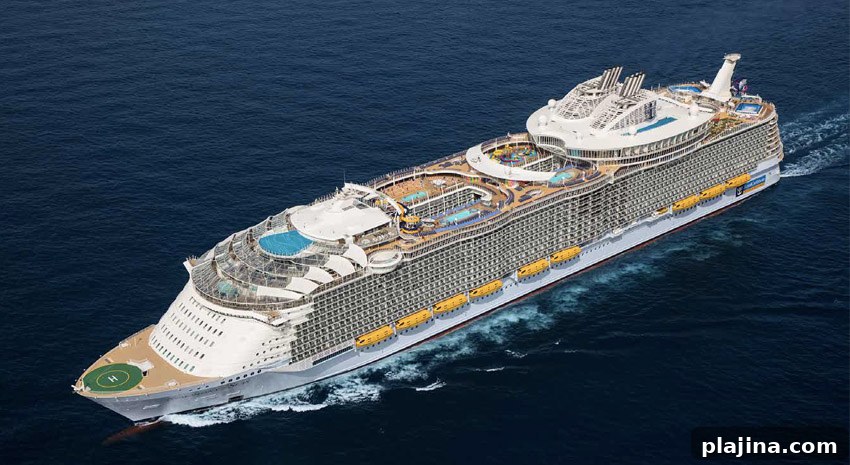
Approximately six miles offshore, a gleaming white silhouette rises from the horizon. Is it a shopping mall, an entertainment complex, a theme park, a vast resort hotel or even a floating town for thousands? From my viewpoint on the waterfront of a Spanish coastal town, the answer is obvious: it is Symphony of the Seas, currently the largest cruise ship in the world, moving steadily and silently northward.
“Currently” is the key word. In recent years the title of world’s largest cruise ship has changed hands frequently, most often within the same company, Royal Caribbean International. In 2009 Oasis of the Seas held the top spot, followed a year later by Allure of the Seas, and then by Harmony of the Seas in 2016. Symphony of the Seas is set to keep the crown until a slightly larger sister ship enters service in 2021.
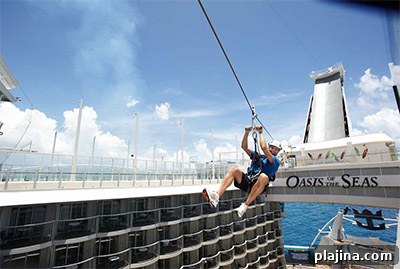
Caribbean’s Oasis of the Seas zip-line © ROYAL CARRIBBEAN
Royal Caribbean is not alone in the push for ever-larger ships. MSC Cruises, Norwegian Cruise Line, Dream Cruises, AIDA Cruises, Costa Cruises, Carnival Cruise Line and P&O all have massive vessels in the pipeline, many designed to run on liquefied natural gas. The next generation of liners aims to be not only larger but also greener.
Why the drive for size? The simple answer is demand: mega-ships are popular and profitable. The more nuanced explanation includes changes in the Panama Canal’s capacity and a shift in what customers expect. The Canal expansion completed in 2016 increased the Panamax limit, allowing bigger ships to cross between the Atlantic and Pacific, but the largest cruise ships remain far too big to use even the new locks. Symphony of the Seas exceeds the updated Canal tonnage by more than double, which shapes its itineraries and seasons.
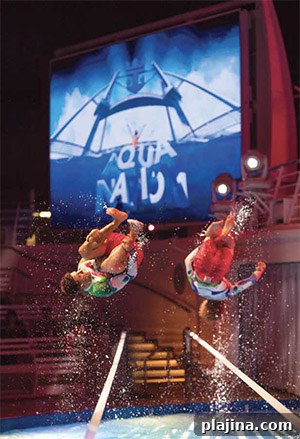
AquaTheater © ROYAL
CARRIBBEAN
When a ship is essentially a destination, sailing routes become secondary. The Caribbean remains the dominant winter base, while the Mediterranean hosts the bulk of summer sailings. For many passengers, ports of call are an added diversion rather than the main attraction because most of the entertainment and amenities are onboard.
Traditional cruise highlights—dressing up for formal dinners, admiring the coastline from the rail—now share the stage with attractions that would have been unthinkable decades ago. From the shore I photographed Symphony of the Seas and posted the image online, but the ship’s social feeds were dominated by interior scenes: Central Park with thousands of tropical plants, a Boardwalk-style funfair, queues for onboard coffee shops, a poolside AquaTheater show and the twin spiraling slides of the Ultimate Abyss, which plunge ten stories in seconds.
The ship’s specifications are staggering: 18 decks, 24 elevators and seven distinct neighborhoods—Central Park, the Boardwalk, the Royal Promenade and a Youth Zone among them. With 2,774 staterooms the ship can accommodate up to 6,680 passengers, supported by about 2,200 crew members. Construction costs topped $1.35 billion.
Other modern giants match ambition with diverse attractions. Sister ship Allure of the Seas features a two-deck dance hall and an ice rink, while Oasis of the Seas offers sports courts, a zip-line and miniature golf. Norwegian Joy includes a go-kart track, and the Disney Dream introduced the first at-sea water coaster. Upcoming designs such as Celebrity Edge push boundaries with innovative platforms that extend over the water.

Norwegian Joy’s go-cart racetrack © NORWEGIAN
Competition drives ever more imaginative features. Drones may soon be used for food and laundry delivery to balcony doors or even to ferry passengers to a waiting tender. Symphony of the Seas already includes a Bionic Bar with robotic arms mixing cocktails, and fully automated restaurants are under development for future ships.
Space for innovation is limited only by technology and designer creativity, but size itself introduces practical constraints. As ships grow, fewer ports can physically accommodate them, and many destinations lack the infrastructure to handle the sudden mass movement of thousands of passengers. Smaller Caribbean islands, for example, often struggle to provide enough coaches or local services for large excursion groups.
Even larger ports feel pressure when multiple mega-ships call simultaneously, stretching terminals and surface transport to their limits. To cope, ports must invest in expanded passenger facilities and improved transport links, or cruise lines will have to select from a shrinking roster of suitable ports of call.
Health and safety also scale with size. Outbreaks of contagious illnesses such as norovirus can spread rapidly in the closed environment of a ship; larger vessels mean more potential cases and more affected passengers. While most outbreaks involve a minority of guests, they can still ruin many vacations.
Worst-case scenarios remain a major concern. International rules require that ships be capable of completing a full evacuation within 30 minutes, a daunting challenge for vessels that carry thousands. The 2012 Costa Concordia disaster demonstrated how quickly a routine voyage can turn tragic; that incident resulted in 35 fatalities and highlighted evacuation difficulties aboard large ships.
Mega-ships like Symphony of the Seas respond with extensive safety measures. Its 18 lifeboats each hold up to 370 people, while numerous other safety systems are built into the design. Yet history—from early liners to modern examples—reminds us that accidents can still occur, so vigilance and rigorous safety protocols remain essential.
Despite those concerns, entertainment and guest experience dominate design priorities. The primary objective is to impress and delight passengers, and in that respect the latest generation of mega-ships succeeds. Whether viewed from a private stateroom, a public deck or the shore six miles away, Symphony of the Seas is an awe-inspiring example of how the cruise industry has transformed ships into floating cities of leisure and spectacle.