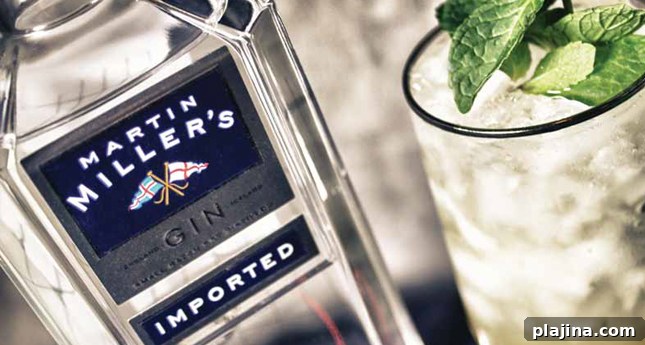
There they were: three friends in a bar in Notting Hill, London, nursing gin and tonics and lamenting the quality of the gin. Martin Miller, exasperated, pushed his glass aside. “Enough,” he said. “Gin shouldn’t taste like this. Gin is romance. Gin is adventure. Gin is the most seductive of drinks. It should invite you to love it.”
The others were silent.
“I’m going to make my own gin,” Miller continued. “I’ll find the best distiller in England and use traditional methods. I want my gin to be as smooth and refined as the Bentley I used to own. I want to create a modern classic with a nod to tradition.”
Still no response.
“And the secret may be the water,” he added. “Many gins use demineralized water — the Icelanders call that dead water.”
The friends looked up.
“They believe demineralizing strips water of its life. My gin will be made only with Icelandic water — soft, pure, and uniquely fresh.”
“You’re mad,” one friend said. “Let’s do it.”
So they did. The gin was distilled twice in a copper pot in England, following traditional practices. Botanicals were carefully incorporated — juniper at the forefront, with coriander, angelica, Florentine iris, orange and lime peel, licorice root, cassia and cinnamon bark, many of which were separately distilled before blending. Then, in a move that became the brand’s signature touch, the distillate was sent 1,500 miles to Iceland to be married with pristine glacial water and then returned to England. The first bottles appeared in 1999.
Today Martin Miller’s Gin is available in two strengths: the standard 40% ABV and the Westbourne Strength at 45.2% ABV. Both expressions offer a clean, citrus-laced aroma and a prominent juniper character, balanced by a softness and clarity that many attribute to the Icelandic water. The 40% bottling is an excellent all-purpose gin, ideal for classics such as a Tom Collins or a gimlet. The higher-proof Westbourne Strength stands up well in bolder or more complex cocktails — try it in a Negroni, an Alexander, or as a vodka substitute in a Bloody Mary. And, of course, either works beautifully in a gin and tonic, the drink that inspired the whole endeavour.