
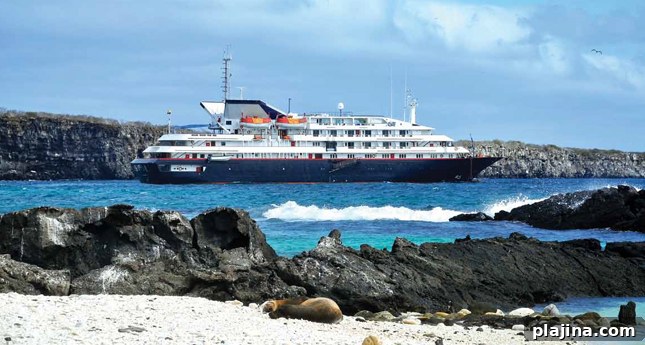
When Lord Byron, a first cousin of the celebrated English poet, dropped anchor in the Galapagos Islands in 1825, he discovered an Eden isolated in the Pacific Ocean.
“The place is like a new creation,” he wrote. “The birds and beasts do not get out of your way; the pelicans and sea-lions look in our faces as if we had no right to intrude on their solitude; the small birds are so tame that they hop upon our feet. … Altogether, it is as wild and desolate a scene as imagination can picture.”
Visitors today encounter much the same scene when they cruise this remote volcanic archipelago roughly 600 miles off Ecuador’s western coast. Recognized as a UNESCO World Heritage site and Biosphere Reserve, the Galapagos remain among the planet’s most pristine and primeval places, teeming with wildlife found nowhere else.
The archipelago comprises 21 islands and 107 islets and rocks, designated as an Ecuadorian National Park with a human population of only about 26,000. They are vastly outnumbered by giant tortoises, sea lions, penguins, marine iguanas and endemic bird species—creatures whose uniqueness helped inspire Charles Darwin’s theory of evolution. In 1835 Darwin described the Galapagos as “that mystery of mysteries — the first appearance of new beings on this earth.”
On our first island-hopping cruise we met many of those remarkable animals, beginning at North Seymour Island. After landing in an inflatable panga, we hiked across an island edged by jagged black cinder and filled inside with red volcanic sand. Blue-footed boobies tended nests right beside the sandy path and did not scatter as we passed. The extraordinary tameness of Galapagos wildlife—remarked upon by early explorers such as the Bishop of Panama in 1535—remains a defining feature: tortoises large enough to carry a man and birds that show little instinct to flee.
Nothing seems particularly afraid of people in the Galapagos, not even sea lions. At Bartolome Island we climbed to the summit of a volcanic pinnacle and later swam in a bay alongside playful sea lions that wove through us in bubbling circles and graceful turns. Each island offers its own charms. On Santa Cruz, home to the archipelago’s largest town, Puerto Ayora, we shopped, sampled local cuisine and toured the Charles Darwin Research Station—the main breeding and conservation center for Galapagos tortoises. On Isabela, the largest island formed by six volcanoes, we observed penguin colonies unique to the equatorial region. On Floreana, we left postcards in the historic barrel at Post Office Bay, a centuries-old informal mail system begun by whalers and maintained by visitors ever since.
For travelers planning their own Galapagos expedition, the islands host about 85 registered yachts and ships. Regulations limit vessels to a maximum of 100 passengers and shore excursions to groups no larger than 16 people, carried out in two- to four-hour shifts and led by guides certified by Ecuador’s National Park Service. Local charter operators handle most itineraries, while larger tour companies and specialist outfitters often charter boats or package cruises using a range of small ships, luxury motor yachts and schooners that typically carry 12 to 40 passengers.
Three international cruise lines maintain year-round schedules in the Galapagos, operating the largest ships permitted in these waters—compact vessels that resemble mega-yachts more than ocean liners. While these ships offer comfortable accommodations and well-organized expeditions, passengers should not expect the full suite of entertainment and amenities found on large mainstream cruise liners.
Silversea’s 100-passenger Silver Galapagos runs two regular itineraries. The western route visits major islands including Isabela, Bartolome, Floreana and Santa Cruz, and calls at Wizard Hill on San Cristóbal to visit the Galapaguera de Cerro Colorado tortoise breeding center. The north-central route includes North Seymour, Genovesa and Rábida among its stops. The all-suite Silver Galapagos provides ocean-view staterooms, a small pool, a sauna, kayaks, glass-bottom boat excursions and relaxed, open-seating dining—focused on comfort and nature rather than nightlife or casinos.
Celebrity Cruises’ 98-passenger Celebrity Xpedition likewise offers a boutique expedition experience with casual open-seating dining, an outdoor grill, a hot tub, a small salon and a modest fitness room. Celebrity operates multiple seven-day itineraries and package options that often bundle pre- and post-cruise arrangements, flights between Quito and the islands, park entrance fees and other essentials, and their cruises typically include shore excursions, gratuities and many onboard amenities.
Lindblad Expeditions/National Geographic’s 96-passenger National Geographic Endeavour appeals to travelers seeking a more academically focused expedition, often featuring naturalists and a professional photographer onboard. The ship runs weekly seven-day voyages, commonly packaged as part of longer tours. Facilities include a library, lounge, fitness center, and a distinctive floating massage platform. Kayaks, snorkel gear and a glass-bottom boat are provided, and passengers are welcome on the open bridge. Lindblad also operates the smaller, 48-passenger National Geographic Islander, a vessel more typical of Galapagos-sized ships that still offers onboard specialists, kayaks and expedition gear.
Whether aboard a five-cabin sailing vessel or a 54-cabin small luxury ship, a Galapagos cruise grants access to one of the world’s foremost wildlife destinations. The islands retain an entrancing, almost magical quality—what writer Herman Melville called the “Encantadas,” or “Enchanted Isles”—where visitors can walk ancient shores and witness life that seems suspended in a remote, evolutionary past.